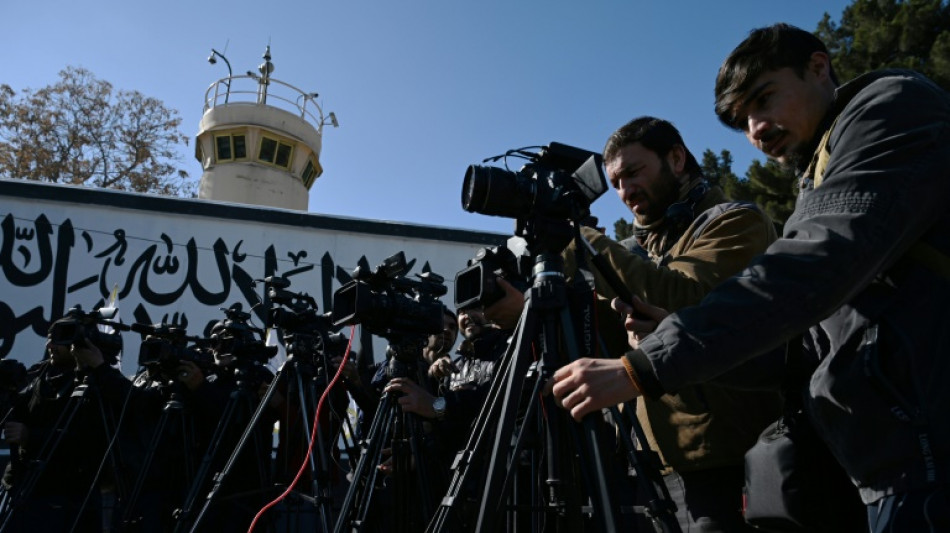
'Humiliated' profession - Afghan media says abuses rising / Photo: © AFP/File

 Antonelli 'mad' about crash in Azerbaijan qualifying
 'Perfect lap' gives Russell pole for Azerbaijan GP as Antonelli crashes out
 UN Security Council condemns Houthi attacks on Saudi Arabia
 China swimmer makes Asian Games history as Thai wins 100m sprint

 Top French literary prize drops best-selling novel over AI claims
 US 'must choose' whether to end war: Iran president
 Pope warns against losing humanity in AI-driven 'paradise of machines'
 Pope warns against losing humanity in 'paradise of machines'

 From FBI warning to literary acclaim: the Russian journalist who took on Putin
 China swimmer in Asian Games first as North Korea lifters reign
 French literary prize removes novel from longlist after AI claims
 China's Zhang wins record seventh Asian Games swimming gold

 Verstappen edges Russell in final practice in Azerbaijan

 English, Spanish, Italian, German football leagues call for FIFA reform

 Pope arrives in France on first official visit in 18 years

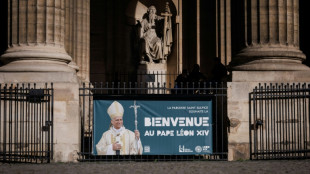 Pope arrives in France on first state visit in 18 years
 Heavy fighting, internet disruption as Ethiopia conflict rages
 From transit to consumption: drug use surges in Mozambique

 Chicago teams, Guardians and Padres all book MLB playoff berths
 Bijan Robinson destroys Packers in 35-14 win for Falcons
 Harimoto hails new era as Japan dethrone table tennis kings China
 India rape cases turn focus back onto women's safety
 Rebellious Afghan taxi drivers defy ban on music

 Brazil candidates mount digital armies for fierce online campaign
 Nepal PM says floods 'a warning to the world' about climate change
Afghan journalists have reported hundreds of cases of abuses by government officials, including torture and arbitrary detention, as well as tightening censorship since the Taliban authorities returned to power.
Reporters say they are frequently rounded up for covering attacks by militant groups or writing about the discrimination of women, and some report being locked up in the same cell as Islamic State fighters.
"No other profession has been so humiliated," said a journalist from the north who was recently detained and beaten.
"Me and my friends no longer want to continue in this profession. Day after day new restrictions are announced," he told AFP, asking not to be named for security reasons.
"If we cover (attacks) or topics related to women, we expose ourselves to threats by phone, a summons or detention."
When the Taliban authorities seized power in 2021 after a two-decade-long insurgency against foreign-backed governments, Afghanistan had 8,400 media employees, including 1,700 women.
Only 5,100 remain in the profession, including 560 women, according to media industry sources.
"We have recorded around 450 cases of violations against journalists since the collapse, including arrests, threats, arbitrary detention, physical violence, torture," said Samiullah, an official at a journalists' association in Afghanistan, whose name has been changed for his protection.
The Taliban authorities have not responded to several requests for comment on the reports.
However, Hayatullah Muhajir Farahi, the deputy minister of information, recently said in a statement that media were allowed to work in Afghanistan on condition that they respect "Islamic values, the higher interest of the country, its culture and traditions".
- New laws and regulations -
In September, new regulations were slapped on political talk shows, media executives told AFP.
Guests must be selected from a Taliban-approved list, the themes sanctioned and criticism of the government prohibited.
Shows must not be aired live, allowing for recordings to be checked and "weak points" to be removed.
The state radio and television station RTA no longer allows women to work as journalists, according to an employee within the organisation who asked not to be named.
In southern Helmand province, women's voices are banned from television and radio.
Surveillance of journalists continues on social networks and the press survives through self-censorship.
The London-based Afghanistan International channel, for which no Afghan is allowed to work anymore, accused Kabul in September of jamming its frequencies.
A recent law on the "promotion of virtue and prevention of vice" which formalises the strict interpretation of Islamic law has further worried journalists.
The law prohibits taking pictures of living beings and women from speaking loudly in public.
Although the authorities "assure us that it will not affect the work of journalists, we see on the ground that it really has an impact," said Samiullah, from the journalist association.
"In July, we had two or three cases of abuse against journalists. In August, 15 or 16 cases and in September, 11 had been reported," he said.
"When we talk to the Ministry of Information, we receive assurances that things will improve," said Samiullah.
"But then we see how (intelligence officers) behave in the provinces, and it is worse."
- 'Alone, lost, defenceless' -
Meena Akbari worked for Khurshid TV but had to flee the country in 2021 -- like hundreds of other Afghan journalists -- "due to numerous threats to (my) security".
She said she still receives death threats on social media and is receiving psychological support.
Arrested in 2023 for "espionage", the French-Afghan journalist Mortaza Behboudi, who worked for several French media outlets, was detained in Kabul for 10 months and said he was routinely tortured.
Dozens of media outlets, also faced with economic hardship, have closed and Afghanistan has slipped from 122nd place to 178th out of 180 countries in a press freedom ranking compiled by Reporters Without Borders (RSF).
Journalists told RSF that they had been locked up in cells with detainees from the Islamic State group.
However, reporters are rarely held for long periods of time, RSF told AFP.
"They don't need to fill the prisons with journalists to have a deterrent effect," said Celia Mercier, the head of the RSF's South Asia team.
"Keeping them in detention for a few days can break them psychologically. After such an ordeal, journalists will try to leave the country," she added.
Another law being prepared is intended to regulate the functioning of the media, according to the information and culture ministry.
"Journalists are very afraid," Samiullah said "They feel alone, lost, defenceless."
Y.Bouchard--BTB