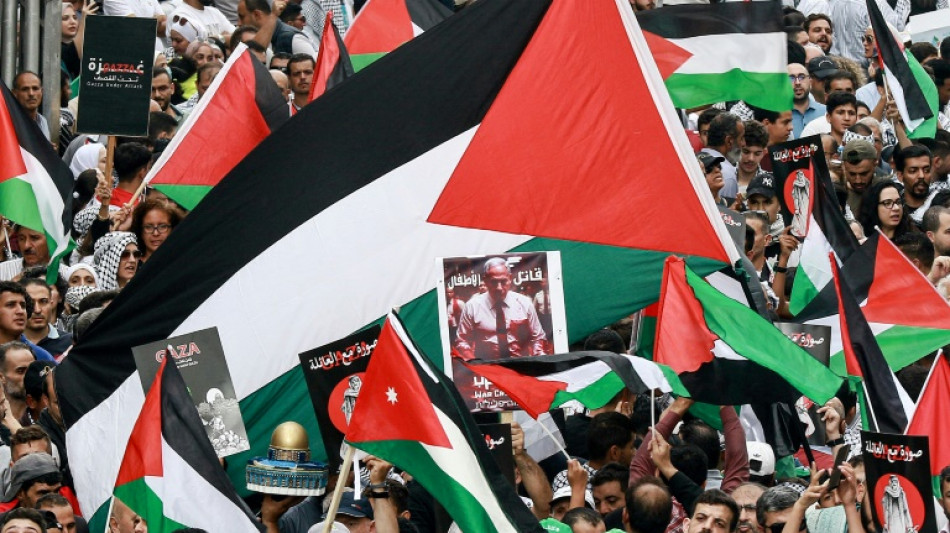
Gaza war fuels Arab support for Palestinians, to little effect / Photo: © AFP/File

 Assefa seeks 'better than my best' at Berlin marathon

 US court refuses to overturn Pentagon ban on Anthropic

 Verstappen and Norris blame slow cars as Mercedes tops qualifying

 Crowds cheer pope in Paris after AI 'paradise of machines' warning

 Teen swimmer makes Games history as Thai, Chinese sprinters win gold
 Man City found guilty of 114 Premier League charges - reports

 Concerns over 'missing' UK explorer Ranulph Fiennes

 Suspected Paris killer of Argentine rugby star begs forgiveness
 Oil prices fall on cautious hopes for US-Iran progress

 Noskova, Muchova take Czech Republic into BJK Cup final

 Thai sprinter Puripol breaks own Asian Games record to win 100m gold
 Russell takes pole for Azerbaijan GP, Antonelli crashes out

 Williams boss hails Chadwick as F1 inspiration for women
 World No.1 Sinner delays return with China Open withdrawal

 South Lebanon children return to school destroyed by Israel strike

 Jewish group urges Berlin far-left vote winners to tackle antisemitism

 European stock markets climb as oil prices drop

 Trump accuser E. Jean Carroll finally has her damages

 Germany's Havertz, Musiala ruled out of Greece match with injury
 Ireland's Gaza stance spills from Eurovision into football
 Welcome aboard the Costa Serena, the Asian Games floating hotel

 Asian markets mixed after recent oil surge
 Cash for nature protection: hotelier's offer to Principe islanders
 US miner KoBold bets on AI to gain edge in DR Congo mineral hunt

 Internet disrupted in Ethiopia as conflict rages
A year into the Gaza war, grassroots support for Palestinians has surged across the Arab world, but the groundswell has yet to trigger stronger action against Israel, with governments largely ignoring these calls.
As the conflict spills into Lebanon and Iran's missile strike on Israel raises fears of further escalation, Arab governments are walking a careful line.
While they routinely condemn Israel's invasion -- triggered by Hamas's unprecedented October 7 attack -- nations with diplomatic ties to Israel have yet to make major policy changes.
"Our government, just like other Arab governments, has ignored the demands of its people, including the expulsion of the Israeli ambassador," said Ahmed, a 27-year-old Bahraini at a September rally in Manama. He asked to be identified by his first name for fear of reprisal.
Bahrain, along with Morocco, Sudan and the United Arab Emirates, recognised Israel under the US-brokered Abraham Accords of 2020, seeking diplomatic and military support.
Egypt and Jordan, which signed the peace deals with Israel in 1979 and 1994 respectively, have not reconsidered those agreements, despite accusing Israel of war crimes in Gaza.
Jordan's Foreign Minister Ayman Safadi said the agreement was "covered with dust", but questioned whether scrapping it would help the kingdom or Palestinians.
Only Saudi Arabia has publicly shifted, halting normalisation talks with Israel unless a Palestinian state is recognised.
- Protest dilemma -
Israel's Gaza offensive has sparked rare protests in a region where autocratic governments usually suppress dissent.
"Normalisation is treason," read a sign at a rally in Amman, echoing slogans in Bahrain and Morocco.
Rachid Fellouli, of Morocco's National Action Group for Palestine, said 5,000 sit-ins were held in the past year. He finds hope in the pro-Palestinian mobilisation of a "new generation".
Arab governments that have moved closer to Israel have "their own reasons... which are all still applicable", said Hussein Ibish, an analyst at the Arab Gulf States Institute in Washington.
"None of them are considering reneging on that based on the wars," he said.
Riccardo Fabiani, North Africa director at the International Crisis Group, said Arab governments value the security, diplomatic and military gains from ties with Israel.
"There's also the question of not giving in to popular pressure, which would set a very dangerous precedent for many of these countries," he told AFP.
The Arab Spring protests still haunt these governments, said Ibish, adding "not one of the major grievances has improved".
The Gaza war was sparked by Hamas's October 7 attack, which resulted in the deaths of 1,205 people in Israel, mostly civilians, according to an AFP tally based on Israeli official figures that include hostages killed in captivity.
Israel's retaliatory military offensive has killed at least 41,689 people in Gaza, the majority of them civilians, according to figures provided by the Hamas-run territory's health ministry. The UN has described the figures as reliable.
- New generations -
Arab leaders face a delicate balancing act with public demands for action.
Suppressing protests could stoke unrest over issues like mismanagement, unemployment or rising living costs, said Ibish.
Allowing demonstrations could "let off steam" safely, he added.
In Egypt, the Arab world's most populous nation, the risk of protests is deemed too high.
No rallies have been allowed since October 20, 2023 when a state-sanctioned protest veered towards Cairo's Tahrir Square, site of the 2011 uprising that toppled longtime president Hosni Mubarak.
Egyptians, long supporters of the Palestinian cause, have instead turned to boycott campaigns against companies seen as pro-Israel.
"Palestine is not the Palestinians' cause alone," reads the description of a mobile phone application with more than a million downloads, which enables users to scan barcodes to know whether products are on boycott lists.
Fabiani said these efforts have "no impact" now, but the long-term effect could be significant.
"There are generations that came of age after the Arab Spring, who have never known the possibility of free expression... who are having their political awakening through the Palestinian cause," he said.
burs-cgo/bk/bha/adp/ser/dv
A.Gasser--BTB