What happens next in Iran-Israel conflict? / Photo: © AFP

 Assefa seeks 'better than my best' at Berlin marathon

 US court refuses to overturn Pentagon ban on Anthropic

 Verstappen and Norris blame slow cars as Mercedes tops qualifying

 Crowds cheer pope in Paris after AI 'paradise of machines' warning

 Teen swimmer makes Games history as Thai, Chinese sprinters win gold
 Man City found guilty of 114 Premier League charges - reports

 Concerns over 'missing' UK explorer Ranulph Fiennes

 Suspected Paris killer of Argentine rugby star begs forgiveness
 Oil prices fall on cautious hopes for US-Iran progress

 Noskova, Muchova take Czech Republic into BJK Cup final

 Thai sprinter Puripol breaks own Asian Games record to win 100m gold
 Russell takes pole for Azerbaijan GP, Antonelli crashes out

 Williams boss hails Chadwick as F1 inspiration for women
 World No.1 Sinner delays return with China Open withdrawal

 South Lebanon children return to school destroyed by Israel strike

 Jewish group urges Berlin far-left vote winners to tackle antisemitism

 European stock markets climb as oil prices drop

 Trump accuser E. Jean Carroll finally has her damages

 Germany's Havertz, Musiala ruled out of Greece match with injury
 Ireland's Gaza stance spills from Eurovision into football
 Welcome aboard the Costa Serena, the Asian Games floating hotel

 Asian markets mixed after recent oil surge

 Cash for nature protection: hotelier's offer to Principe islanders

 US miner KoBold bets on AI to gain edge in DR Congo mineral hunt

 Internet disrupted in Ethiopia as conflict rages
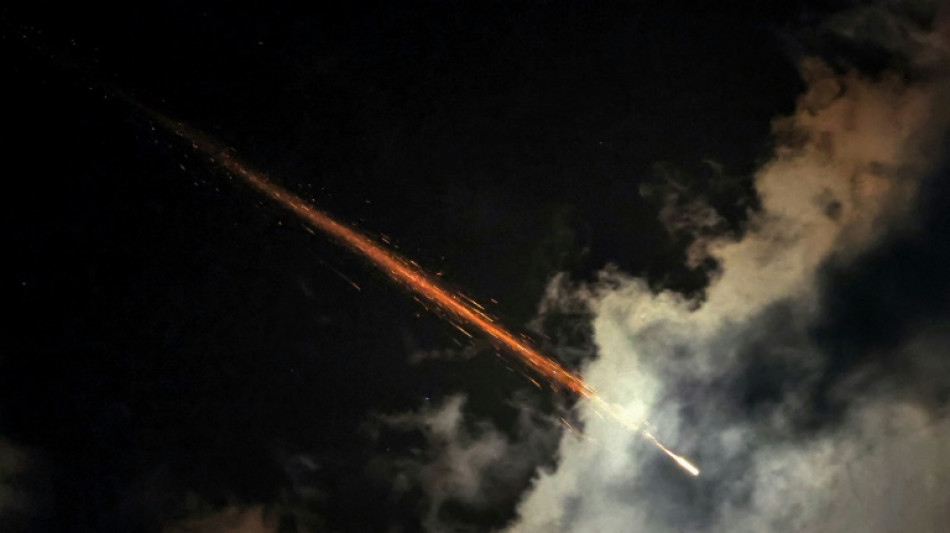
Israel's invasion of Lebanon this week and Iran's missile attack on its regional foe, all while war rages on in Gaza, have heightened the risk of a high-intensity conflict across the Middle East.
The spiralling violence now threatens to engulf more and more of the region despite diplomatic efforts to calm tensions, with UN Secretary General Antonio Guterres warning of a "sickening cycle of escalation after escalation".
AFP spoke to analysts to assess what could happen next:
- Will Israel retaliate? -
Israeli Prime Minister Benjamin Netanyahu swiftly condemned the launch of some 200 missiles at his country on Tuesday, declaring: "Iran made a big mistake tonight and will pay for it."
David Khalfa, a Middle East expert at the Jean-Jaures Foundation, a Paris-based think-tank, said Israel has little choice but to respond to the Iranian attack "because of the scale and the fact that the nature of the targets has changed" to include sensitive military sites.
It was the second time Iran directly attacked Israel. In April, a barrage of around 300 drones and missiles triggered a measured Israeli retaliation that saw a single Iranian air-defence radar installation destroyed.
The response this time is expected to be of far greater magnitude, according to analysts.
With many Israelis celebrating the Jewish new year this week, the holidays may "not a good time to retaliate", said Danny Citrinowicz, an Iran specialist at the Institute for National Security Studies (INSS) in Tel Aviv.
"But I don't think it will take much time," he said.
- What are Israel's options? -
Since the Iranian attack, Israeli officials have argued there was a potential "historic opportunity to decisively deal with the Iranian regime", according to Khalfa.
A former prime minister, Naftali Bennett, was one of the first to call for an attack on Iranian nuclear facilities, which Israel regards as an existential threat.
But the most sensitive equipment is believed to be buried deep underground where Israel may be unable to hit.
US President Joe Biden has advised against even trying, urging Israel to respond "in proportion" -- although Netanyahu has often ignored his guidance in the past.
Other possible Israeli responses include targeted assassinations, strikes on Iranian industrial sites or cyberattacks, according to experts and Israeli media reports.
Biden has also mentioned ongoing discussions about potential strikes on Iranian oil infrastructure, which sent prices for crude spiking on Thursday.
Khalfa said that after decades of tension, Israel and Iran are now "no longer in a low-intensity confrontation but an open war", which could evolve into a "regional war of attrition".
- Do Iran and Israel want war? -
Iran has "already thought things through, to some extent at least. They are ready," said Citrinowicz, suggesting that Tehran's response to any Israeli retaliation would be "swift".
Sima Shine, another Iran expert at the INSS, said that the Islamic republic possessed "undeniable" destructive capabilities.
"They can launch more than 200, or even 300 missiles, and they also have drones," she said, while also warning about "terrorist operations abroad" that could include attacks on Israeli diplomatic missions or Jewish community centres.
"Everything right now hinges on Israel's response, whether it escalates into a regional war," said Sina Toossi, a senior fellow at the Center for International Policy in Washington.
Both Netanyahu and Iran were "taking huge gambles", he said.
And with each escalation, the risks increase.
However, both Iran and Israel have repeatedly insisted that they do not want to be drawn into a spiral of retaliatory violence.
Israel is already engaged on several military fronts.
In the Gaza Strip, the military is fighting Hamas, aiming to rescue the 97 hostages taken on October 7 who are still held there.
In Lebanon, after days of air strikes against Hezbollah, troops are now battling the Iran-backed militants on the ground.
And elsewhere in the region, Israel confronts armed groups like Yemen's Huthi rebels who have increased their missile and drone attacks.
Ultimately, Citrinowicz said, both Iran and Israel "will look for a political solution" that may be supported by the United States and France, whose influence particularly in Lebanon could play a critical role in restoring calm.
L.Dubois--BTB