Former South Korea clinic for US 'comfort women' to be demolished / Photo: © AFP

 Spotting AI writing: how reliable are the detectors?

 French youth await pope after AI 'paradise of machines' warning
 Man City found guilty of Premier League charges, set to appeal: reports
 Embolo follows Xhaka out of Swiss squad over fake Covid documents
 Trump, Xi inspect founding documents of US democracy to close summit

 'Bottle Claus': Kipchoge's 'hero' helping runners chase Berlin marathon glory

 Olympic medallist Samba-Mayela handed provisional doping ban
 First US trial against TikTok to open Monday
 Palmer misses 'too many' England games, says Tuchel

 UN refugees chief warns conditions in W.Sahara 'deteriorating'
 Antonelli 'mad' about crash in Azerbaijan qualifying
 'Perfect lap' gives Russell pole for Azerbaijan GP as Antonelli crashes out
 UN Security Council condemns Houthi attacks on Saudi Arabia

 China swimmer makes Asian Games history as Thai wins 100m sprint

 Top French literary prize drops best-selling novel over AI claims

 US 'must choose' whether to end war: Iran president
 Pope warns against losing humanity in AI-driven 'paradise of machines'
 Pope warns against losing humanity in 'paradise of machines'

 From FBI warning to literary acclaim: the Russian journalist who took on Putin
 China swimmer in Asian Games first as North Korea lifters reign
 French literary prize removes novel from longlist after AI claims

 China's Zhang wins record seventh Asian Games swimming gold

 Verstappen edges Russell in final practice in Azerbaijan

 English, Spanish, Italian, German football leagues call for FIFA reform

 Pope arrives in France on first official visit in 18 years
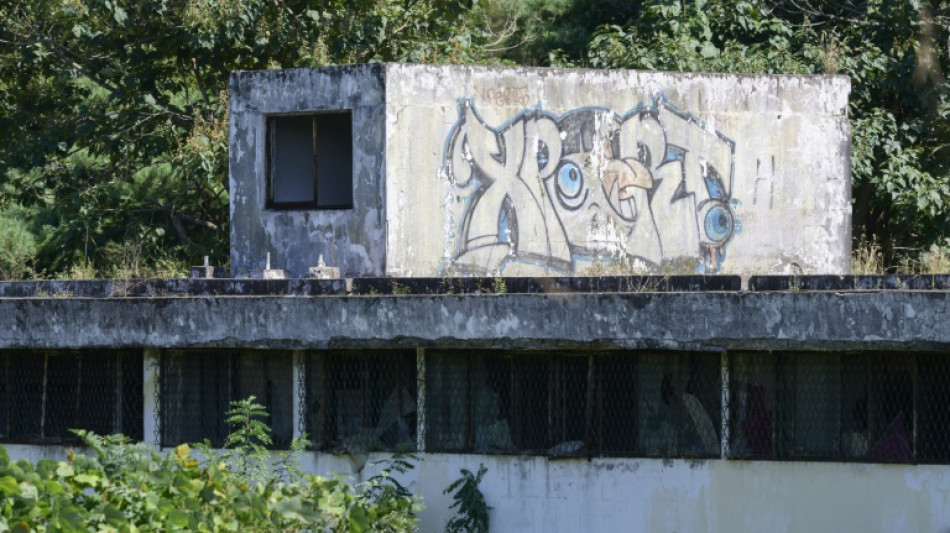
Slated for demolition, the graffiti-covered building close to the inter-Korean border was once a "monkey house", a clinic for sex workers forced to serve US soldiers protecting Seoul from North Korea.
Activists, including women who were forced into gruesome treatments for sexually transmitted diseases, say the site should be preserved for its historical significance, but the bulldozers will move in this month to clear it for a tourist development.
The fight over the building in the lush forest of Dongducheon is illustrative of the broader struggle for recognition faced by South Korean women who say they were tricked or forced to work in state-run brothels serving US troops.
Unlike the better-known "comfort women" used by Japanese soldiers until the end of World War II, the tens of thousands of victims of state-sanctioned brothels run from the 1950s to 1980s by the South Korean government, have received relatively limited attention.
"It was nicknamed the 'monkey house' because the women were kept confined like monkeys," Choi Hei-shin, a peace activist and researcher, told AFP.
Many women in the brothels, which Seoul's Supreme Court ruled were illegally "established, managed, and operated" by the state for US troops, were forced to undergo STD treatments against their will to protect their clients' health.
Kim Un-hui was dragged to the monkey house in Dongducheon in the late 1970s when she was caught by authorities without an STD certificate and forcefully injected with an excessive amount of penicillin.
It was so painful it felt like someone was "stabbing me over and over again," Kim, now 66, told AFP.
At that point, Kim was not even working in the military brothels, as she had married an American GI. Even so, she says she was detained and forced to share a cramped room with 20 other women.
One woman passed out from the penicillin injection and injured herself by hitting herself against the bedframe while unconscious, she says.
Medical staff "just stood there and did nothing," Kim told AFP, adding the experience still haunted her.
- No recognition -
A historic 2022 Supreme Court ruling found the South Korean government had illegally been "justifying and promoting prostitution" among its women citizens, causing "loss of human dignity" and "mental suffering".
Kim said she responded to an advert looking for a waitress but was trafficked by a Korean pimp into a military brothel. She considers herself lucky as she quickly met her husband, one of her first customers, and escaped with him.
Many other women died from the drugs handed out by pimps or from the consequences of the botched medical treatments offered in the monkey houses, according to survivors and historians.
"The authorities administered over ten times the safe amount of penicillin to the victims," said Kim Eun-jin, director of Durebang, a group of activists supporting the survivors, to AFP.
Some survivors have received small payouts from the Korean state, but efforts to get the United States, which still has tens of thousands of troops stationed in South Korea, to acknowledge its role and apologise have so far been fruitless.
"We have witnessed our colleagues die from illnesses, suicides and crimes," 73 South Korean survivors wrote in a letter to then-US president Barack Obama in 2009.
"The US military authorities in South Korea intervened directly in the prostitution surrounding military bases for the 'health and comfort of the US troops'... This was a clear state crime."
- 'Erase our story' -
About six kilometres (3.7 miles) from the monkey house lies a cemetery where up to 70 percent of the graves are likely former sex workers from US military camps, activists say.
They are now being relocated to transform the area into a park.
When AFP reporters visited, most graves were unmarked and completely overgrown with thick weeds. A lone excavator was already relocating remains.
Signs posted at each indistinguishable grave site asked any surviving relatives to get in touch.
Due to shame, many women in the brothels were cut off from their families and kept their identities secret, which explains why "they were buried even without names", said activist Choi.
But the economy surrounding military brothels in US camp-towns, including restaurants, barbershops and bars catering to American GIs, made up about 25 percent of South Korea's GDP during the 1960s and 70s.
The state "profited from their bodies, using them merely as tools", Choi said.
The building is in poor repair: video obtained by AFP showed the interior, covered with disturbing graffiti including a face weeping blood, and local authorities say it is now too late to cancel the demolition.
But survivor Kim says it should be preserved as a way to give her and her colleagues recognition for their suffering.
"We were abused by our own country," she said. "They're trying to erase (our story) from history."
I.Meyer--BTB