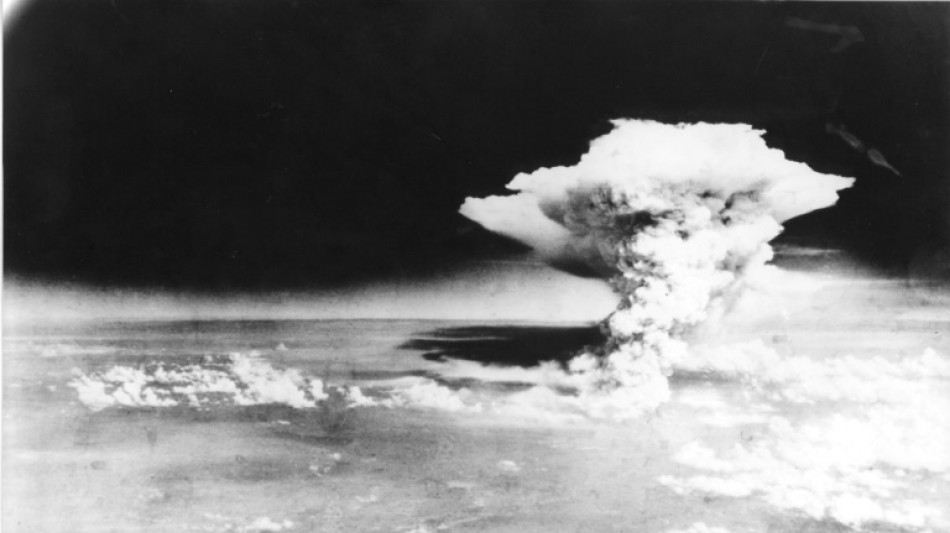
'Unspeakable horror': the attacks on Hiroshima and Nagasaki / Photo: © Hiroshima Peace Memorial Museum/AFP/File

 Mancini finds positives in Italy loss, accepts fans' jeers

 Alcaraz helps Europe into Laver Cup lead

 Six missing after building collapses in historic Athens district

 Mbappe scores but suffers knee injury as Zidane gets debut France win
 Mancini's Italy return spoiled by Belgium defeat

 Rodri confident in Man City innocence despite reported charges

 Jay-Z rape accuser says she made 'false accusations'
 Senegal draw first match under Vieira and Nigeria survive scare
 Trump, Xi end summit long on pomp, but short on progress

 Russia not preparing for conflict with Europe, Putin says

 Trump's photo of Xi greeting carries signs of AI

 Six missing after building blast in historic Athens district

 Millions in US northeast brace for powerful storm
 Assefa seeks 'better than my best' at Berlin marathon
 US court refuses to overturn Pentagon ban on Anthropic

 Verstappen and Norris blame slow cars as Mercedes tops qualifying

 Crowds cheer pope in Paris after AI 'paradise of machines' warning

 Teen swimmer makes Games history as Thai, Chinese sprinters win gold
 Man City found guilty of 114 Premier League charges - reports
 Concerns over 'missing' UK explorer Ranulph Fiennes

 Suspected Paris killer of Argentine rugby star begs forgiveness
 Oil prices fall on cautious hopes for US-Iran progress

 Noskova, Muchova take Czech Republic into BJK Cup final
 Thai sprinter Puripol breaks own Asian Games record to win 100m gold
 Russell takes pole for Azerbaijan GP, Antonelli crashes out
The Nobel Peace Prize was awarded Friday to Nihon Hidankyo, a Japanese group of atomic bomb survivors who are advocating for "a world free of nuclear weapons".
The survivors are from Hiroshima and Nagasaki, two cities that the United States dropped nuclear bombs on in 1945 at the end of World War II.
Hiroshima was hit on August 6, 1945, killing 140,000 people. Three days later, another bomb was dropped on Nagasaki, killing around 74,000 people.
Here are some facts about the attacks:
- The bombs -
The first atomic bomb was dropped on the western city of Hiroshima by the US bomber Enola Gay.
The bomb was nicknamed "Little Boy" but its impact was anything but small.
It detonated about 600 metres (2,000 feet) from the ground, with a force equivalent to 15,000 tonnes of TNT.
Tens of thousands died instantly, while others succumbed to injuries or illness in the weeks, months and years that followed.
Three days later the US dropped a second bomb, dubbed "Fat Man", on the city of Nagasaki.
The attacks remain the only time atomic bombs have been used in wartime.
- The attacks -
When the bomb was dropped on Hiroshima, the first thing people noticed was an "intense ball of fire", according to the International Committee of the Red Cross (ICRC).
Temperatures near the blast reached an estimated 7,000 degrees Celsius (12,600 Fahrenheit), which burned human skin within a radius of about 3.5 kilometres (two miles).
ICRC experts say there were cases of temporary or permanent blindness due to the intense flash of light, and subsequent related damage such as cataracts.
A whirlwind of heat generated by the explosion also ignited thousands of fires that burned several square kilometres of the largely wooden city. A firestorm that consumed all available oxygen caused more deaths by suffocation.
It has been estimated that burn- and fire-related casualties accounted for more than half of the immediate deaths in Hiroshima.
The explosion generated an enormous shock wave that in some cases literally carried people away. Others were crushed to death inside collapsed buildings or injured or killed by flying debris.
"I remember the charred bodies of little children lying around the hypocentre area like black rocks," Koichi Wada, a witness who was 18 at the time of the Nagasaki attack, has said of the bombing.
- Radiation effects -
The bomb attacks unleashed radiation that proved deadly both immediately and over the longer term.
Radiation sickness was reported in the aftermath by many who survived the initial blasts and firestorms.
Acute radiation symptoms include vomiting, headaches, nausea, diarrhoea, haemorrhaging and hair loss, with radiation sickness fatal for many within a few weeks or months.
Bomb survivors, known as "hibakusha", also experienced longer-term effects including elevated risks of thyroid cancer and leukaemia, and both Hiroshima and Nagasaki have seen elevated cancer rates.
Of the 50,000 radiation victims from both cities studied by the Japanese-US Radiation Effects Research Foundation, about 100 died of leukaemia and 850 suffered from radiation-induced cancers.
The group found no evidence however of a "significant increase" in serious birth defects among survivors' children.
- The aftermath -
The twin bombings dealt the final blow to imperial Japan, which surrendered on August 15, 1945, bringing an end to World War II.
Historians have debated whether the devastating bombings ultimately saved lives by bringing an end to the conflict and averting a ground invasion.
But those calculations meant little to survivors, many of whom battled decades of physical and psychological trauma, as well as the stigma that sometimes came with being a hibakusha.
Despite their suffering and their status as the first victims of the atomic age, many survivors were shunned -- in particular for marriage -- because of prejudice over radiation exposure.
Survivors and their supporters have become some of the loudest and most powerful voices opposing the use of nuclear weapons, meeting world leaders in Japan and overseas to press their case.
In 2019, Pope Francis met several hibakusha on visits to Hiroshima and Nagasaki, paying tribute to the "unspeakable horror" suffered by victims of the attacks.
In 2016, Barack Obama became the first sitting US president to visit Hiroshima. He offered no apology for the attack, but embraced survivors and called for a world free of nuclear weapons.
C.Meier--BTB