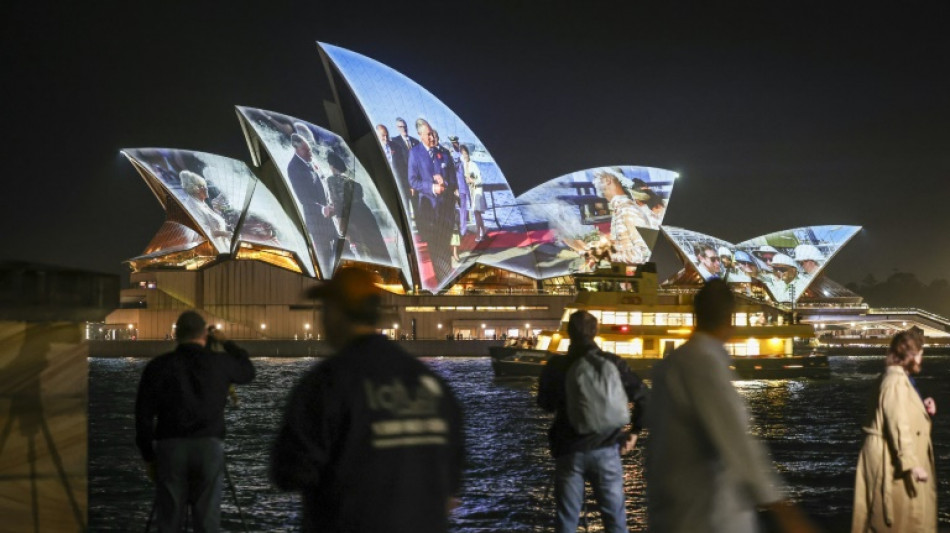
Spectre of royal meddling haunts Charles in Australia / Photo: © AFP

 Japan organisers 'not satisfied' as empty seats blight Asian Games

 Canals full, roads submerged as Bangkok declares flood disaster

 China, US to open AI 'communication channel' after summit
 Nepal tunnel survivor wants to help post-flood rebuild

 New China sprint star, 17, vows 'no limits' after Asian Games gold
 Japanese 11-year-old wins Asian Games eSports gold

 TikTok agrees to teen limits in US settlement following Meta
 Venezuela's oil cradle pins hopes on US energy deals

 US, China buy time with trade truce as pressure builds
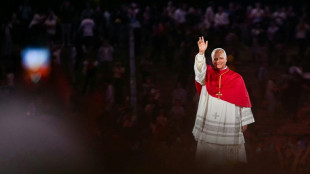
 'Leo, Leo': Young Catholics give pope rockstar welcome in France

 Lula bans sports betting days ahead of Brazil's election

 Guatemala ensures survival of vulnerable 'fossil' fish

 Mancini finds positives in Italy loss, accepts fans' jeers
 Alcaraz helps Europe into Laver Cup lead
 Six missing after building collapses in historic Athens district
 Mbappe scores but suffers knee injury as Zidane gets debut France win
 Mancini's Italy return spoiled by Belgium defeat

 Rodri confident in Man City innocence despite reported charges
 Jay-Z rape accuser says she made 'false accusations'
 Senegal draw first match under Vieira and Nigeria survive scare

 Trump, Xi end summit long on pomp, but short on progress

 Russia not preparing for conflict with Europe, Putin says

 Trump's photo of Xi greeting carries signs of AI
 Six missing after building blast in historic Athens district

 Millions in US northeast brace for powerful storm
The cloud from a decades-old political crisis hangs over King Charles III's tour of Australia, where the 1975 sacking of a sitting prime minister continues to fuel suspicions of royal meddling.
Governor-General John Kerr used his vice-regal powers in 1975 to topple Labor Prime Minister Gough Whitlam, a popular leader beset by a string of parliamentary scandals.
It remains the only time the governor-general -- the throne's envoy in overseas realms -- has made such a drastic intervention in Australian democracy.
Almost 50 years later, intrigue still swirls around the monarchy's role in "The Dismissal".
Recently unearthed correspondence exposed then-Prince Charles's stance on the interference -- a source of further controversy in a decades-long simmering debate on the relevance of the monarchy.
"It was an unprecedented action by Queen Elizabeth's representative in Australia," historian Jenny Hocking told AFP.
"It's a stunning, volcanic moment in our history. And the potential role of the monarch has always been a question."
Hocking fought a years-long legal battle to publish a trove of secret letters between Kerr and Buckingham Palace.
Finally unsealed in 2020 after a High Court ruling, the so-called "Palace Letters" showed Kerr dutifully keeping the queen's aides abreast of the unfolding political turmoil.
The letters suggest Queen Elizabeth II had no hidden role in sacking the prime minister.
- 'Extraordinary interference' -
But one recently surfaced exchange shows then-Prince Charles was at least supportive of Kerr's decision in hindsight.
"Please don't lose heart," Charles wrote to Kerr in the aftermath.
"What you did last year was right and the courageous thing to do."
Hocking said this amounted to "an extraordinary interference in Australian politics".
"Charles is basically praising him for dismissing an elected government, saying he'd made a courageous decision.
"And we should keep that in mind as we entertain the current king, who has been described before as a meddling prince."
News of the government's removal sent Australian stock markets into meltdown, sparking mass rallies and fears of civil violence.
For many Australians, it shattered their sense of independence and fuelled fears of colonial masters pulling the strings.
It remains seared into the psyche of the nation, where it is still taught in schools, and debated over the airwaves and over drinks at the pub.
- 'Eruptive' moment -
"It's because it was such an eruptive moment in our history," said Hocking.
Australian Prime Minister Anthony Albanese -- an avowed republican -- has said the imbroglio showed "the need for us to have an Australian head of state".
Swept to power in 1972 -- the first Labor government in more than 20 years -- Whitlam lost control of parliament as a string of forced resignations whittled away his majority.
Unable to secure enough votes to pass the government budget, governor-general Kerr sacked Whitlam and installed conservative opposition leader Malcolm Fraser in his place.
It remains "the most dramatic and controversial event in Australia's constitutional and political history", according to government historians.
Ironically, Whitlam and Fraser would bury the hatchet in the late 1990s to campaign together in favour of an Australian republic.
That 1999 referendum failed as 54 percent of Australians backed the status quo.
A recent poll showed about a third of Australians would like to ditch the monarchy, a third would keep it and a third are ambivalent.
J.Bergmann--BTB