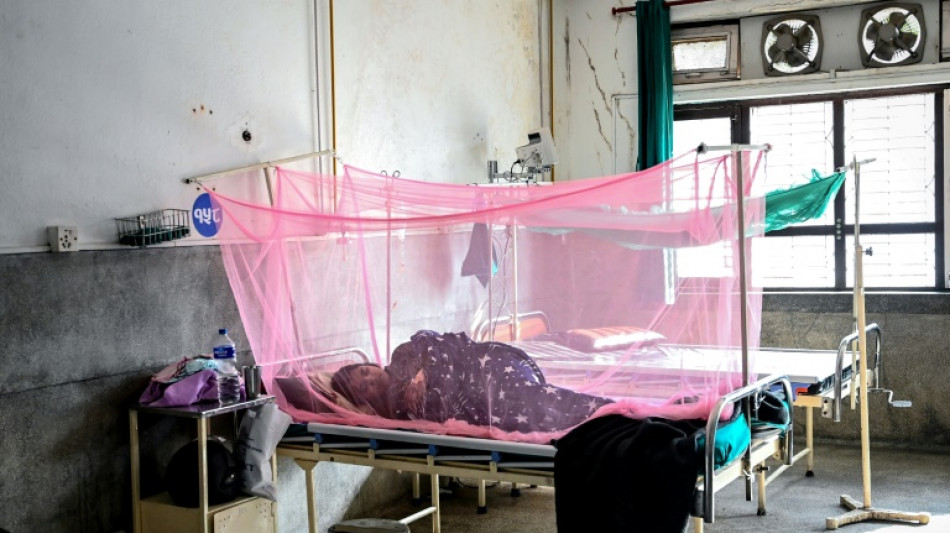
Climate shifts and urbanisation drive Nepal dengue surge / Photo: © AFP

 Man City chairman defiant over reported Premier League charges

 Germany ready to 'walk through fire' for Klopp, says Tah

 At least 16 killed in Russian and Ukrainian strikes

 Powerful storm pummels US Northeast
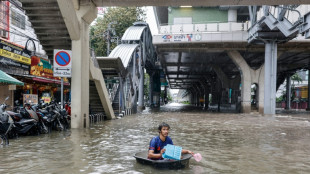 Bangkok declares disaster after homes flooded, roads submerged by heavy rain

 Norris calls for errant Colapinto to be banned for causing Baku crash

 Russell finds himself again and prepares to heap pressure on Antonelli
 South Korea hold nerve to win Asian Games basketball gold

 Russell holds off Verstappen to claim imperious victory in Baku

 Russell holds off Verstappen to win Azerbaijan Grand Prix

 India's Kohli says 2027 ODI World Cup will be his last

 Huge crowds cheer Pope Leo along Champs-Elysees ahead of Paris mass

 Putellas wants to bring 'winning culture and mentality' to London City

 Rare Italian opera returns to Moscow after nearly 120-year hiatus

 Pope to celebrate giant Paris mass after 'peace' appeal
 Homes flooded, roads submerged: Bangkok declares disaster over heavy rains

 Ahead of Paris mass, pope urges life together in 'dignity and peace'

 Austria 'ghetto' language classes leave children to repeat school
 S.African women runners arm themselves after string of killings

 'I felt embarrassed': Japan eSports whizz-kid, 11, wins Games gold
 Indonesia fires threatens critically-endangered orangutan: IUCN

 Bangkok declares flood disaster across city

 'World records not enough': North Korea weightlifters target Olympic gold rush

 Iran proposes Hormuz plan, Trump reportedly refuses
 El Nino rewrites the menu in the world's top restaurants

Nepal is fighting a surge in dengue cases, a potentially deadly disease once unheard of in the country's high-altitude Himalayan regions, as climate change and urbanisation nurture fever-bringing mosquitoes in new zones.
Only a single case of dengue was recorded in Nepal in 2004. Two decades later, thousands of cases are being reported across the country.
Once confined to tropical regions in the country's plains, dengue-carrying mosquitoes have begun breeding in the valleys and even cool mountainous areas, reaching elevations where its bite was once unknown.
Twelve people have died and more than 28,000 people have been infected this year, including 18 cases in Solukhumbu district, home to Mount Everest.
Doctors say the real number might be higher, as not everyone is tested.
"It should not be seen here at all," Suman Tiwari, district health chief for Solukhumbu, which sits at an altitude of some 2,500 metres (8,202 feet).
"What is surprising is that some people with no travel history have also tested positive for dengue".
In the worst cases, dengue causes intense viral fevers that trigger bleeding, internally or from the mouth and nose.
The capital Kathmandu, at an elevation of approximately 1,400 metres (4,600 feet), has seen over 4,000 cases.
"Unfortunately, it is expanding itself geographically," said Sher Bahadur Pun, a doctor at Kathmandu's Sukraraj Tropical and Infectious Disease Hospital.
"Once upon a time, it was just seen in a certain area, but it is moving up towards mountainous regions, even up to the Himalayan foothills."
- 'Grown exponentially' -
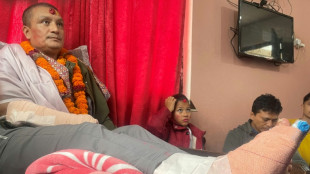
In some districts, hospitals have been overwhelmed with dengue patients suffering from crippling fevers, body aches and rashes.
"In the last decade, it has grown exponentially," Pun said.
"After every outbreak, the number of infected people has increased... and my experience is that after every outbreak, it has become more deadly."
In October, the UN health agency said the number of reported dengue cases worldwide has approximately doubled each year since 2021, with over 12.3 million cases, including more than 7,900 deaths, reported in just the first eight months of 2024.
WHO chief Tedros Adhanom Ghebreyesus called the global spread an "alarming trend".
Experts say changes in temperature and rainfall patterns driven by climate change and urbanisation are creating favourable conditions for Aedes aegypti, the mosquito responsible for transmitting dengue.
That means it can survive and breed at higher elevations.
Narayan Gyawali, a virologist who specialises in zoonotic diseases, said that urbanisation and increased mobility of people were also driving the dengue surge.
"When microclimates are established with urbanisation in new areas, internal temperatures become warm and there is humidity," Gyawali said.
"A favourable environment is created for breeding and survival."
- 'Injustice' -
This is the third consecutive year that Nepal has seen a dengue outbreak -- an apparent shift from cyclical patterns where outbreaks are expected every two to three years.
The country's worst outbreak was in 2022, with 88 deaths and nearly 55,000 cases, according to government figures.
Last year, 20 people died, with more than 50,000 cases.
"Dengue used to be reported in a cyclical trend, but in the last few years, it has been seen every year," said Gokarna Dahal of the Health Ministry's Epidemiology and Disease Control Division.
"Our preparation now is to fight with it every year".
Dahal said it was an "injustice" that a developing country like Nepal -- which makes a minimal contribution towards the burning of fossil fuels driving the planet's warming -- should shoulder greater impacts of climate change.
Meenakshi Ganguly, from Human Rights Watch, said that while the primary responsibility to protect its public's health lies with Nepal, countries most responsible for global emissions also have an obligation.
"Those countries which are primarily responsible for global emissions need to do a lot more to protect people in countries like Nepal from the consequences of global warming," Ganguly said.
"Combatting mosquito-borne diseases like dengue, which are spreading fast to new areas, needs to be part of that."
L.Janezki--BTB