German law easing legal gender change comes into force / Photo: © AFP/File

 Man City chairman defiant over reported Premier League charges

 Germany ready to 'walk through fire' for Klopp, says Tah

 At least 16 killed in Russian and Ukrainian strikes

 Powerful storm pummels US Northeast

 Bangkok declares disaster after homes flooded, roads submerged by heavy rain

 Norris calls for errant Colapinto to be banned for causing Baku crash

 Russell finds himself again and prepares to heap pressure on Antonelli
 South Korea hold nerve to win Asian Games basketball gold

 Russell holds off Verstappen to claim imperious victory in Baku

 Russell holds off Verstappen to win Azerbaijan Grand Prix
 India's Kohli says 2027 ODI World Cup will be his last

 Huge crowds cheer Pope Leo along Champs-Elysees ahead of Paris mass

 Putellas wants to bring 'winning culture and mentality' to London City

 Rare Italian opera returns to Moscow after nearly 120-year hiatus

 Pope to celebrate giant Paris mass after 'peace' appeal

 Homes flooded, roads submerged: Bangkok declares disaster over heavy rains

 Ahead of Paris mass, pope urges life together in 'dignity and peace'

 Austria 'ghetto' language classes leave children to repeat school

 S.African women runners arm themselves after string of killings

 'I felt embarrassed': Japan eSports whizz-kid, 11, wins Games gold
 Indonesia fires threatens critically-endangered orangutan: IUCN

 Bangkok declares flood disaster across city

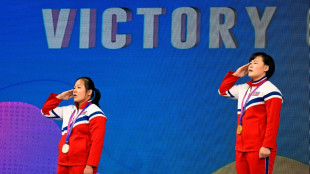 'World records not enough': North Korea weightlifters target Olympic gold rush

 Iran proposes Hormuz plan, Trump reportedly refuses

 El Nino rewrites the menu in the world's top restaurants

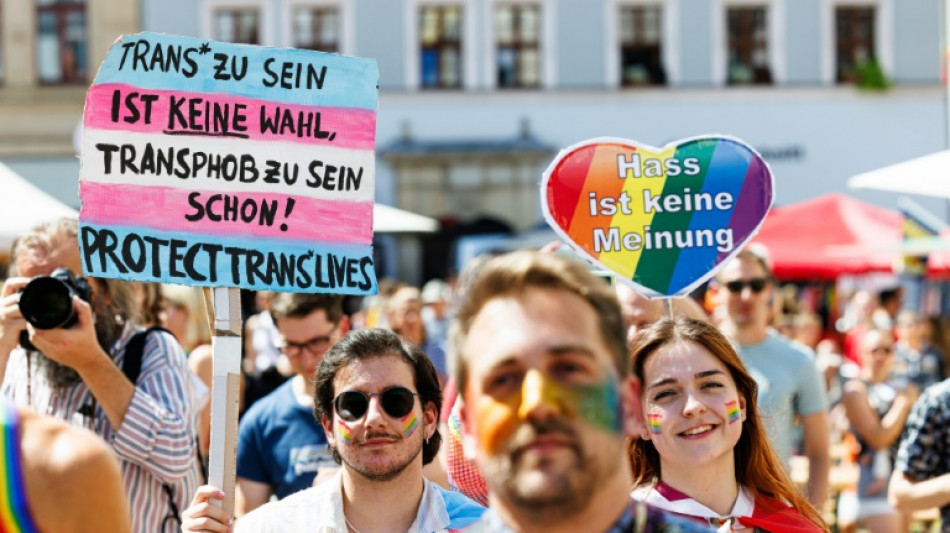
Germans will be able to change their legal gender more easily from Friday thanks to a new law hailed as a "historic" step for the LGBTQ community.
Under the Gender Self-Determination Act, anyone will be able to change their name or legal gender by making a simple application to their local registry office.
The legislation replaces a law known as the Transsexuals Act dating back to the early 1980s, under which Germans who wanted to change their legal gender had to submit two psychological reports and wait for a court decision.
Some 15,000 people had already submitted applications to change their gender in advance of the law coming into force, according to Der Spiegel magazine.
Families Minister Lisa Paus said it was "a very special day for all transgender, intersex and non-binary people".
"From today, their right to gender self-determination will be significantly strengthened," she said.
Under the new law, people who want to change their legal gender can make an application without having to give a reason or provide any medical information.
In the case of children under 14, parents will be able to submit the application. Minors over 14 may do it themselves, but only with the consent of their parents.
- 'Full of joy' -
Children or their parents must first submit a declaration that they have sought advice from a psychologist or youth welfare service.
The law also includes penalties for anyone who "outs" a transgender person without their permission.
It will take three months for a gender switch to take effect and no further changes will be allowed for a year.
The changes bring Germany in line with Belgium, Spain, Ireland, Luxembourg and Denmark, which have also passed legislation to make it easier for people to change their legal gender.
Nyke Slawik, one of only two openly transgender MPs in Germany, said she was "full of joy because this is a truly historic day for the recognition of gender diversity".
"Now everyone can go to the registry office relatively easily... and change their first name and gender with a simple declaration. That's a very good thing," the lawmaker for the Greens told AFP.
The Bundesverband Trans (BVT) advocacy group also welcomed the law, calling it "a significant and fundamental step towards recognising trans and non-binary people as a natural and equal part of society".
"Many organisations and individuals have worked towards this moment for years," it said.
- Backlash -
The plans have led to a backlash from opposition politicians, especially from the far right and the conservative CDU-CSU alliance.
CSU lawmaker Dorothee Baer this week accused the government, a coalition between the centre-left SPD, the Greens and the liberal FDP, of an "outrageous... ideological project" that had "completely overshot the mark".
Some women's rights organisations also fear that predatory men could abuse the new rules to gain easy access to spaces reserved for women and girls.
Reem Alsalem, the UN special rapporteur on violence against women and girls, said in a statement that the law "undermines the safety, privacy, and other human rights of women and girls, especially those affected by male violence".
Slawik acknowledged this "widespread fear" but said it was not justified.
The law retains the right for establishments such as saunas and swimming pools to decide on their own entry policies -- something that has been criticised by the trans community.
Slawik said many countries had already implemented similar laws and she was "not aware that (they) have led to more assaults on women".
According to a recent YouGov poll, more Germans are in favour of the change than not -- some 47 percent of respondents said they supported the law, compared with 37 percent who were against it.
S.Keller--BTB