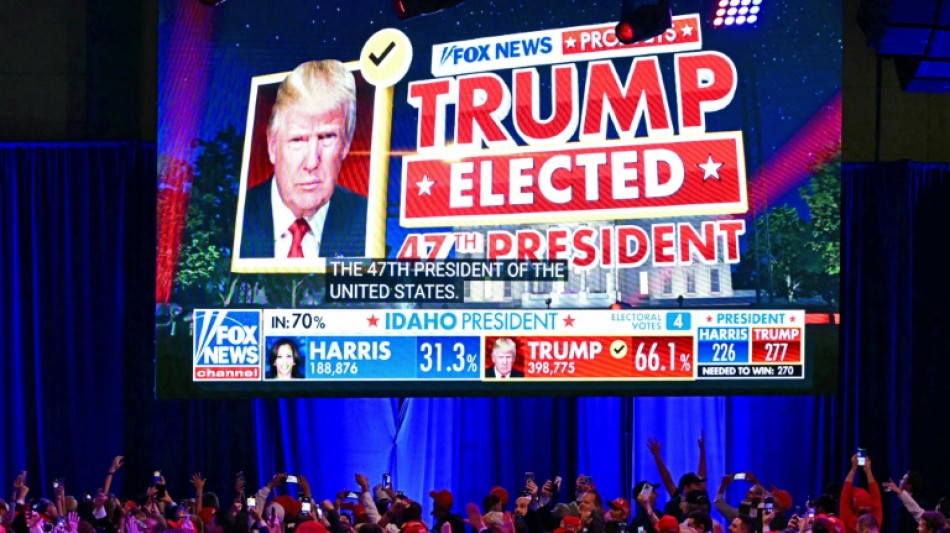
Trump has vowed sweeping tariffs: What comes next? / Photo: © AFP/File

 Venezuela releases more political prisoners after opposition talks

 England's best 'for a long time' despite Spain defeat, says Kane

 Powerful storm pummels northeast US with rain, high winds

 Filmmaker Mike Leigh wins top prize at Spain festival with 'last film'

 Spain beat England in Nations League to extend unbeaten run

 Ireland squad vote to play Israel tie despite Gaza unease

 Gutsy Vollering wins cycling road race world title

 Vollering wins cycling road race world title
 Man City's meteoric rise clouded by dark shadow

 Mbappe out for two weeks or more with knee injury say Real
 Lyon collapse away to Stade and suffer first Top 14 loss

 Russia accuses Europe of seeking to thwart Ukraine talks

 Man City chairman defiant over reported Premier League charges
 Germany ready to 'walk through fire' for Klopp, says Tah

 At least 16 killed in Russian and Ukrainian strikes

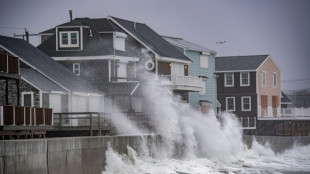 Powerful storm pummels US Northeast

 Bangkok declares disaster after homes flooded, roads submerged by heavy rain

 Norris calls for errant Colapinto to be banned for causing Baku crash

 Russell finds himself again and prepares to heap pressure on Antonelli
 South Korea hold nerve to win Asian Games basketball gold

 Russell holds off Verstappen to claim imperious victory in Baku
 Russell holds off Verstappen to win Azerbaijan Grand Prix
 India's Kohli says 2027 ODI World Cup will be his last

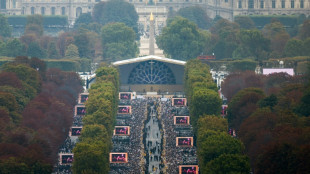 Huge crowds cheer Pope Leo along Champs-Elysees ahead of Paris mass

 Putellas wants to bring 'winning culture and mentality' to London City

US president-elect Donald Trump says "tariff" is the most beautiful word in the dictionary -- and the Republican's second term promises sweeping measures on all $3 trillion worth of US imported goods.
This will not be the first time Trump has used tariffs to exert pressure on other countries. What should households and businesses expect?
- What did he pledge? -
Trump has promised at least a 10 percent tariff on all imports, and a higher level of 60 percent or more on Chinese goods -- stepping up levies on Beijing and others.
The aim, he said, was to target countries that had been "ripping us off for years" and to lower US trade deficits.
Trump has also suggested tariffs above 200 percent on vehicles from Mexico, saying this was to protect US auto firms.
In Pennsylvania this week, Trump threatened to take further aim at China and Mexico if they did not stop deadly fentanyl from entering the country.
Experts note, however, that when Washington imposes tariffs on imports, it is US businesses who pay the fees to the government.
- Can he do it? -
"The risk is significant," said Scott Lincicome, vice president of general economics at the Cato Institute.
Laws exist that "allow the president to apply tariffs unilaterally for extremely broad and discretionary reasons," he told AFP.
This includes national security justifications, he said, pointing to what the US government did when imposing steel and aluminum tariffs in 2018.
Courts have also been "extremely reluctant to act as a check on that power," Lincicome added.
Experts have pointed to laws like the International Emergency Economic Powers Act, which allows a president to declare a national emergency and restrict trade.
- What are the consequences? -
US consumers could lose $46 billion to $78 billion in spending power annually if new tariffs on imports are implemented, according to the National Retail Federation (NRF).
This applies if proposed tariffs were imposed on six product categories alone -- apparel, toys, furniture, household appliances, footwear and travel goods.
"Retailers rely heavily on imported products and manufacturing components so that they can offer their customers a variety of products at affordable prices," said Jonathan Gold, NRF vice president of supply chain and customs policy.
"This tax ultimately comes out of consumers' pockets through higher prices," he added.
For companies, uncertainty over US tariff regimes for their industries and retaliatory risks "will clearly be a huge problem when forward planning," said Ben May, director of global macro research at Oxford Economics.
- How might countries respond? -
When Washington slapped tariffs on 6.4 billion euros worth of European steel and aluminum exports in 2018, the EU retaliated with "rebalancing tariffs" on US exports -- hitting a value of 2.8 billion euros.
These have since been suspended but both sides have struggled to finalize a longer-term solution.
When the first Trump administration announced tariffs on hundreds of billions of Chinese products between July 2018 and August 2019, Beijing retaliated with tariffs on more than $185 billion of US products, the Brookings Institution noted.
Trump's aggressive trade actions left the US farm industry suffering from China's response, hitting soybeans especially hard with exports plunging.
The Trump administration paid out some $28 billion in aid to farmers hit by the trade war's consequences.
- Is there recourse? -
Across-the-board tariffs could violate US international trade obligations in the World Trade Organization (WTO) and with free trade area partners, said Jeffrey Schott, senior fellow at the Peterson Institute for International Economics (PIIE).
While other countries can challenge US actions, Schott noted that any dispute settlement process involving the United States will hit a wall as it can appeal any adverse panel ruling and there is no appellate body to hear the case.
Countries would likely retaliate instead, said Schott.
This could take the form of tariffs or other levers like regulatory approvals, the Cato Institute's Lincicome said.
Foreign governments would likely try to strike deals with the Trump administration as well, he added.
He noted that the first Trump government started free trade agreement talks with Kenya and renegotiated the North American Free Trade Agreement.
But it is unclear if his new policymakers will be similarly inclined to trade deals.
R.Adler--BTB