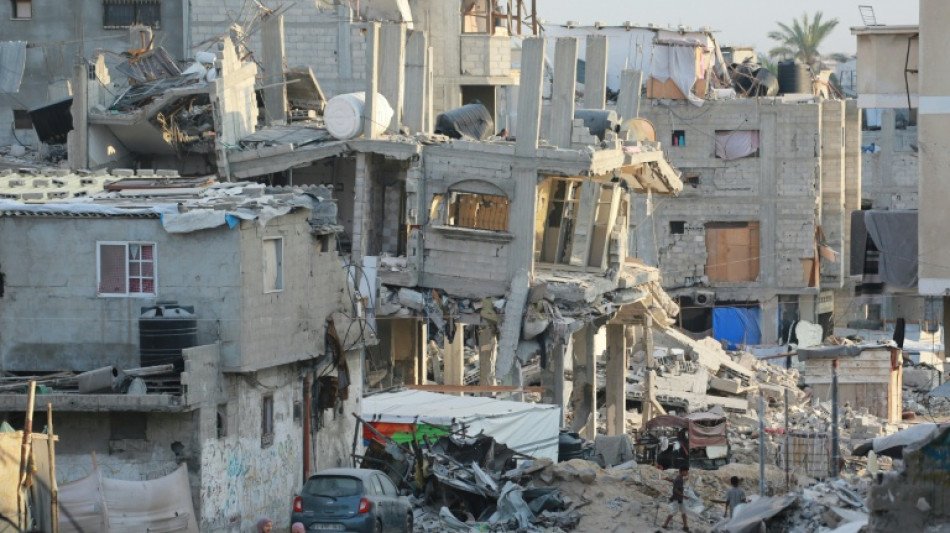
Gazans rebuild homes from rubble in preparation for winter / Photo: © AFP/File

 Swiss vote on what it means to be neutral

 Pope to meet with victims of clerical sex abuse during France trip

 Iran stands firm on Hormuz plan after US rejection

 Madrid protest camp grows after eviction outrage

 Italy winemakers hail bumper harvest but cut output

 Kyiv shoppers feel the pinch from Russian strikes
 Japanese anime actor fights TikTok over AI voice cloning
 Curtain falls on the romance of India's single-screen cinemas

 Smells like teen spirit as US thrash Peru 4-1

 Cavy chaos: Hundreds attend New Zealand's biggest guinea pig show

 Venezuela releases more political prisoners after opposition talks

 England's best 'for a long time' despite Spain defeat, says Kane

 Powerful storm pummels northeast US with rain, high winds

 Filmmaker Mike Leigh wins top prize at Spain festival with 'last film'

 Spain beat England in Nations League to extend unbeaten run

 Ireland squad vote to play Israel tie despite Gaza unease

 Gutsy Vollering wins cycling road race world title

 Vollering wins cycling road race world title

 Man City's meteoric rise clouded by dark shadow

 Mbappe out for two weeks or more with knee injury say Real

 Lyon collapse away to Stade and suffer first Top 14 loss

 Russia accuses Europe of seeking to thwart Ukraine talks

 Man City chairman defiant over reported Premier League charges

 Germany ready to 'walk through fire' for Klopp, says Tah

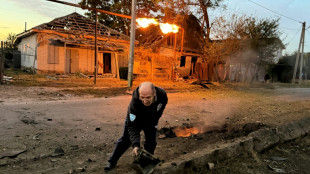 At least 16 killed in Russian and Ukrainian strikes

Abdelrahman Abu Anza's family home in war-ravaged Gaza's south has been reduced to rubble, which the Palestinian man is now using to build a shelter to protect from the winter cold.
Israeli bombardment in more than 13 months of war has left "more than 70 percent of civilian housing... either damaged or destroyed", according to the United Nations' humanitarian agency OCHA.
With many residents of the Gaza Strip displaced by the war, often seeking shelter in tent camps, the approaching winter is a major cause for concern.
Some, like Abu Anza, have resorted to building makeshift homes using broken concrete from war-damaged buildings and antiquated techniques to make mortar.
Surrounded by debris in Khan Yunis, southern Gaza's main city, Abu Anza told AFP that "our home was very old, it was built in 1936."
Making mortar by mixing clay sand with water, Abu Anza said he was "able to collect these stones to rebuild a wall to protect us, and then we will rebuild the whole house".
Others are also scrambling to prepare shelters with limited resources, anticipating the cold winter nights in the besieged territory, where temperatures can drop to around 6 degrees Celsius (42 Fahrenheit).
Last year, few months into the war, heavy rains flooded the tents of hundreds of thousands of people displaced by fighting, leaving them even more vulnerable to the effects of the coastal territory's humid nights.
Although temperatures never fall below zero degrees Celsius, nighttime humidity seeps into clothes, creating a damp feeling that is hard to get rid of in such precarious living conditions.
- 'Warmer than a tent' -
Even before the war, triggered by Palestinian militant group Hamas's October 7, 2023 attack, an Israeli blockade meant that very little building material has entered Gaza.
Israeli authorities have drastically restricted cement imports, for example, for fear that armed groups would build tunnels with it that could be used for military purposes.
Now it is virtually banned, despite pleas from several aid groups since the summer to include construction material in the list of products allowed into Gaza.
"There is no cement, so the alternative is that we go back to how it was 70 years ago, to the time of our ancestors, building with clay," said Muhammad Shanino, whose three-storey home had been destroyed.
"They have taken us back to a primitive life," he said, pointing to a wall of mismatched building blocks, roughly mortared.
The Global Shelter Cluster coalition of aid groups said that "when possible, repairing existing houses is the most effective approach" to prepare for winter.
Shanino said he had used some 700 stones from his ruined home to construct a humble shelter, where his family now share a single room.
With a corrugated metal sheet and tarps for a roof, a window covered only by a thin piece of fabric and walls riddled with cracks, their abode is still exposed to the elements.
And although it is much smaller than the house they used to live in, "my children say it's warmer than a tent", Shanino added.
- 'We want to live' -
Users on social media have shared videos of makeshift homes, praising Gazans' ingenuity and resilience as they endure dire humanitarian conditions.
Beyond the widespread destruction, Israel's military campaign has killed at least 43,922 people in Gaza, most of them civilians, according to figures from the Hamas-run territory's health ministry which the United Nations considers reliable.
The Hamas attack on Israel that preceded it resulted in 1,206 deaths, mostly civilians, according to an AFP tally of Israeli official figures.
Palestinian woman Nidaa al-Jarn said she was grateful to have a shelter.
Standing barefoot in a makeshift room "made of stones that we took from demolished houses and reclaimed, and built with mud", Jarn said she had constructed it "because we want to live".
H.Seidel--BTB