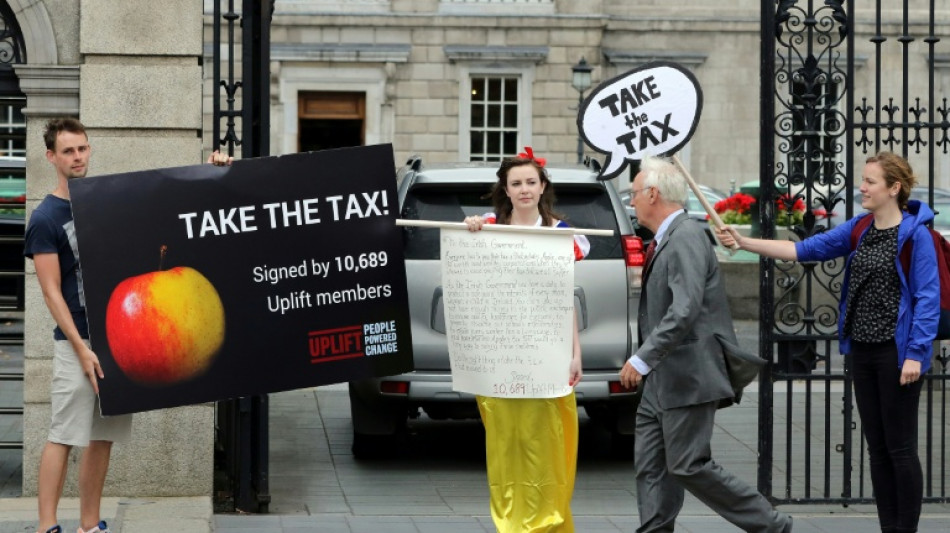
Irish economy faces the test of Trump's protectionism / Photo: © AFP

 Alex Bodi and Prof. Dr Dieter Lazik sign a contract for ALPHA WHEY and BODI Energy Drink

 Swiss reject plan to toughen neutrality: projection

 UK police call in bomb disposal team near air force base

 Bangkok floods send thousands into shelters after days of rain

 Assefa just misses women's world record at Berlin Marathon

 Dramatic winners Zimbabwe to end five-year exile by tackling DR Congo

 Pope to meet victims of clerical sex abuse on France trip

 How young is too young as child prodigies win big at Asian Games
 UK Labour party meets buoyed by Burnham but eager for concrete plans
 Thousands protest ahead of Mexican president's report on missing students

 Bangkok floods force thousands into shelters

 AI startup urges optimism from Europe despite safety fears

 'Godlike, invincible': Japan hails 11-year-old Games history-maker

 Nepal's hydropower ambitions face climate reality check
 Power cuts, rubble: millions come home to find Sudan's capital unlivable

 Internationals keep Presidents Cup lead with late fightbacks

 Tuchel to 'keep pushing' England to reach Spain's level

 Alcaraz saves match points to keep Europe ahead in Laver Cup
 Spain success driven by hunger to improve, says De La Fuente

 Lyon collapse at Stade Francais to suffer first Top 14 loss
 Oyarzabal and Spain sink England again as Modric shines for Croatia

 Housing protesters camp in central Madrid after mass demonstration

 Louise Trotter expands her palette at Bottega Veneta
 Pope prays at Lourdes after huge Paris mass

 USA trims International lead after Presidents Cup four-balls

With a general election next week, Ireland and its 5.4 million inhabitants fear finding themselves in the eye of a protectionist storm promised by incoming US president Donald Trump.
Ireland has a budget surplus -- a rarity in the European Union -- as well as record growth, putting its economy in rude health, despite the conflicts in Ukraine and the Middle East that have hit its nearest neighbours.
Its long-standing asset has been a corporate tax rate that has enticed major US tech giants such as Apple, Google and Facebook parent company Meta to set up European headquarters in Dublin.
Much to the annoyance of other capitals in the bloc, they send their European profits to Dublin to pay less tax, in a deal that in turn ensures Ireland billions.
"Corporate tax is a major source of revenues," said economist James Charles Stewart.
But the return of Trump is worrying the Irish.
If he follows through on a promise to lower the US corporate tax rate from 21 percent to Ireland's rate of 15 percent, fears are growing that the tech firms will pack up and head home.
- Don't panic... yet! -
Stewart, from Trinity College Dublin Business School, described the looming Trump presidency as "a matter of concern" but said "not to panic at this stage".
"The big tech companies will need to stay in Europe for their investments in the continent and Ireland is a good country to do that," he told AFP.
The main danger for Ireland's economy could be the 10-20-percent customs duties promised by Trump on imports, said Dan O'Brien, chief economist at the Institute of International and European Affairs in Dublin.
"Ireland per person sells more goods to the United States than any other European country or even Mexico and Canada," he said.
"So Ireland is hugely exposed to protectionism between the United States and Europe, and this is my biggest concern in the short-term for the Irish economy."
As an economic hub in the transatlantic economy, Ireland is particularly vulnerable, even though there has been more talk about "deglobalisation" than action, he added.
- Back-tax billions -
Pharmaceuticals and the agri-food industry are major industries in Ireland and are likely to lobby hard against any hike in US import tariffs.
Unlike other EU countries, Ireland earns more than it spends and expects to generate a budget surplus of 9.7 billion euros ($10.2 billion) by 2025.
Other countries may look on enviously. This year the surplus was 23.7 billion euros, if the 14 billion in undue tax advantages that Apple has to pay are counted, after a years-long saga between Brussels, Dublin and California.
Ireland was reluctant to accept the unexpected windfall and has since decided to place a chunk of it in a fund to finance the increasing health and pension costs of its ageing population.
"My view is that this money should be kept in reserve in case we have an economic shock and that's the time for government to invest when there is too little demand in an economy," said O'Brien.
"Hopefully we won't get to that point but it would better to keep that money and use it to boost demand if we get a fall in demand because of, for example, a transatlantic trade war."
J.Bergmann--BTB