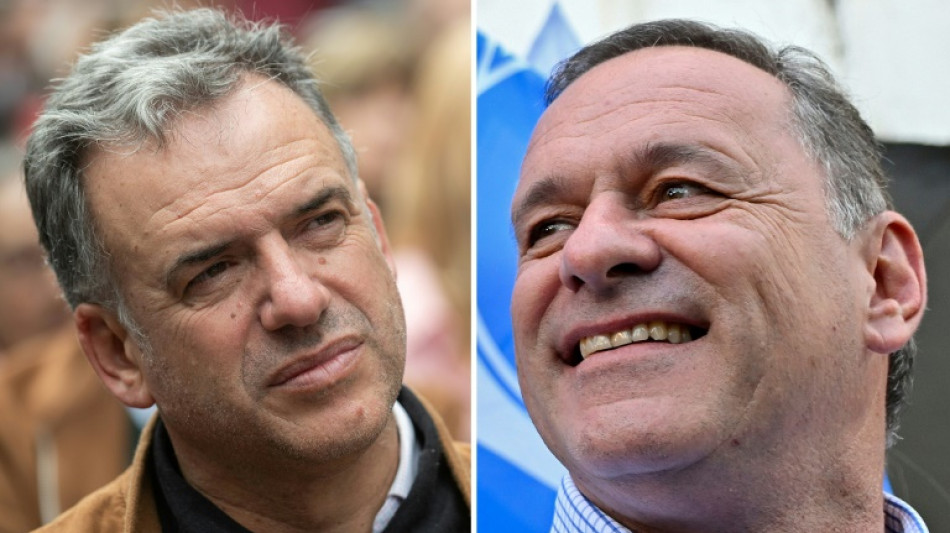
Uruguay readies for polls with left hoping for comeback / Photo: © AFP

 China's Factory Activity Contracts as Export Orders Weaken

 US Retail Sales and Fed Minutes Set Up a Critical Test for Consumers

 Oil Heads for Second Weekly Loss as Supply Surplus Emerges

 Four Mainland Universities Join Scheme for Hong Kong DSE Admissions from 2027

 Canada Signals Openness to Chinese Automakers if US Trade Talks Fail

 Canada Expands Asian Trade Push as US Negotiations Resume

 US Jobless Claims Rise to 200,000 but Layoffs Remain Historically Low

 Euro-Area Growth Slows to 0.4% While Employment Stalls

 US Wholesale Inflation Eases Monthly but Hits a Four-Year Annual High

 India's Wholesale Inflation Jumps to 12.29% as Fuel Costs Surge

 Japan's Economy Edges Into Contraction as Costly Oil Weighs on Demand

 Helen Haines Discharged from Hospital Following Attack That Cost Her Both Legs

 River Medway Reveals Financial Struggles Before 'Drag Race' Windfall

 OBI Pharma Signs Collaboration and License Agreement with Novartis
Uruguayans go to the polls Sunday with the leftist alliance of celebrated ex-president Jose Mujica hoping to reclaim the country's top job five years after a right-wing victory based on concerns over crime and taxes.
Former history teacher Yamandu Orsi of the leftist Frente Amplio (Broad Front) will go head-to-head with ex-veterinarian Alvaro Delgado of the National Party, a member of outgoing President Luis Lacalle Pou's center-right Republican Coalition.
Orsi, 57, is seen as the understudy of 89-year-old "Pepe" Mujica, a former leftist guerrilla lionized as "the world's poorest president" during his 2010-2015 rule because of his modest lifestyle.
Orsi had garnered 43.9 percent of the October 27 first-round vote -- short of the 50-percent cutoff to avoid a runoff but ahead of the 26.7 percent of ballots cast for Delgado, 55.
The pair came out tops from a crowded field of 11 candidates seeking to replace Lacalle Pou, who has a high approval rating but is barred constitutionally from seeking a second consecutive term.
Polls point to a tight race Sunday, with Orsi only marginally ahead in stated voter intention in South America's second-smallest country.
Other parties within the Republican Coalition have since thrown their support behind Delgado, boosting his numbers.
"Conditions are in place for us to take charge... to make the changes the country needs," Orsi told a closing campaign rally Wednesday.
Delgado, for his part, told supporters Uruguay was better off today thanks to the Republican Coalition in charge, adding: "I am prepared" to lead.
- Liberal mold-breaker -
A victory for Orsi would see Uruguay swing left again after five years of conservative rule in the country of 3.4 million inhabitants.
The Frente Amplio coalition broke a decades-long conservative stranglehold with an election victory in 2005, and held the presidency for three straight terms.
It was voted out in 2020 on the back of concerns about rising crime blamed on high taxes and a surge in cocaine trafficking through the port of Montevideo.
Polling numbers show perceived insecurity remains Uruguayans' top concern five years later.
The first round of voting was accompanied by a referendum in which Uruguayans were asked whether police should be allowed to carry out nighttime raids on homes as part of the fight against drug trafficking. The initiative failed.
Voting is compulsory in Uruguay, one of Latin America's most stable democracies which boasts comparatively high per-capita income and low poverty levels.
During the heyday of leftist rule, Uruguay legalized abortion and same-sex marriage, became the first Latin American country to ban smoking in public places and the world's first nation, in 2013, to allow recreational cannabis use.
I.Meyer--BTB

