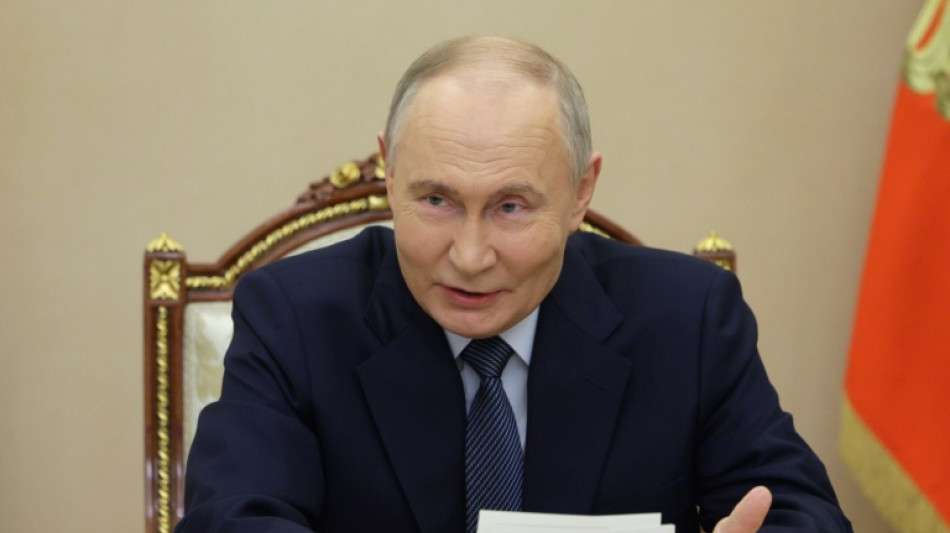
Putin signs law letting Ukraine fighters write off bad debts / Photo: © POOL/AFP

 China's Factory Activity Contracts as Export Orders Weaken

 US Retail Sales and Fed Minutes Set Up a Critical Test for Consumers

 Oil Heads for Second Weekly Loss as Supply Surplus Emerges

 Four Mainland Universities Join Scheme for Hong Kong DSE Admissions from 2027

 Canada Signals Openness to Chinese Automakers if US Trade Talks Fail

 Canada Expands Asian Trade Push as US Negotiations Resume

 US Jobless Claims Rise to 200,000 but Layoffs Remain Historically Low

 Euro-Area Growth Slows to 0.4% While Employment Stalls

 US Wholesale Inflation Eases Monthly but Hits a Four-Year Annual High

 India's Wholesale Inflation Jumps to 12.29% as Fuel Costs Surge

 Japan's Economy Edges Into Contraction as Costly Oil Weighs on Demand
 Helen Haines Discharged from Hospital Following Attack That Cost Her Both Legs
 River Medway Reveals Financial Struggles Before 'Drag Race' Windfall

 OBI Pharma Signs Collaboration and License Agreement with Novartis
Russian President Vladimir Putin on Saturday signed a law that allows those who sign up to fight in Ukraine to write off unpaid debts worth almost $100,000, the government announced.
The new legislation will be a strong motivation for some to join up, experts said, as Russia seeks new ways to recruit fighters for the nearly three-year conflict grinding through troops.
The new legislation will allow those who sign a one-year contract to fight in Ukraine after December 1 to free themselves of existing bad debts. It also covers their spouses.
The law concerns debts where a court order for collection was issued and enforcement proceedings began before December 1, 2024.
The total amount of unpaid debt that can be covered is 10 million rubles, around $96,000 at current rates.
Parliament approved the bill earlier this month.
The legislation will largely concern younger Russians of fighting age, since those in their 30s and younger are most likely to have loans.
Russia has extremely high interest rates for loans and many Russians have almost no cash savings, although the proportion of home owners is relatively high.
"Previously (for those fighting) there was only provision for taking repayment holidays on loans," Sergei Krivenko of advocacy group Citizen Army Law told Vazhniye Istorii Telegram channel.
The new legislation applies to those who are conscripted for national service and those mobilised for the so-called "special military operation", Krivenko said.
Conscripts cannot be sent to the front line but can choose to sign a contract to join the professional army and be sent to fight in Ukraine.
Russian authorities "are strengthening the motivation to sign a contract," political analyst Georgy Bovt wrote on Telegram.
The legislation provides "another way to get rid of an unbearable burden of credit, at least for several hundred thousand people," Bovt wrote.
Over 13 million Russians have three or more loans, according to a central bank report released last month covering the first two quarters. This was up 20 percent on the same period last year.
The average amount owed by those with three or more loans is 1.4 million rubles ($13,400 at current rates).
Many start with a bank loan and then apply for further loans from microfinance organisations.
Russians serving on the front line are already paid far more than the national average.
Ukraine also has legislation allowing those fighting to get preferential terms for loans and in some cases to write off debts.
C.Meier--BTB

