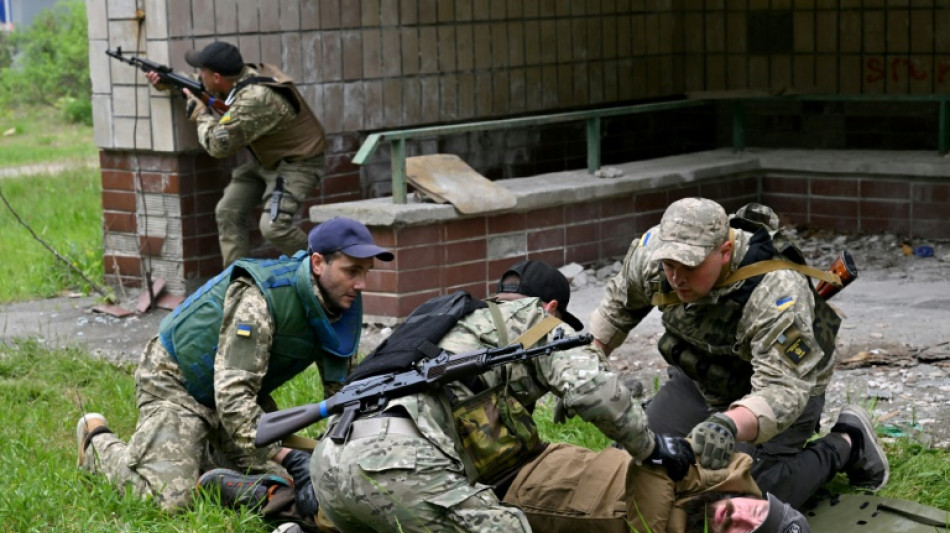
Mechanics, hairdressers... Ukraine recruits train for attack / Photo: © AFP

 Man Utd agree deal for Brighton midfielder Baleba: reports
 Werro wins Lausanne 800m, well off world record pace
 China mulls bid to host 2028 UN climate talks: sources
 Jones becomes third Englishman to join Inter this summer
 Mexican governor wanted on US drug charges returns to job
 Bolivia's Paz forced to fire economy minister in mid-crisis

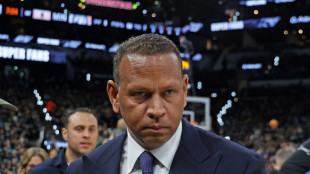 A-Rod ups T-Wolves stake in $4.5bn ownership change
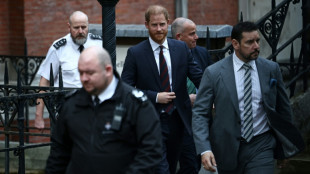 UK court orders Prince Harry, others to pay Daily Mail initial £9.5mn

 'Grateful' ex-world champion Alaphilippe retires from cycling
 US, Canada work to wrap up trade deal ahead of looming deadline

 Malaysia's JDT claim unbeaten run world record

 At least 2 teens seriously wounded in sword attack at Swedish school
 Popular forest near Paris to reopen after wildfire
 UN holds second informal poll of secretary-general candidates
 Shakhtar Donetsk to play Champions League home games at Chelsea
 Arsenal sign Villa centre-back Konsa as champions bolster defence
 The 'hedgehogs' leading Poland's defences on Russian border
 England thrash Pakistan by an innings and 103 runs in first Test
 Fury says Joshua fight 'doesn't look like it's going to happen'
 Argentina's Paredes suspended 10 matches by FIFA for World Cup fight

 Watkins and Martinez could join Villa exodus says Emery
 UK court orders Prince Harry, others to pay Daily Mail £9.5mn

 Aligned Launches $ALIGN, the Native Token of Its Full Ethereum Stack
 Bitcoin jumps, stocks bounce as traders weigh US Treasury action

 Man City boss Maresca hit with Doku injury blow

"Hold on to the rope, look at me," the instructor says, coaxing 28-year-old lawyer Iryna Gorobiyovska who is nervously about to abseil down a building.
Brimming with motivation but lacking experience, the Ukrainian, whose nom de guerre is Bunny, ends up sliding, somewhat awkwardly, to the ground.
Like thousands of others, she signed up to the territorial defence unit, a support force to the regular Ukrainian army, immediately after Russia invaded.
Open to all nationals, the only requirement is being aged between 18 and 60.
Some members already have military experience acquired after Moscow's annexation of Crimea in 2014 and in the conflict with pro-Russian separatists in eastern Ukraine that began the same year.
They immediately deployed to the war effort, but many others, like Gorobiyovska, did not know how to handle a weapon or apply a tourniquet.
While the capital Kyiv was under siege by Russian forces earlier in the war, they mostly helped build barricades or hand out humanitarian aid.
Russian soldiers are now focused on the south and eastern regions of Ukraine, but -- anticipating a drawn-out conflict -- Kyiv has stepped up the training of its new recruits so they are ready to face the enemy if and when needed.
- Taught 'how to attack' -
Training sessions have been held every week since March, says Mykhailo Shcherbina, deputy director of defence affairs for the Department of Municipal Security at Kyiv City State Administration.
He says that between 8,000 and 10,000 people have been trained since March.
"It's a crime to send people who aren't prepared to a frontline. Everyone has to be trained even (to a) minimum," he tells AFP.
It's all the more crucial now, he adds, as after largely defensive operations, Ukrainian forces have begun going more on the offensive, such as in the area around the northern city of Kharkiv.
"And we have to teach people how to attack, how to liberate the cities," he says.
- 'Defend my country' -
Deep in the forest, away from the capital, an old hut formerly used by the Pioneers, the Soviet version of the Scouts, is now a training ground.
Over five days, mechanics, construction workers, hairdressers and the likes are put through their paces, learning how to navigate a minefield, evacuate the wounded under fire, shoot an automatic weapon -- or escape through the window of a multi-storey building.
It's the latter that causes difficulty for Gorobiyovska.
"It was so scary because I didn't understand what should I do," says the woman with khaki painted fingernails afterwards.
"I agree to defend my country. But I hope I won't have to climb down from a high storey" to do it, she adds.
In another training exercise, the recruits must take back a site held by the enemy.
Advancing in single file, their weapons trained as they pass open areas, a small group enters an abandoned building.
"Contact", "contact," one of them shouts out amid the crackling of weapon fire -- in this case, their amunition is small white plastic pellets.
"Our task is to teach them to do fighting correctly in buildings, to know how to clear them and annihilate the enemy," an instructor, who declines to give his name, says.
"And remain alive."
- 'A chance' -
Konstantin, a 27-year-old municipal employee, knows the stakes only too well.
He joined the territorial defence unit after fighting got close to his home in March, he says.
"I couldn't not do anything, so I joined the territorial defence to protect my town, my country," he explains.
He acknowledges however: "If I'd gone straight to the frontline, I wouldn't have survived."
Now, having undergone his training, he believes he "has a chance".
Nevertheless the baby-faced young man wonders how he'll react when on the ground in a real-life situation.
"Training is training, but when you see real blood it's different. Is it going to stop me in my tracks, or give me a rush of adrenaline?" he says.
Doctor Demian Popov, 53, tries to provide the recruits with methods of overcoming battle stress and teaches them about post-traumatic stress disorder and the role of intuition in battle.
He says that despite them being highly motivated "there is no methodology to find out who will leave the battle and who will not".
"It will be known only when the person will get there if he/she can fight or not," he adds.
M.Ouellet--BTB