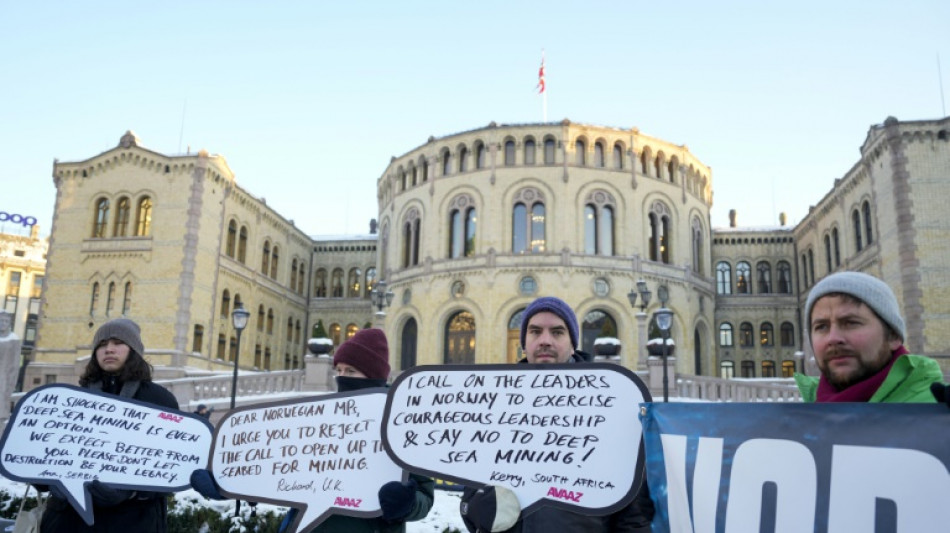
Norway faces WWF in court over deep sea mining / Photo: © NTB/AFP

 Kansas City Fed Chief Says Inflation Is Still Running Too Hot

 Asian Markets Slide as AI Concerns Hit Chip Stocks

 Brazil Faces Debt and Inflation Test as Lula Prepares Fourth Term

 Chinese Drug Ribupatide Shows Greater Weight Loss Than Wegovy in Clinical Trial

 US Mortgage Rate Falls for Fourth Week but Remains Above 7%

 Italy Raises 2026 Growth View but Warns Energy Will Keep Inflation High

 UK Economy Grows 0.7% in Third Quarter as Services Lead Expansion

 India's Retail Inflation Reaches 6.09% as Food Prices Accelerate

 China's October Activity Data Reveal a Weak Start to the Fourth Quarter
 Thomas Tuchel Refuses to Name England Number One Goalkeeper After James Trafford's Display

 Qatar's Amir and Venezuelan Acting President Discuss Energy Cooperation

 Russell Brand’s Wife Reads Prison Letter Denying Guilt; Fellow Inmate Questions Faith

 Alouettes and Elks Set for 113th Grey Cup Showdown
The World Wide Fund for Nature's (WWF) Norwegian chapter will have its day in court Thursday, after it sued Norway for opening up its seabed to mining before performing sufficient impact studies.
Already Western Europe's largest oil and gas producer, Norway could become one of the first countries to authorise seabed mining, arguing the importance of not relying on China for minerals essential for renewable technology.
While deep-sea mining is contentious due to its potential impact on vulnerable marine ecosystems, Norway's parliament in January formally gave its green light to open up parts of its seabed to exploration.
"We believe the government is violating Norwegian law by now opening up for a new and potentially destructive industry without adequately assessing the consequences," Karoline Andaur, CEO of WWF-Norway, said in a statement.
Norway "must halt the rushed process, must actively support a national and global moratorium -- a temporary ban on seabed mining until there is sufficient knowledge," Andaur said in an online meeting earlier in November.
With their lawsuit, WWF-Norway is also calling on the Norwegian government to stop giving public support to mining companies for the exploration phase and to allocate these funds to independent research institutions.
That would help "to close the many knowledge gaps about marine life", Andaur said.
The trial will run until December 5.
- Possible dangers -
On April 12, Norway's Ministry of Energy announced that it was opening up an area of the Norwegian Sea and Greenland Sea to exploration, with the aim of awarding the first licences in the first half of 2025.
Within the area, which is the size of the United Kingdom, it has designated locations covering 38 percent of the area suitable for exploration for a first licensing round.
"Before any exploitation can begin, it has to be shown that the proposed exploitation can take place in a sustainable and responsible manner," Astrid Bergmal, state secretary at the energy ministry, told AFP in an email.
The first projects will also have to be approved by parliament, Bergmal added.
"The first phase will consist of mapping and exploration, which has little environmental impact," she said.
But critics see this stage as a first step towards exploitation.
According to several NGOs, opening up the seabed poses an additional threat to an ecosystem that is little-known and has already been weakened by global warming.
Possible dangers include the destruction of marine habitats and organisms, noise and light pollution, as well as the risk of chemical leaks from machines and species being displaced.
Norwegian authorities meanwhile stress that by allowing the prospecting they want to fill in the gaps in knowledge.
In early 2023, the Norwegian Offshore Directorate published a report concluding that "substantial resources are in place on the seabed" including minerals such as copper, zinc and cobalt.
W.Lapointe--BTB