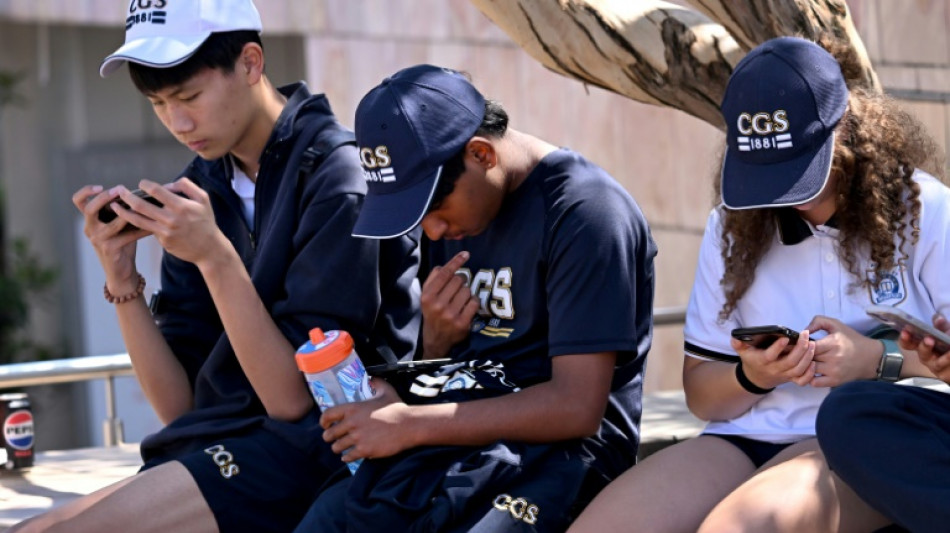
Australia passes landmark social media ban for under 16s / Photo: © AFP

 Kansas City Fed Chief Says Inflation Is Still Running Too Hot

 Asian Markets Slide as AI Concerns Hit Chip Stocks

 Brazil Faces Debt and Inflation Test as Lula Prepares Fourth Term

 Chinese Drug Ribupatide Shows Greater Weight Loss Than Wegovy in Clinical Trial
 US Mortgage Rate Falls for Fourth Week but Remains Above 7%

 Italy Raises 2026 Growth View but Warns Energy Will Keep Inflation High

 UK Economy Grows 0.7% in Third Quarter as Services Lead Expansion

 India's Retail Inflation Reaches 6.09% as Food Prices Accelerate

 China's October Activity Data Reveal a Weak Start to the Fourth Quarter

 Thomas Tuchel Refuses to Name England Number One Goalkeeper After James Trafford's Display
 Qatar's Amir and Venezuelan Acting President Discuss Energy Cooperation

 Russell Brand’s Wife Reads Prison Letter Denying Guilt; Fellow Inmate Questions Faith

 Alouettes and Elks Set for 113th Grey Cup Showdown
Australian lawmakers passed landmark rules to ban under 16s from social media on Thursday, approving one of the world's toughest crackdowns on popular sites like Facebook, Instagram and X.
The legislation ordering social media firms to take "reasonable steps" to prevent young teens from having accounts was passed in the Senate with 34 votes in favour and 19 against.
The firms -- who face fines of up to Aus$50 million (US$32.5 million) for failing to comply -- have described the laws as "vague", "problematic" and "rushed".
The new rules will now return to the lower house -- where lawmakers already backed the bill on Wednesday -- for one final approval before it is all but certain to become law.
Speaking during the Senate debate, Greens politician Sarah Hanson-Young said the ban would not "make social media safer for young people".
She said it was "devastating" that young people were "finding themselves addicted to these dangerous algorithms".
Centre-left Prime Minister Anthony Albanese, eyeing an election early next year, has enthusiastically championed the new rules and rallied Aussie parents to get behind it.
In the run up to the vote, he painted social media as "a platform for peer pressure, a driver of anxiety, a vehicle for scammers and, worst of all, a tool for online predators".
He wanted young Australians "off their phones and onto the footy and cricket field, the tennis and netball courts, in the swimming pool".
But young social media users, like 12-year-old Angus Lydom, are not impressed.
"I'd like to keep using it. And it'll be a weird feeling to not have it, and be able to talk to all my friends at home," he told AFP.
Many are likely to try to find ways around it.
"I'll find a way. And so will all my other friends" Lydom said.
Similarly, 11-year-old Elsie Arkinstall said there was still a place for social media, particularly for children wanting to watch tutorials about baking or art.
"Kids and teens should be able to explore those techniques because you can't learn all those things from books," she added.
- Other countries weigh restrictions -
On paper, the ban is one of the strictest in the world.
But the current legislation offers almost no details on how the rules will be enforced -- prompting concern among experts that it will simply be a symbolic piece of legislation that is unenforceable.
It will be at least 12 months before the details are worked out by regulators and the ban comes into effect.
Some companies will likely be granted exemptions, such as WhatsApp and YouTube, which teenagers may need to use for recreation, school work or other reasons.
Late amendments were introduced to ensure government-issued digital ID cannot be used as a means of age verification.
Social media expert Susan Grantham told AFP that digital literacy programmes that teach children to think "critically" about what they see online should be adopted -- similar to a model used in Finland.
The legislation will be closely monitored by other countries, with many weighing whether to implement similar bans.
Lawmakers from Spain to Florida have proposed social media bans for young teens, although none of the measures have been implemented yet.
China has restricted access for minors since 2021, with under-14s not allowed to spend more than 40 minutes a day on Douyin, the Chinese version of TikTok.
Online gaming time for children is also limited in China.
C.Meier--BTB