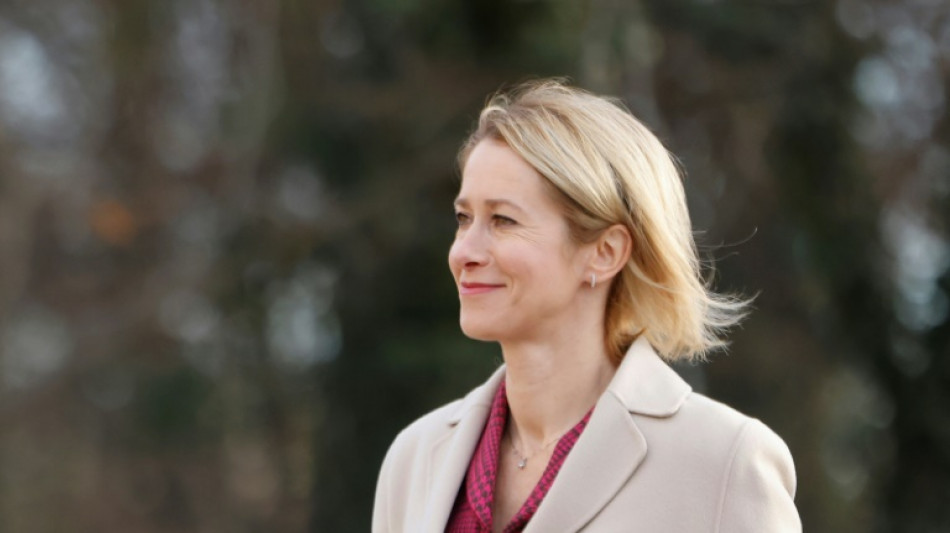
New EU chiefs visit Kyiv on first day of mandate / Photo: © AFP/File

 Brazil Faces Debt and Inflation Test as Lula Prepares Fourth Term
 Chinese Drug Ribupatide Shows Greater Weight Loss Than Wegovy in Clinical Trial
 US Mortgage Rate Falls for Fourth Week but Remains Above 7%

 Italy Raises 2026 Growth View but Warns Energy Will Keep Inflation High

 UK Economy Grows 0.7% in Third Quarter as Services Lead Expansion

 India's Retail Inflation Reaches 6.09% as Food Prices Accelerate

 China's October Activity Data Reveal a Weak Start to the Fourth Quarter
 Thomas Tuchel Refuses to Name England Number One Goalkeeper After James Trafford's Display
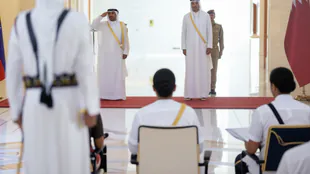 Qatar's Amir and Venezuelan Acting President Discuss Energy Cooperation
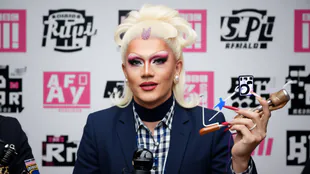
 Russell Brand’s Wife Reads Prison Letter Denying Guilt; Fellow Inmate Questions Faith

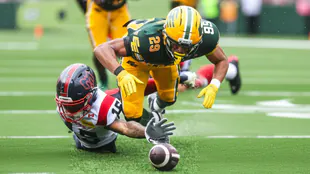 Alouettes and Elks Set for 113th Grey Cup Showdown
The EU's new top diplomat Kaja Kallas and head of the European Council Antonio Costa arrived in Kyiv Sunday in a symbolic show of support for Ukraine on their first day in office.
"We came to give a clear message that we stand with Ukraine, and we continue to give our full support," Costa told media outlets including AFP accompanying them on the trip.
The European Union's new leadership team is keen to demonstrate it remains firm on backing Kyiv at a perilous moment for Ukraine nearly three years into its fight against Russia's all-out invasion.
Questions are swirling around the future of US support once Donald Trump assumes office in January and there are fears he could force Kyiv to make painful concessions in pursuit of a quick peace deal.
Meanwhile, tensions have escalated as Russian President Vladimir Putin has threatened to strike government buildings in Kyiv with his new Oreshnik missile after firing it at Ukraine for the first time last month.
The Kremlin leader said the move is a response to Kyiv getting the green light to strike inside Russia with American and British missiles, and he has threatened to hit back against the countries supplying the weaponry.
As winter begins Russia has also unleashed devastating barrages against Ukraine's power grid and on the frontline Kyiv's fatigued forces are losing ground to Moscow's grinding offensive.
"The situation in Ukraine is very, very grave," Kallas, a former prime minister of Estonia, said. "But it's clear that it comes at a very high cost for Russia as well."
- Ceasefire? -
The new EU leaders -- the bloc's top officials along with European Commission chief Ursula von der Leyen -- were set to hold talks with Ukraine's President Volodymyr Zelensky.
Zelensky on Friday appeared to begin staking out his position ahead of any potential peace talks.
He called on NATO to offer guaranteed protections to parts of Ukraine controlled by Kyiv in order to "stop the hot stage of the war", and implied he would then be willing to wait to regain other territory seized by Russia.
"If we speak ceasefire, (we need) guarantees that Putin will not come back," Zelensky told Britain's Sky News.
Kallas said that "the strongest security guarantee is NATO membership."
"We need to definitely discuss this -- if Ukraine decides to draw the line somewhere then how can we secure peace so that Putin doesn't go any further," she said.
Diplomats at NATO say there appears little prospect of the alliance granting Ukraine membership soon given opposition from a raft of members cautious of getting dragged into war with Russia.
Kallas said the EU "shouldn't really rule out anything" in terms of the question of sending European troops to help enforce any ceasefire.
"We should have this strategic ambiguity around this," she said.
- 'Transactional language' -
Trump has cast doubt on continuing Washington's vast aid for Ukraine and called on EU countries to do more.
Europe together has spent around $125 billion on supporting Ukraine since Russia's 2022 invasion, while the United States alone has coughed up over $90 billion, according to a tracker from the Kiel Institute.
Kallas said the EU would use a "transactional language" to try to convince Trump that backing Kyiv was in the interest of the US.
"Aid for Ukraine is not charity," she said. "A victory for Russia definitely emboldens China, Iran, North Korea."
The new EU foreign policy chief said the bloc would continue seeking to put Ukraine in the "strongest" position -– if and when Kyiv chose it was time to negotiate with Moscow.
But she conceded that it was becoming "increasingly difficult" for the 27-nation bloc to agree on new ways to ramp up support for Ukraine.
"This war has been going on for quite some time and it is harder and harder to explain it to our own people," she said. "But I don't see any option."
C.Meier--BTB