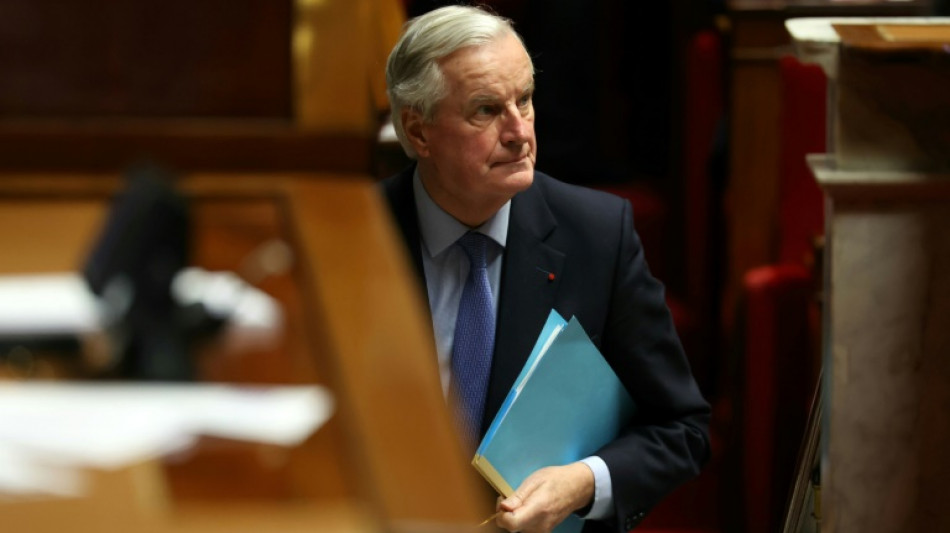
France's Macron seeks new PM after no-confidence defeat / Photo: © AFP

 US Mortgage Rate Falls for Fourth Week but Remains Above 7%

 Italy Raises 2026 Growth View but Warns Energy Will Keep Inflation High
 UK Economy Grows 0.7% in Third Quarter as Services Lead Expansion

 India's Retail Inflation Reaches 6.09% as Food Prices Accelerate

 China's October Activity Data Reveal a Weak Start to the Fourth Quarter
 Thomas Tuchel Refuses to Name England Number One Goalkeeper After James Trafford's Display

 Qatar's Amir and Venezuelan Acting President Discuss Energy Cooperation

 Russell Brand’s Wife Reads Prison Letter Denying Guilt; Fellow Inmate Questions Faith

 Alouettes and Elks Set for 113th Grey Cup Showdown

President Emmanuel Macron on Thursday sought a new prime minister to prevent France from sliding deeper into political turmoil after Michel Barnier's government was ousted in a historic no-confidence vote in parliament.
Poised to be contemporary France's shortest-serving premier, Barnier met Macron at the Elysee Palace to submit his resignation, after the defeat in parliament on Wednesday forced his government to step down.
The vote was the first successful no-confidence action since a defeat for Georges Pompidou's government in 1962, when Charles de Gaulle was president.
Macron was to meet both upper and lower house parliament speakers before giving an address to the nation at 1900 GMT.
The president is believed to be in a hurry to appoint the new premier to avoid a vacuum, according to multiple sources who spoke to AFP.
Limiting any impression of political chaos is all the more important for Macron who on Saturday will host world leaders -- including US president-elect Donald Trump -- for the reopening of Notre Dame cathedral in Paris after the devastating 2019 fire.
A majority of lawmakers on Wednesday supported the no-confidence vote proposed by the hard left and backed by the far right headed by Marine Le Pen.
Barnier's record-quick ejection comes after snap parliamentary elections in June resulted in a hung parliament with no political force able to form an overall majority and the far right holding the key to the government's survival.
The trigger for Barnier's ouster was his 2025 budget plan including austerity measures that were unacceptable to a majority in parliament, but that he argued were necessary to stabilise France's finances.
On Monday he forced through a social security financing bill without a vote, but the ousting of the government means France is still without a budget.
National Assembly Speaker Yael Braun-Pivet urged Macron to quickly choose a new premier, saying that France could not be allowed to "drift" for long.
"Macron alone in the face of an unprecedented political crisis," said the Le Monde daily in its headline.
- 'Political stalemate' -
"France probably won't have a 2025 budget," said ING Economics in a note, predicting that the country "is entering a new era of political instability".
Moody's, a ratings agency, warned that Barnier's fall "deepens the country's political stalemate" and "reduces the probability of a consolidation of public finances".
The Paris stock exchange fell at the opening on Thursday before recovering to show small gains. Yields on French government bonds were again under pressure in debt markets.
Strike calls across transport, education and other public sector services were maintained on Thursday despite the disappearance of the austerity budget that has prompted anger.
Macron has more than two years of his presidential term left, but some opponents are calling on him to resign.
"We are now calling on Macron to go," Mathilde Panot, head of the parliamentary faction of the hard-left France Unbowed (LFI) party, told reporters.
She urged "early presidential elections" to solve the political crisis.
Macron has however vehemently rejected such a scenario, calling it "political fiction".
Taking care not to crow over the government's fall, Le Pen said in a television interview that, once a new premier is appointed, her party "would let them work" and help create a "budget that is acceptable for everyone".
She also, conspicuously, did not call on Macron to resign.
- Bayrou-Macron lunch -
Barnier is the fifth prime minister to serve under Macron since he came to power in 2017, with each premier serving a successively shorter period.
Given the composition of the National Assembly, there is no guarantee that Barnier's successor would last any longer.
Loyalist Defence Minister Sebastien Lecornu and Macron's centrist ally Francois Bayrou have been touted as possible contenders, as has former Socialist premier and interior minister Bernard Cazeneuve.
Bayrou, who leads the MoDem party, had lunch with the president at the Elysee, a source close to him told AFP.
Before his address to the nation, Macron was also to meet Braun-Pivet and upper-house Senate speaker Gerard Larcher.
M.Odermatt--BTB

