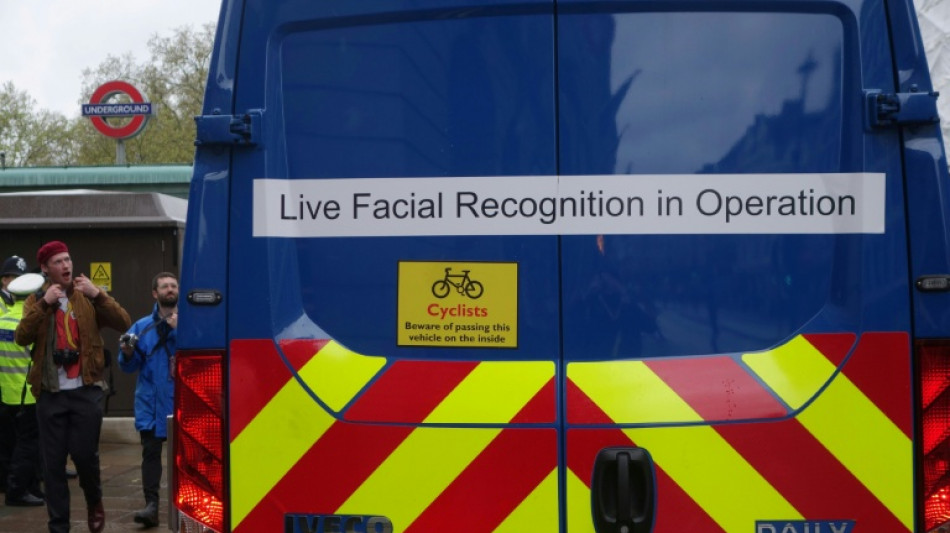
London police make 500 arrests using facial recognition tech / Photo: © AFP

 US Mortgage Rate Falls for Fourth Week but Remains Above 7%
 Italy Raises 2026 Growth View but Warns Energy Will Keep Inflation High

 UK Economy Grows 0.7% in Third Quarter as Services Lead Expansion

 India's Retail Inflation Reaches 6.09% as Food Prices Accelerate

 China's October Activity Data Reveal a Weak Start to the Fourth Quarter

 Thomas Tuchel Refuses to Name England Number One Goalkeeper After James Trafford's Display

 Qatar's Amir and Venezuelan Acting President Discuss Energy Cooperation

 Russell Brand’s Wife Reads Prison Letter Denying Guilt; Fellow Inmate Questions Faith

 Alouettes and Elks Set for 113th Grey Cup Showdown

London's Metropolitan Police force said on Friday that it had used facial recognition technology to make more than 500 arrests in 2024 for offences ranging from shoplifting to rape.
The force uses live facial recognition in specific areas of the UK capital, positioning a van equipped with cameras in a pre-agreed location.
The cameras capture live footage of passers-by and compare their faces against a pre-approved watchlist, generating an alert if a match is detected.
Civil liberties campaigners have criticised the use of such technology, and advocacy group Big Brother Watch has launched legal action to stop its expansion.
"The technology works by creating a 'faceprint' of everyone who passes in front of camera —- processing biometric data as sensitive as a fingerprint, often without our knowledge or consent," the group says on is website.
"This dangerously authoritarian surveillance is a threat to our privacy and freedoms -— it has no place on the streets of Britain," it adds.
The Met says it is a "forerunner" in using the technology, adding that it helps "make London safer" by helping detect "offenders who pose significant risks to our communities".
Of the 540 arrests, more then 50 were for serious offences involving violence against women and girls, including offences such as strangulation, stalking, domestic abuse and rape.
More than 400 of those arrested have already been charged or cautioned.
"This technology is helping us protect our communities from harm," said Lindsey Chiswick, the Met's Director of Performance.
"It is a powerful tool that supports officers to identify and focus on people who present the highest risk that may otherwise have gone undetected," she added.
Responding to privacy fears, police said that the biometric data of any passer-by not on a watchlist is "immediately and permanently deleted".
H.Seidel--BTB