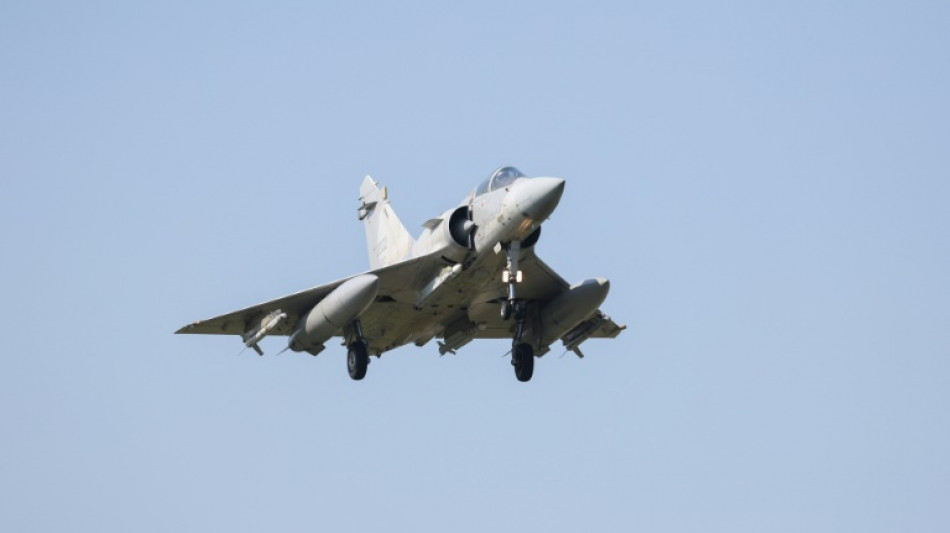
The Taiwan Strait: crucial waterway and military flashpoint / Photo: © AFP

 Oil prices spike after Trump rejects Iran truce offer

 Taylor Swift sets new record at MTV VMAs
 Seoul seeks apology after Ukraine reveals transfer of North Korean POWs

 Messi on target again but Miami downed by Columbus
 In Washington's political cauldron, a fight over foie gras
 Flavio Bolsonaro: political heir in his father's shadow

 Ravens grab last-second win in Rio as Commanders stop Seahawks

 USA rallies to capture 11th consecutive Presidents Cup

 Phillies clinch, Astros wrap up division on final day of MLB season

 Commanders hand champion Seahawks their first loss

 Dupont scores twice to send Toulouse top of Top 14

 Ireland beat Israel but no handshakes due to war in Gaza

 Tense standoff over flashpoint N.Ireland parade lasts into night

 Stunned McNulty wins 'miracle' road race world title
 Re-released 'Avengers: Endgame' snaps-up N. America box office lead
 American McNulty wins shock road race world title
 Serbia's President Aleksandar Vucic announces resignation

 Tuchel urges Bellingham to play with 'rage'

 Russian strikes on Ukraine kill 8

 Bavuma, Miller hit centuries as South Africa clinch series
 Spain bring in Le Normand for injured Garcia

 UK Labour party meets buoyed by Burnham but seeking concrete plans

 Nor'easter lashes US east with punishing rain and wind
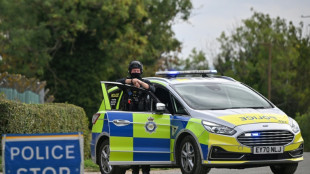 UK police arrest five on suspicion of preparing 'terrorist act' near air base

 Washington denounces Iran's truce proposal as 'cynical'

Taiwan accused China on Tuesday of holding its biggest maritime mobilisation around the island in years, though Beijing has stayed tight-lipped over its latest show of force.
Here, AFP looks at the Taiwan Strait, a critical waterway and growing military flashpoint:
- Where is the Taiwan Strait? -
The strait separates the eastern Chinese province of Fujian from the main island of Taiwan, home to around 23 million people.
At its narrowest point, just 130 kilometres (about 80 miles) of windswept water separates the two major landmasses, and several outlying Taiwanese islands -- including Kinmen and Matsu -- lie just a few kilometres from the Chinese coastline.
China and Taiwan have been governed separately since Mao Zedong's communist army won a civil war and sent the opposition nationalist forces fleeing across the strait in 1949.
Beijing has maintained ever since that the island is part of its territory, and has not ruled out using force to bring it under control.
- Why is it important? -
The strait is a critical artery for global shipping through which a huge volume of trade passes every day.
Around $2.45 trillion of goods -- more than a fifth of global maritime trade -- transited the strait in 2022, according to the Center for Strategic and International Studies, a Washington-based think tank.
Taiwan plays an outsized role in the global economy thanks to producing over 90 percent of the world's most advanced computing chips, used in everything from smartphones to cutting-edge military equipment.
Analysts say a Chinese invasion would deal a catastrophic blow to these supply chains.
More minor disruptions, such as a blockade of the island, would cause costly shipping cancellations and diversions that would impact worldwide consumers.
"In the event of a long conflict over Taiwan, financial markets would tank, trade would shrivel, and supply chains would freeze, plunging the global economy into a tailspin," Robert A. Manning, a China expert at Washington's Stimson Center, wrote this year.
A report by the Rhodium Group estimated that a blockade of the island could cost firms dependent on Taiwan's chips $1.6 trillion in revenue annually.
An invasion would also endanger Taiwan's way of life, embodied by its democratic freedoms and boisterous elections.
It would also risk a wider conflict because the United States, while not recognising Taiwan diplomatically, has an agreement to help the island defend itself.
- What do we know about the drills? -
Unlike previous exercises, Beijing has not announced any drills.
But a senior Taiwanese security official told AFP on Tuesday that "nearly 90" Chinese naval and coast guard ships were currently in waters along the so-called first island chain, which includes Japan's Okinawa, Taiwan and the Philippines.
Taiwan's defence ministry said earlier it had also detected 47 Chinese aircraft near the island in the 24 hours to 6:00 am (2200 Monday GMT), the highest number since October.
China's foreign ministry declined to answer questions about the drills on Tuesday, referring reporters to the "competent authorities".
But ministry spokeswoman Mao Ning said at a regular press conference that Beijing would "resolutely defend its national sovereignty and territorial integrity".
The developments came after Taiwanese President Lai Ching-te visited the US last week, a visit strongly criticised by Beijing.
- Has this happened before? -
China has ramped up pressure on Taiwan in recent years and has staged four large-scale military exercises around the island since 2022.
In October, Chinese forces deployed fighter jets, bombers and warships in areas to the north, south and east of Taiwan, and simulated a rocket strike in drills called "Joint Sword-2024B".
The manoeuvres came after Lai gave a speech on Taiwan's national day that Beijing viewed as a provocative move towards independence.
Beijing launched other drills -- "Joint Sword-2024A" -- in May following Lai's inauguration, and encircled Taiwan in April last year after his predecessor Tsai Ing-wen met with then US Speaker Kevin McCarthy.
But a spokesperson for Taipei's defence ministry has said the scale of the maritime forces in the current operation "exceeds the four drills since 2022".
Several major crises flared across the strait in preceding decades, most recently in 1995-6, when China conducted missile tests around Taiwan.
J.Horn--BTB