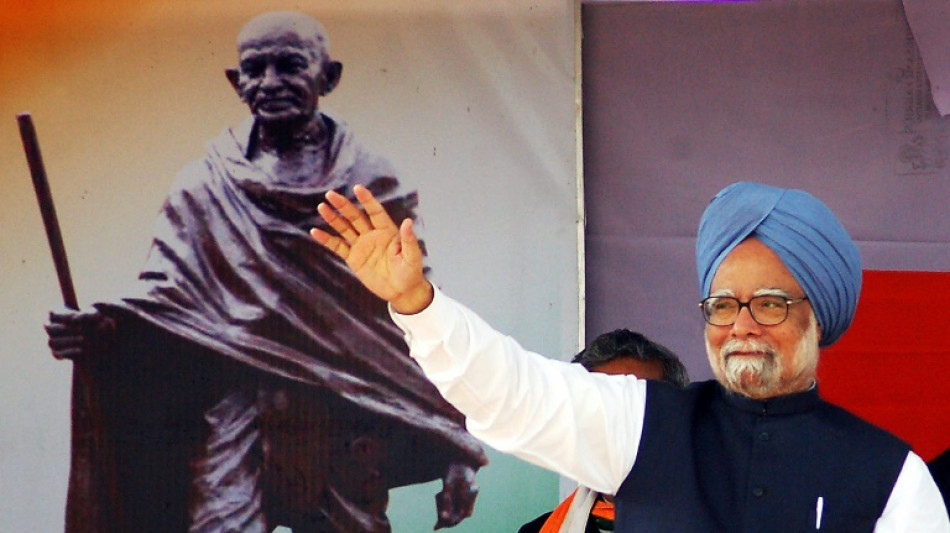
Manmohan Singh: technocrat who became India's accidental PM / Photo: © AFP/File

 SpaceX puts Starship megarocket in orbit for first time
 Iran denies link to suspected bomb plot at UK airbase used by US
 Ex-boss Mancini says City charges 'not my concern'
 Berlin Marathon winner Assefa finished race with torn Achilles

 Comedian convicted for Erdogan 'insult' but freed pending appeal

 French prosecutors seek two-year sentence for ex-minister Dati in graft case
 Eala makes fast start as weather and transport woes hit Asian Games
 Hurricane Polo approaches Mexico, threatens severe damage
 Energy markets rally after Trump rejects Iran truce offer
 Japanese convenience store enlists Lady Gaga to bolster recruitment
 Seoul summons Ukraine envoy in row over North Korean POWs

 Ireland 'raised awareness worldwide' in Israel game: Hallgrimsson

 Colombian police capture wife, daughter of Ecuador drug lord
 More Asian Games woes as bus takes Pakistan team to wrong venue

 Radio frequencies vital to Earth observation must be protected: UN
 Comedian on trial for insulting Erdogan in standup show

 Women's Fashion Week kicks off in Paris

 Pope arrives in French border city to speak on united Europe
 The wildfires choking Indonesia, sparking regional haze
 PU Prime Deepens Argentina Presence Through FX Expo Buenos Aires 2026

 Nothing to seal here: NZ police help stranded pup home
 White House releases list of products US, China could tax less
 'Pseudo-journalism': Partisan 'news' sites target US midterms

 'Currently impossible': North Korea defections in freefall
 Erasmus sizes up 'improved' Wallabies ahead of 2027 World Cup
Manmohan Singh's father may have believed his bookworm son would one day lead India, but the understated technocrat with the trademark blue turban, who died Thursday at the age of 92, never dreamed it would actually happen.
Singh was pitchforked into leading the world's largest democracy in 2004 by the shock decision of Congress leader Sonia Gandhi to turn down the role after leading the party to an upset win over the ruling Hindu nationalists.
He oversaw an economic boom in Asia's fourth-largest economy in his first term, although slowing growth in later years marred his second stint.
Known as "Mr Clean", Singh nonetheless saw his image tarnished during his decade-long tenure when a series of corruption cases became public.
As finance minister in the early 1990s, he was hailed at home and abroad for initiating big-bang reforms that opened India's inward-looking economy to the world.
Known as a loyalist to the Gandhi political dynasty, Singh studied economics to find a way to eradicate poverty in the vast nation and never held elected office before becoming PM.
But he deftly managed the rough and tumble of Indian politics -- even though many said Sonia Gandhi, the Italian-born widow of the assassinated Rajiv Gandhi, was the power behind the throne.
- Streetlight studying -
Born in 1932 in the mud-house village of Gah in what is now Pakistan, Singh moved to the holy Sikh city of Amritsar as a teenager around the time the subcontinent was split at the end of British rule into mainly Hindu India and Muslim Pakistan.
His father was a dry-fruit seller in Amritsar, and he had nine brothers and sisters.
He was so determined to get an education he would study at night under streetlights because it was too noisy at home, his brother Surjit Singh told AFP in 2004.
"Our father always used to say Manmohan will be the prime minister of India since he stuck out among the 10 children," said Singh. "He always had his nose in a book."
Singh won scholarships to attend both Cambridge, where he obtained a first in economics, and Oxford, where he completed his PhD.
He worked in a string of senior civil posts, served as a central bank governor and also held various jobs with global agencies such as the United Nations.
Singh was tapped in 1991 by then Congress prime minister P.V. Narasimha Rao to reel India back from the worst financial crisis in its modern history -- currency reserves had sunk so low the country was on the brink of defaulting on foreign loans.
Singh unleashed sweeping change that broke sharply with India's Soviet-style state-directed economy.
- 'History will be kinder' -
In his first term he steered the economy through a period of nine-percent growth, lending the country the international clout it had long sought.
He also sealed a landmark nuclear deal with the US that he said would help India meet its growing energy needs.
But by 2008 there was growing disquiet among the ruling alliance's left-leaning parties about the pact, while high inflation -- notably food and fuel prices -- hit India's poor hard.
Still, voters remained drawn to his calm, pragmatic persona, and in 2009 Congress steered its alliance to a second term.
Singh vowed to step up financial reforms to drive economic growth, but he came under increasing fire from critics who said he had done nothing to stop a string of corruption scandals on his watch.
Several months before the 2014 elections, Singh said he would retire after the polls, with Sonia Gandhi's son Rahul earmarked to take his place if Congress won.
But Congress crashed to its worst-ever result at that time as the Hindu-nationalist Bharatiya Janata Party, led by Narendra Modi, won a landslide.
More recently, an unflattering book by a former aide titled "The Accidental Prime Minister" portrayed him as timid and controlled by Sonia Gandhi.
Singh -- who said historians would be kinder to him than contemporary detractors -- became a vocal critic of Modi's economic policies, and more recently warned about the risks that rising communal tensions posed to India's democracy.
G.Schulte--BTB