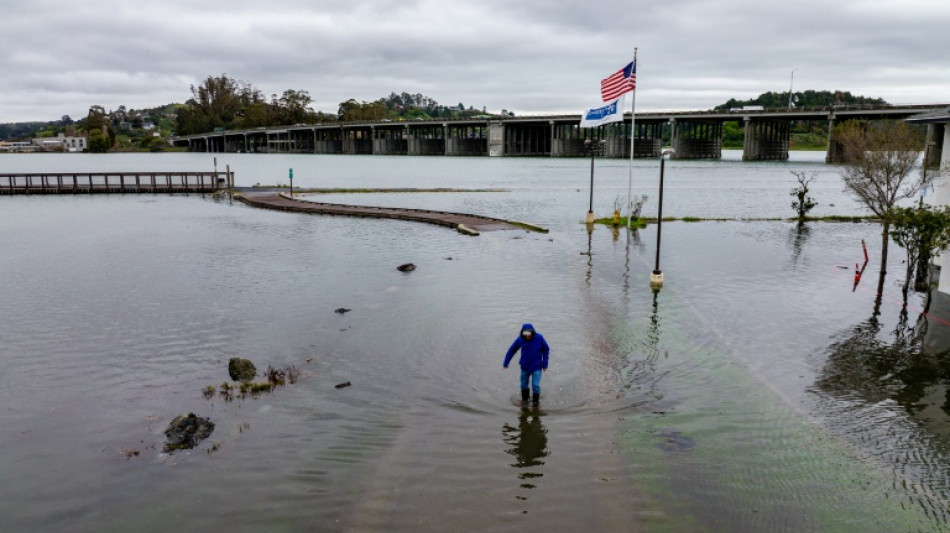
Climate change, population threaten 'staggering' US flood losses by 2050 / Photo: ©

 US judge weighing Trump's White House ban on media outlets

 At UN, OpenAI's Altman calls 'for extreme care' in AI

 Hamilton gives thumbs up to Gulf GPs despite Iran conflict

 Leclerc admits going 'too far' in Hamilton shunt in Italy

 Row engulfs Dolly Parton's estate as manager accuses nephew of making threats

 Mandela Digital Extends Early Access Programme to 11 February 2027 Following Strong Response

 US seeks 11th Presidents Cup win in a row over global foes

 McDonald's to boost franchisees as inflation weighs on consumers

 Trump invites Putin to G20 summit in Miami

 Archaelogical 'breakthrough' could confirm origins of Paris

 ILO financial crisis takes centre stage in leadership race

 Stocks dip, oil soars despite Trump hailing "productive" Iran talks

 China's Xi to get rare airport welcome from Trump

 Turkey reassures investors over investment fund crisis

 Saka says England still have 'scar' from World Cup semi-final loss

 アレックス・ボディ氏とシュテファン・ハウプト教授、ルーマニアの伝説的な美術コレクションをめぐり提携に合意

 亞歷克斯·博迪與史蒂芬·豪普特教授就羅馬尼亞傳奇藝術收藏達成合作協議

 Алекс Боди и проф. д-р Стефан Хаупт договорились о сотрудничестве в рамках легендарной коллекции произведений искусства в Румынии

 French foreign minister says Palestinians 'must' hold polls

 Fresh Russian strikes on Ukraine's infrastructure kill seven

 Eriksen to return to Denmark after parting ways with Wolfsburg

 Brad Pitt says working with dog co-star was 'really moving'

 Golan will remain Syrian, vows President al-Sharaa at UN

 Blueberry Strengthens MENA Presence with CMA Category 5 License and Dubai Office Launch

 Russia probes bear attacks, as official says town under 'siege'

Climate change is on track to ramp up the annual cost of US flood damage more than 25 percent by 2050, according to new research Monday that warns disadvantaged communities will likely bear the brunt of the financial burden.
The study published in the journal Nature Climate Change used new flood models to map out the present and future impact of sea level rise, tropical cyclones and changing weather patterns.
Losses include destruction projected to hit homes and businesses. Researchers warned that even more people are expected to move into areas at growing risk of inundation.
"Climate change combined with shifting populations present a double whammy of flood risk danger and the financial implications are staggering," said lead author Oliver Wing, of the University of Bath's Cabot Institute for the Environment.
Wing said the findings should be a "call to action" for both a reduction in emissions and efforts to adapt to accelerating climate risks "to reduce the devastating financial impact flooding wreaks on people's lives."
Researchers used nationwide property asset data, information on communities and flood projections to estimate flood risk across the US.
The study showed that poorer communities with a proportionally larger white population currently face the steepest losses.
But future growth in flood risk is expected to have a greater impact on African American communities on the Atlantic and Gulf coasts.
"The mapping clearly indicates Black communities will be disproportionately affected in a warming world, in addition to the poorer White communities which predominantly bear the historical risk," said Wing.
"Both of these findings are of significant concern."
- 'Unacceptable' risks -
Average annual flood losses were forecast to increase by 26.4 percent, from $32 billion currently, to $40.6 billion in 2050, based on 2021 dollar values.
The researchers said these figures are "essentially locked in climatically", meaning that even if emissions fall dramatically they would still be the same.
They also warned that expanding populations in the US would also significantly increase the flood risk, eclipsing even the impact of climate change.
With inundations expected to intensify in areas where populations are also increasing, the researchers said average annual exposure of the US population to floods is expected to grow to more than seven million by 2050, a 97-percent increase from current levels.
It said increases in climate-enhanced exposure was particularly concentrated along the US East Coast, with existing Texas and Florida residents seeing a roughly 50-percent increase in flood exposure by 2050.
In terms of increased flood risk due to population growth, the researchers highlighted intensified development on existing floodplains, which they said was "relatively severe in the currently sparsely populated central Prairie States and the Deep South".
The study said even developments currently considered low risk may be in areas expected to see a heightened flood risk in the coming decades.
"Current flood risk in western society is already unacceptably high, yet climate and population change threaten to inflate these losses significantly," said co-author Paul Bates, a professor of hydrology at the Cabot Institute for the Environment.
"The relatively short timescales over which this increase will take place mean we cannot rely on decarbonisation to reduce the risk so we have to adapt better, both to the situation now and for the future."
H.Seidel--BTB