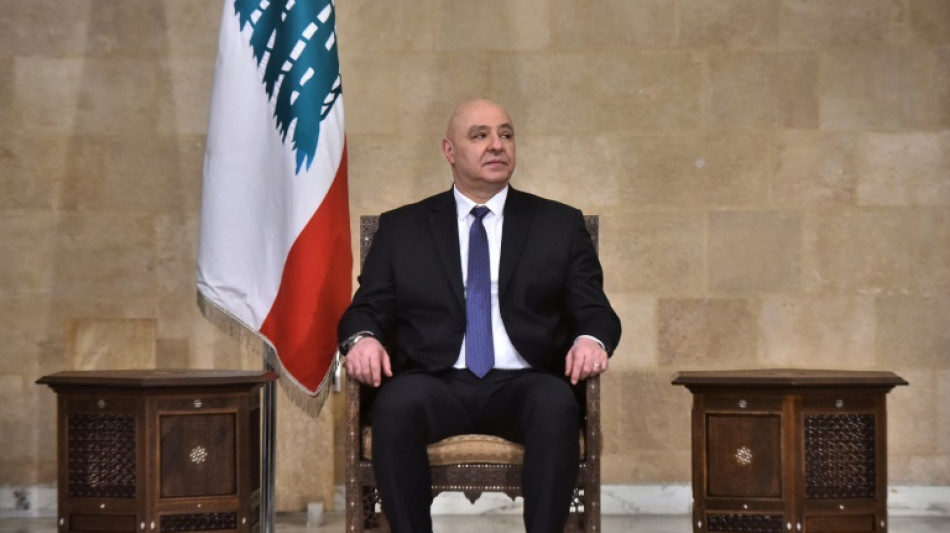
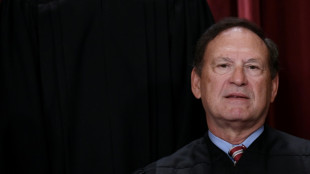
Lebanon's president names ICJ judge Nawaf Salam prime minister / Photo: © AFP

 Manchester City's Premier League charges: What comes next?

 Brazil's cellphone crime: a security nightmare in every pocket

 Russia pummels Kyiv in latest deadly attack

 NFL Giants obtain QB McCarthy from Vikings

 Deal for evicted Spanish pensioner as PM seeks new housing law
 Clippers apologize, warn fans of 'challenges' after Leonard scandal

 Turkish comedian convicted for Erdogan 'insult' freed pending appeal
 Trump announces 'biggest' US steel plant in battleground Iowa

 Olise wonder strike gives Zidane's France win in Belgium
 US stocks fall, bond yields rise as Middle East war drags on

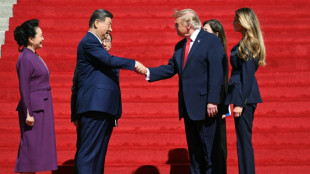
 Trump denies offering to sell arms to China's Xi
 Wemby ready for NBA Spurs to move rivals in climb to top
 Ukraine to postpone some spending amid delays in aid: PM
 Tuchel says Czech Republic game 'not yet a must-win'

 MaXhosa puts South Africa on the Paris fashion map

 Rose, Scott among 2027 World Golf Hall of Fame finalists
 Brunson says NBA champion Knicks can't get satisfaction

 France puts out largest wildfire since 1949

 Real Madrid's Perez summoned over Barcelona referee payments comments

 Oil takes off again, Wall Street dips after Trump rejects Iran truce offer

 AlgoQuant Asset Management Selects Liquid Mercury to Enhance Digital Asset Trading Infrastructure
 UK to reopen refugee resettlement scheme to push 'safe' migration

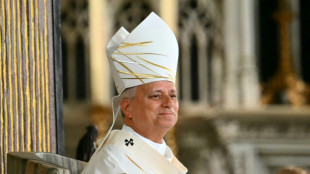 Pope urges Europe to help combat 'lies and deceit' in world affairs

 Iranian lawyer Nasrin Sotoudeh wins Council of Europe's rights prize
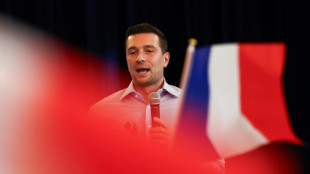 French far-right's Bardella denies alleged 2013 antisemitic comments

Lebanese President Joseph Aoun on Monday picked international jurist Nawaf Salam to form a government for the war-scarred country and pull it out of economic crisis.
A majority of Lebanese lawmakers endorsed Nawaf Salam, the presiding judge at the International Court of Justice in The Hague, after two years of caretaker government.
"The president of the republic called on Judge Nawaf Salam to task him with forming a government, knowing that he is currently abroad. It has been decided he will return tomorrow," the presidency said.
Aoun, whose election last week ended a two-year vacancy for the post, held consultations with lawmakers ahead of announcing his nominee.
By Monday afternoon, 84 members of parliament told Aoun they backed Salam, according to a tally by Lebanese media, with nine endorsing Najib Mikati who has served as prime minister in a caretaker capacity.
Aoun's election last week was made possible in part by the weakening of Iran-backed militant group Hezbollah in a war with Israel.
With the prime minister named by the president, the eastern Mediterranean country has been run by a caretaker government for more than two years amid a crushing economic crisis.
Under Lebanon's power-sharing system, the president must be a Maronite Christian, the prime minister a Sunni Muslim, and the parliament speaker a Shiite Muslim.
- 'Change' -
Salam's backers view the judge and former ambassador as an impartial figure able to carry out much-needed reforms, a contrast to Mikati regarded by critics as under Hezbollah's influence.
Lawmaker George Adwan of Christian party the Lebanese Forces said after meeting Aoun and endorsing Salam that it was time for Hezbollah to focus on "political work".
"The era of weapons is over," Adwan told reporters.
Hezbollah ended a deadly war against Israel this autumn bruised and weakened. Under a ceasefire deal, the group must pull its fighters from areas of southern Lebanon near the Israeli border as the national army -- until last week under Aoun's command -- and UN peacekeepers deploy there.
Hezbollah also lost a key ally in neighbouring Syria when Islamist-led forces toppled president Bashar al-Assad last month.
Independent lawmaker Melhem Khalaf said he backed Salam as a candidate of change.
A source close to Hezbollah had told AFP that the movement and its ally Amal movement supported Mikati.
The Monday front page of Al-Akhbar, a newspaper close to Hezbollah, said Salam's nomination would be tantamount to a "complete US coup", after Washington had backed Aoun for president.
- 'Two options' -
In his inaugural speech on Thursday, Aoun said his election as president would usher in a "new phase" for the country.
Lebanese university professor Ali Mrad said support for Salam's nomination reflected "the real changes that Lebanon is experiencing".
"Today there are two options in the country: a serious reform option, called Nawaf Salam, and an option that takes us back, called Najib Mikati," he said.
Some opposition lawmakers on Saturday threw their weight behind anti-Hezbollah lawmaker and businessman Fouad Makhzoumi, but on Monday he withdrew to allow consensus around Salam.
Whoever heads Lebanon's new government will face major challenges, including implementing reforms to satisfy international donors amid the country's worst economic crisis in its history.
They will also face the daunting task of reconstructing swathes of the country after the Israel-Hezbollah war and implementing the November 27 ceasefire agreement.
According to Lebanon's constitution, the president designates the prime minister after talks with all political parties and independent lawmakers in parliament. By convention, he chooses the candidate with the most votes during these consultations.
Nominating a premier does not guarantee a new government will be formed imminently.
The process has previously taken weeks or even months due to deep political divisions and horse-trading.
A.Gasser--BTB