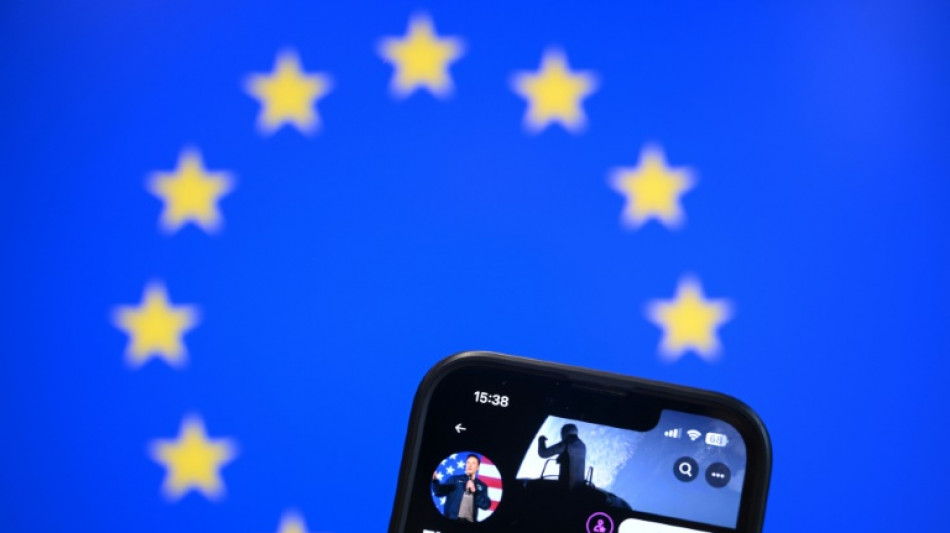
EU's legal weapon facing the heat from US big tech / Photo: © AFP/File

 Ruthless An makes history to retain Asian Games badminton crown

 Australian central bank lifts key interest rate to 15-year high

 Polo makes landfall in Mexico as Category 3 hurricane

 South Korea team latest to be bussed to wrong Asian Games venue

 Bears thrash Eagles 27-7 as third-string QB Keenum shines

 All Blacks name veteran Taylor captain as Mo'unga seizes 10 jersey

 Race against time as Asian Games cricket quarter-finals washed out

 India turns to corals and seagrass to shield against rising seas
 Manchester City's Premier League charges: What comes next?

 Brazil's cellphone crime: a security nightmare in every pocket
 Russia pummels Kyiv in latest deadly attack

 Akkodis and Biolevate Partner to Accelerate AI-Powered Scientific, Regulatory and Technical Documentation in Highly Regulated Industries
 Dodgers eye three-peat, Red Sox face Yankees as MLB playoffs begin

 Certification of Boeing 737 MAX delayed by software bug

 Celine Dion wows Paris Fashion Week with surprise gig
 AMD buys firm founded by AI 'godmother' Fei-Fei Li
 Italy rebound in Turkey as France win late in Belgium

 Pope says concerns about AI 'should be taken seriously'
 Hurricanes to hoist title banner as NHL season begins
 Justice Alito steps aside from major US climate case

 Willis happy with England exile after retains Top 14 player award

 Spain housing protests keep heat on government as PM seeks new law
 Wissa spoils Zimbabwe homecoming as DR Congo win AFCON qualifier

 UK police release on bail five men held over airbase incident

 Ex-All Black Plummer 'sure' New Zealand will find Super Rugby solution
For tech billionaires Elon Musk and Mark Zuckerberg, the EU's digital rules are a tool of censorship. For the bloc, they are its most powerful weapon to stop the spread of illegal content.
The rules, known as the Digital Services Act (DSA), will be debated in the European Parliament Tuesday, as dozens of lawmakers pile pressure on Brussels to enforce measures aimed at taming the worst excesses of social media.
But the law's detractors -- including hard-right members of the EU parliament itself -- support Musk and Zuckerberg's argument, and accuse Brussels of censoring free speech.
- Is the law a tool of censorship? -
The DSA does not define what is legal or illegal online in the European Union.
What it does is force digital companies, big and small, to ensure there is an effective system in place to report and remove content that breaches existing national or EU laws.
In other words, it makes sure that if it is forbidden in the real world, it is banned on the world wide web too.
For example, Nazi symbols are outlawed in Germany while several European countries including France and the Netherlands prohibit denying the Holocaust.
EU tech chief Henna Virkkunen categorically rejects the censorship charge.
"Free speech is a fundamental value of the EU. The aim of the DSA is the protection of fundamental rights," she said on X Saturday.
- Is fact-checking obligatory? -
The DSA does not force platforms to use fact-checking to moderate online content.
The EU does however support such initiatives, considering fact-checking to be a useful tool to combat misinformation and disinformation.
At the heart of the law is a requirement for companies to subdue the risks their platforms pose, for example to children and vulnerable adults.
When Zuckerberg announced the end of Meta's US fact-checking programme, he said he would turn to "Community Notes", like those used by Musk's social media platform X.
Rather than professional fact-checkers, this model hands over the duty of debunking falsehoods to ordinary users, who can add comments and links to posts.
It is not yet known if the EU believes this system complies with the law as European regulators are currently probing its effectiveness as part of an investigation into X launched in December 2023.
- Does the DSA cover foreign interference? -
Since his outbursts against European leaders and an online chat this month with German far-right party leader Alice Weidel, Musk has attracted concerns from dozens of EU lawmakers about his "interference" in Germany's elections.
Musk's actions are allowable under EU rules protecting freedom of speech.
But the world's biggest platforms have a duty to analyse what risks their systems pose for public debate and elections, and to take steps to reduce the dangers.
The EU last month opened an investigation into TikTok following allegations it was used by Russia to sway the result of Romania's later annulled presidential election.
There are also suspicions X's algorithms are boosting far-right messages, but proving such potential biases and their impact on elections is "very difficult", said Alexandre de Streel, an expert at the Centre on Regulation in Europe think tank.
European Commission head Ursula von der Leyen has indicated she would propose new rules that would counter foreign information manipulation and interference.
- Do platforms have to consider political balance? -
Although Musk's discussion with Weidel sparked concern over the US billionaire's influence on Europe, EU officials stressed he could do as he wanted since platforms do not have to give equal airtime to different groups, unlike television.
"Platforms are not seen as traditional media," said de Streel. "There is no neutrality rule."
Musk's use of X to boost Donald Trump and European far-right figures, however, now has regulators and EU politicians asking whether to toughen the current law and force platforms to comply with similar rules on political balance.
- Can the DSA ban social media? -
The law gives the EU the right to temporarily suspend any platform -- as a last resort -- if a breach of its rules "persists and causes serious harm to users and entails criminal offences involving threat to persons' life or safety".
Before it gets that far, there are many steps the EU can take to force a platform into line, including heavy financial penalties for violations.
EU regulators can slap fines of up to six percent of a service provider's annual global turnover, which would not always be limited to the platform itself.
For example, Brussels is examining whether any fine it may decide to impose on X would include other parts of Musk's business empire such as SpaceX or Neuralink.
P.Anderson--BTB