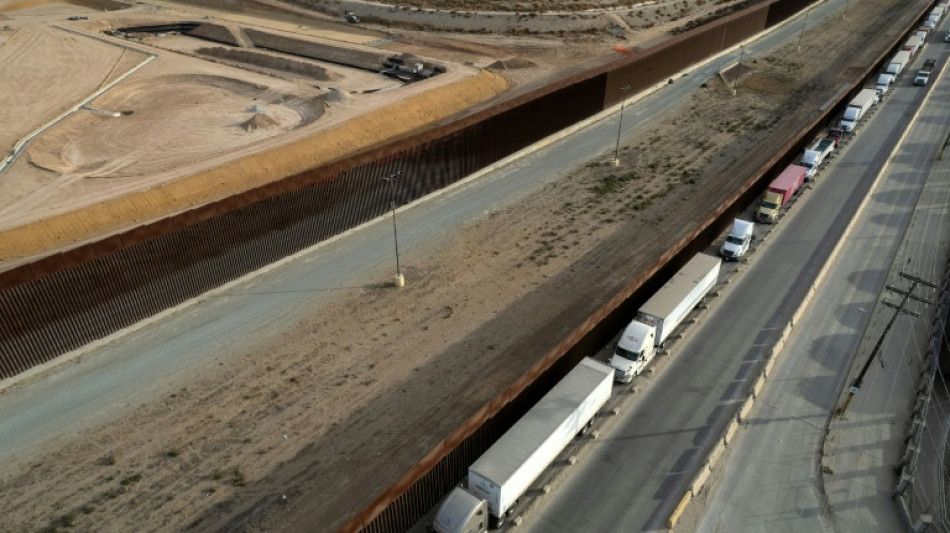
What would Trump tariffs mean for key trade partner Mexico? / Photo: © AFP/File

 Slovenia sees surge in '.si' sites after Trump hypes 'super intelligence'

 'Like a dream' for An as Games organisers 'sorry' for latest mix-up

 Tokyo suffers longest streak of rainy days on record

 Indonesia charges train driver over crash that killed 16 women

 Ruthless An makes history to retain Asian Games badminton crown

 Australian central bank lifts key interest rate to 15-year high

 Polo makes landfall in Mexico as Category 3 hurricane

 South Korea team latest to be bussed to wrong Asian Games venue

 Bears thrash Eagles 27-7 as third-string QB Keenum shines

 All Blacks name veteran Taylor captain as Mo'unga seizes 10 jersey

 Race against time as Asian Games cricket quarter-finals washed out

 India turns to corals and seagrass to shield against rising seas

 Manchester City's Premier League charges: What comes next?

 Brazil's cellphone crime: a security nightmare in every pocket

 Russia pummels Kyiv in latest deadly attack
 fiskaltrust launches e-invoicing across Europe

 NFL Giants obtain QB McCarthy from Vikings

 Deal for evicted Spanish pensioner as PM seeks new housing law

 Clippers apologize, warn fans of 'challenges' after Leonard scandal

 Turkish comedian convicted for Erdogan 'insult' freed pending appeal

 Trump announces 'biggest' US steel plant in battleground Iowa

 Olise wonder strike gives Zidane's France win in Belgium
 US stocks fall, bond yields rise as Middle East war drags on

 Trump denies offering to sell arms to China's Xi

 Wemby ready for NBA Spurs to move rivals in climb to top

US President Donald Trump has threatened to slap a 25-percent tariff on Mexican goods on February 1, a move that analysts say would deal a heavy blow to Latin America's second-largest economy.
Mexican President Claudia Sheinbaum called for "a cool head" in response to Trump's trade and other policy announcements.
What would be the implications for Mexico if its biggest trading partner imposes tariffs?
- Would tariffs tip Mexico into recession? -
Mexico's economy is "arguably the most vulnerable" to US trade protectionism, according to London-based consultancy firm Capital Economics.
Mexico replaced China in 2023 as the largest trading partner with the United States, which buys 83 percent of its exports.
The electronics and vehicle sectors would be particularly exposed to tariffs because half of their demand comes from the United States, Capital Economics said.
The vehicle sector alone generates five percent of Mexico's national economic output, it noted.
The two sectors are also "the ones where US security concerns are high about Chinese tech entering the country."
According to Oxford Economics, another advisory firm, US tariffs and expected Mexican retaliation would weaken the Mexican peso, drive up inflation and "could push Mexico into a technical recession."
Tourism, however, could benefit if a weaker peso makes vacations in Mexico more attractive, analysts said.
- What leverage does Mexico have? -
Trump said that he was thinking of enacting the tariffs on February 1 because of their failure to stop illegal immigration and drug trafficking into the United States.
His threats are aimed at "exerting pressure and trying to obtain concessions," according to former Mexican trade negotiator Kenneth Smith.
During his first term (2017-2021), Trump successfully used the threat of tariffs to pressure Mexico to reduce the number of Central American migrants arriving at the southern US border.
Arantza Alonso, an analyst at risk intelligence company Verisk Maplecroft, said that "by pushing back the imposition of tariffs until February 1, Trump is giving Mexico time to make concessions."
Capital Economics thinks that cooperation on tackling flows of migrants and drugs could "be an effective bargaining chip to stave off tariffs."
Buying more goods from the United States and fewer from China could also assuage the United States, it said.
Retaliatory agricultural tariffs that would hit Republican states like Texas, Nebraska, Iowa and the Dakotas in particular are another option, Alonso said.
- Is free trade deal dead? -
In theory, Mexico and Canada should be protected against US tariffs by a regional free trade agreement that was renegotiated under Trump.
"Imposing tariffs on all products violates the treaty," said Diego Marroquin, an international trade expert at the Wilson Center, a Washington-based think tank.
The United States-Mexico-Canada Agreement (USMCA), which replaced the previous NAFTA accord on July 1, 2020, is due to be reviewed by July next year.
"This review now looks poised to become more of a full-fledged renegotiation as President Donald Trump seeks to leverage the discussions to reshape North American trade, migration, and security, as well as address China's growing influence in regional supply chains," Council on Foreign Relations experts Shannon K. O'Neil and Julia Huesa wrote in a briefing note.
According to the Mexican political risk consultancy EMPRA, signs that Trump wants an early renegotiation suggest that he does not plan to kill the USMCA.
"Trump remains committed to securing more favorable terms for the US, particularly with regard to the automobile industry," it told clients.
Sheinbaum recently hailed the USMCA as "one of the best trade agreements in history" and "the only way we can compete with Asian countries, particularly China."
She presented a plan to replace Chinese imports with domestically produced goods -- an apparent bid to ease Washington's concerns that Chinese companies want to use Mexico as a backdoor into the United States.
S.Keller--BTB