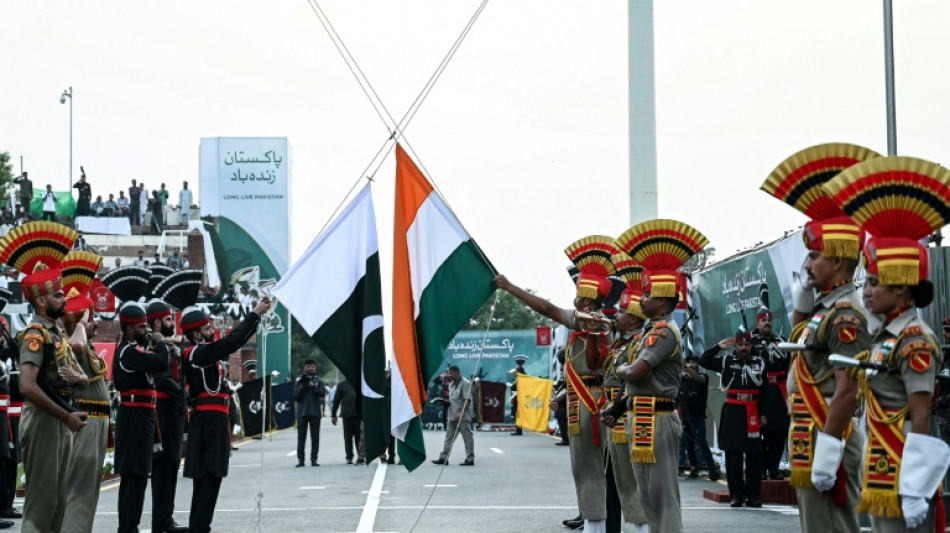
Old India-Pakistan rivalry drives South Asia diplomatic reshuffle / Photo: © AFP/File

 UN to hold fourth informal poll of secretary-general candidates
 Who are the Emiratis behind crisis-hit Manchester City?

 Singer Angelique Kidjo urges Africans to 'create together'

 Alleged Rihanna mansion shooter mentally fit for trial, says judge
 Mystery over UK airbase scare as police find petrol not explosives

 OpenAI unveils low-cost AI model, a day after shelving Astra upgrade
 Premier League confirms Man City guilty of serious financial breaches
 Brazil's Lula turns to Bad Bunny tune to criticise Trump ahead of polls

 Nigerian dancer eyes world record after seven-day marathon
 Swiss regulator concludes Julius Baer bank probe

 Brazil's patron saint pulled into latest election scrap

 Football overload leaves players near 'breaking point', warns Tebas
 Paris Eiffel Tower says chief to step down after uproar over removing women staff

 Amaze Holdings (NYSE: AMZE) Executes Binding LOI to Acquire BullionFX | Alchemy, a Decentralized Gold-Backed Financial Ecosystem for Valued at US$155 Million

 Clashes between French teens, police as school blockades intensify

 Stocks move sideways despite oil moving lower
 African leaders to gather in Egypt for business summit
 UK decides against charging foreign visitors for museums

 Dallaglio to sell England World Cup winners' medal

 Brazil come from behind to beat Australia 4-2 in friendly

 Ruthless An retains Asian Games badminton crown as Kunlavut triumphs

 Alonso to stay with F1 team Aston Martin in 2027
 China badminton 'still strong' despite Asian Games slump
 'Exceptional' Turner painting shown in Rome before sale
 European stocks climb as oil dips

Old rivalries between India and Pakistan are driving a shift in regional ties, with New Delhi courting Afghanistan's Taliban while Islamabad befriends the new leaders of post-revolutionary Bangladesh.
Diplomatic dynamics in South Asia are rooted in long-running distrust between the region's two most populous nations.
Nuclear-armed India and Pakistan -- carved out of the subcontinent at the chaotic end of British colonial rule in 1947 -- have fought multiple wars and remain bitter foes.
The rivalry shows no sign of abating, with New Delhi denying in January it had launched covert operations to kill anti-Indian militants on Pakistani soil.
"You can't have snakes in your backyard and expect them to only bite your neighbours," Indian Foreign Ministry spokesman Randhir Jaiswal told reporters in dismissing the allegations.
Relations between Afghanistan and Pakistan have also worsened since the Taliban returned to power in Kabul nearly four years ago.
Islamabad has accused Taliban authorities of failing to rein in militants they say are using Afghan territory to stage attacks that have killed thousands of Pakistani security personnel.
Pakistan launched deadly air strikes in Afghanistan border regions in December, with subsequent cross-border exchanges of fire.
The Taliban's austere interpretation of Islamic law seems at first glance an unlikely pairing for the Hindu nationalism of Prime Minister Narendra Modi, but India has nonetheless moved to exploit the opportunity.
"India has been pursuing this path quite consistently for quite some time," international relations professor Hassan Abbas of the National Defense University in Washington told AFP.
"They don't want the Taliban to give space to any group that is going to ultimately be a bigger threat to India," he said, adding that the prospect of "annoying Pakistan" was also appealing for New Delhi.
- 'Want to do more' -
India's top career diplomat, Vikram Misri, met with Taliban foreign minister Mawlawi Amir Khan Muttaqi in Dubai in January.
Jaiswal described the meeting as the "highest level of engagement" yet, adding that New Delhi was determined to "strengthen our longstanding relationship with the people of Afghanistan".
Muttaqi had in turn "expressed his hope for the expansion of relations", a spokesman for his ministry said.
Jaiswal said it was agreed at the meeting to "promote the use" of India's $370 million development of Iran's Chabahar container port "for supporting trade and commercial activities" to landlocked Afghanistan.
Chabahar is just west of Pakistan's Gwadar port, which is considered a cornerstone of the infrastructure expansion of China's Belt and Road Initiative in Pakistan.
India has long been wary of China's growing regional clout and the world's two most populous countries compete for influence in South Asia, despite a recent diplomatic thaw.
The Times of India said in an editorial after the Dubai meeting that New Delhi's "quiet yet deliberate engagement" with the Taliban was reshaping strategic regional ties.
"Despite not officially recognising the Taliban government, India understands the importance of maintaining a foothold in Afghanistan," the newspaper wrote.
"The move also aligns with India's broader regional strategy, which seeks to counter China's Belt and Road Initiative and its influence in neighbouring Pakistan," it said.
- 'Enemy of my enemy' -
At the same time, old enemies Pakistan and Bangladesh now speak of "friendly" ties.
Pakistan and Bangladesh were once one nation but split in a brutal 1971 war, with Bangladesh then drawing closer to India.
However, long-time Bangladeshi premier Sheikh Hasina was ousted in an August 2024 revolution, fleeing by helicopter to her old ally India, where she has defied Dhaka's extradition requests to face charges including mass murder.
Relations between India and Bangladesh's new government have been frosty since then, allowing Islamabad and Dhaka to slowly rebuild ties.
The first cargo ship in decades to sail directly from Pakistan to Bangladesh successfully unloaded its containers in the port of Chittagong in November.
Bangladesh's interim leader Muhammad Yunus also met with Pakistan's Prime Minister Shehbaz Sharif in December, saying he had "agreed to strengthen relations".
Top Bangladeshi army commanders later visited Pakistan, discussing training programmes and praising the "friendly relationship" between the nations.
Dhaka University professor Amena Mohsin told AFP that the sudden closeness reflected one of the oldest dictums in international diplomacy.
"The enemy of my enemy is my friend," she said.
burs-pjm-gle/pbt/mtp
W.Lapointe--BTB