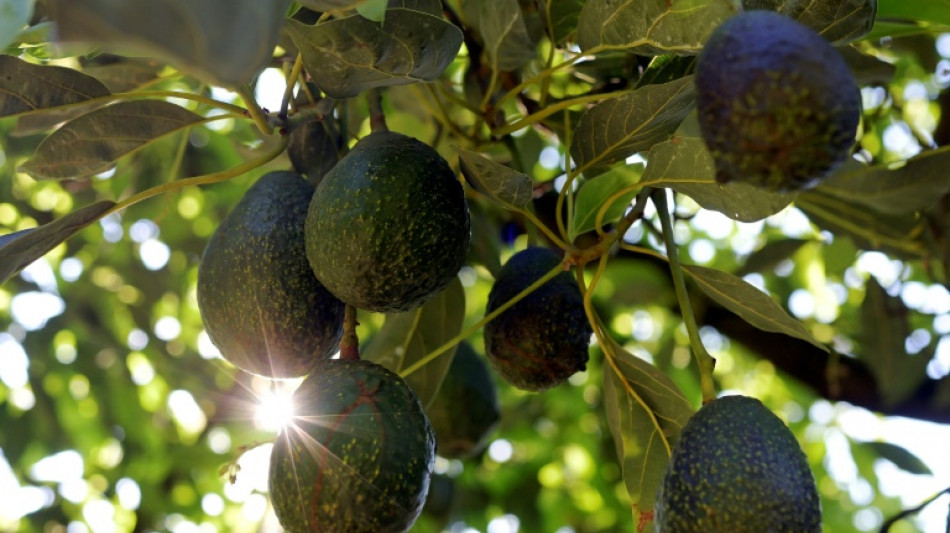
Despite Trump, Mexico avocado farmers see no end of Super Bowl demand / Photo: © AFP

 How to Watch the Rugby League World Cup Final on 7plus for Free

 Kayla Harrison Defeats Amanda Nunes via Submission at UFC 334
 GTA 6 Advertising Strategy and Disc Version Controversy

 From First Date to Wedding Day: How a TV Quote Sparked a Lifetime Commitment

 Malta Stuns Sweden with Late Penalty Comeback in Rugby Europe Trophy

 BingX: Major Announcement of Far-Reaching Significance

Despite Donald Trump's tariff threats, Mexican farmers working flat out to meet Super Bowl fans' appetite for guacamole believe that, as long as they keep growing avocados, people will keep buying them.
"In the end, the trees are here, the avocados are there, and the customer will either want them or not," said Agustin del Rio, a producer in the western state of Michoacan.
"Fortunately, they always do," the 49-year-old told AFP.
The farmers who harvest the fruit beloved for its creamy green flesh are no strangers to adversity.
Michoacan is one of Mexico's most dangerous states, and ultra-violent drug cartels battle for a share of its agricultural riches through robbery, kidnapping and extortion.
Trump's vow to impose 25-percent tariffs on Mexican goods -- he cites illegal migration and drug smuggling as his motive -- are another headache for the industry.
"Am I worried? Of course, just like anyone would be," Del Rio said in his orchard in Uruapan.
"How is it our fault? We're a bargaining chip," he added.
- Free trade in doubt -
Mexican avocado shipments are worth more than three billion dollars a year, with consumption in the United States set to peak on Sunday when the Kansas City Chiefs will take on the Philadelphia Eagles in New Orleans in the climax of the NFL season.
Trade between the neighboring countries has flourished under a North American free trade deal whose future has been plunged into uncertainty by Trump's tariff threats.
Michoacan -- which covers an area as big as Costa Rica -- will have exported some 110,000 tons of the fruit for the Super Bowl by the time it kicks off, according to Mexico's association of avocado producers and exporters.
It is the importers in the United States who would be responsible for paying the tariffs and most probably try to pass the extra cost on to the consumer.
For now, Trump has agreed to delay the levies for a month, until early March, after Mexico pledged to deploy 10,000 more troops to its border with the United States to combat drug and migrant flows.
As the Super Bowl approached, farmers were working at full capacity to meet demand.
Near Del Rio's orchard, dozens of employees packed avocados using a mechanized process allowing shipments to reach the border in one day.
Machines selected the fruits by size and quality before workers arranged them in cardboard boxes.
Some 150 tons of the fruit are processed daily at this location alone with the label: "Avocados from Mexico. The world's finest."
The boxes, which are kept in cold storage, have codes that allow the entire production chain to be tracked.
A sample is selected from each shipment to be checked by an inspector from the US Department of Agriculture.
In 2022, the United States briefly suspended avocado imports from Michoacan after one such inspector checking shipments before the Super Bowl received phone threats.
Industry sources said at the time that the incident was believed to be linked to attempts by some producers to surreptitiously export avocados from regions other than Michoacan to the United States.
Drivers of the trucks that transport avocados must also be vigilant for potential robberies.
For now, however, avocado farmers can at least breathe a sigh of relief that tariffs were avoided at their busiest time of the year.
And whatever the future holds, few expect demand for the fruit to wither away.
"It's a good product, a reliable product, a healthy product. So at a higher or lower price, they will sell -- I'm sure of it," Del Rio said.
L.Janezki--BTB