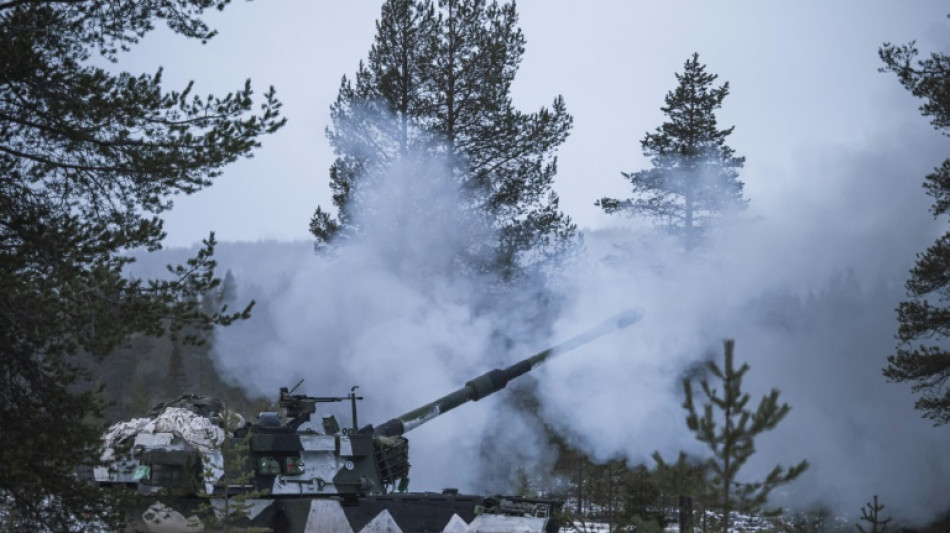
In NATO, the closer to Russia, the more spent on defence / Photo: © AFP/File

 Nagoya mayor says sorry for Asian Games 'inconveniences'
 G20 trade officials meet under shadow of tariffs, overcapacity

 India's fat dog vote goes viral
 Asian Games crowds in spotlight as 998 see hosts in 50,000 stadium
 The eight stadiums for the 2027 Rugby World Cup

 Thieves swipe drugs under nose of Fiji police, swap with flour
 South Korea demands North apologise for DMZ mine blasts
 In Nepal's flood zone, teachers mourn students who never returned

 US Supreme Court lifts limits on third-country deportations
 Antonelli eager to 're-establish order' as F1 returns to Malaysia

 Paw-fect candidate: Australia finds new koala rescue dog
 One third of world population exposed to harmful air pollution: monitor
 North Korea denies South's claim it was apparently behind DMZ mine blasts
 West Bank's violent settlers part of a new generation fuelled by ideology
 US-led coalition ends mission in Iraq
 Pope-backed White Sox join Braves with MLB playoff wins

 NBA close to picking new $12-13bn Vegas team owners: report
 LA28 Olympics torch relay to visit all 50 states
 Spain brush aside Croatia in Nations League, England down Czechs
 Trump hails 'morally binding' AI self-regulation pledge
 Yamal inspires Spain to Croatia romp on World Cup homecoming
 UN to hold fourth informal poll of secretary-general candidates
 Who are the Emiratis behind crisis-hit Manchester City?
 Singer Angelique Kidjo urges Africans to 'create together'
 Alleged Rihanna mansion shooter mentally fit for trial, says judge
While NATO countries living near the Russian border pay well over two percent of their GDP on defence, those further away pay less.
Twenty-two of the US-led defence alliance's 30 European members met the minimum target for military spending in 2024, but that differed from place to place.
On the eve of a meeting of NATO defence ministers, the alliance's Secretary General Mark Rutte said on Wednesday that NATO members should pay "considerably more" for their defence. US President Donald Trump has demanded an increase to five percent of national output.
Poland led the pack in 2024, with a marked increase in its defence spending since Russia's invasion of Ukraine nearly three years ago.
Its spending grew from 1.88 percent of GDP in 2014 to 2.23 percent in 2022, 3.26 percent in 2023 and 4.12 percent in 2024.
Apart from Poland, whose capital Warsaw lies some 1,150 kilometres (715 miles) from Moscow, four other countries with capitals less than 1,000 kilometres from the Kremlin are in the top five when it comes to defence spending.
Estonia (3.43 percent), Latvia (3.15 percent), Lithuania (2.85 percent) and Finland (2.41 percent) all share a border with Russia.
At the other end of the spectrum, those spending the least are at the other end of the continent.
In the case of Spain, which spent just 1.28 percent on defence in 2024, its capital Madrid lies 3,450 kilometres from Moscow.
On average those lying 1,000 kilometres from Moscow spend 0.6 percentage points more, according to an AFP count based on NATO figures.
Overall, the 32 NATO members devote $1.474 billion to their defence.
Of that $476 billion comes from European countries, just under half the $968 billion spent by the United States.
Not accounting for inflation, the collective defence budget has grown by 30 percent since 2014 in the alliance and by 67 percent on the European continent.
- Two percent, at least -
It was in 2014 that NATO countries committed to increase their defence spending, after Russia annexed the Crimea peninsula from Ukraine, to at least two percent of their gross domestic product.
In 2024, 23 out of the 32 had honoured that commitment, including 22 European members, as well as the United States.
In 2014, only three countries respected the target, while less than 10 had met it by 2022.
Several countries have called for the target to be increased.
Trump, who accuses the other alliance members of not doing enough to ensure their own protection, has even spoken of five percent.
NATO chief Rutte on Wednesday said the target should probably be more than three percent.
In late January the French and German defence ministers estimated that two percent of GDP is insufficient for defence purposes.
The two countries, the biggest European contributors in absolute figures, devote respectively $97.7 and $64.3 billion to their defence.
Lithuania has floated a target of three percent for the alliance.
Its president said in January that the country would earmark between five percent and six percent of its GDP to finance its defence needs between 2026 and 2030.
G.Schulte--BTB