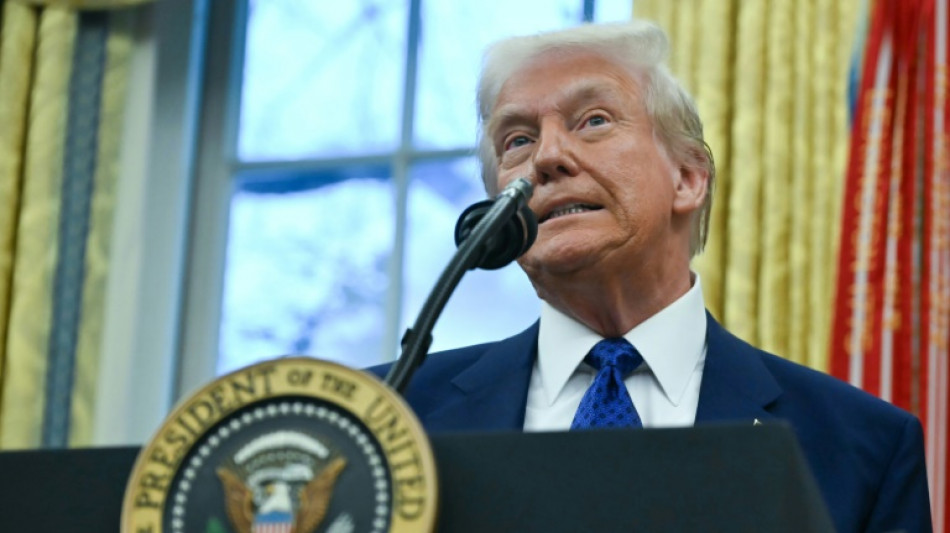
President Trump says US 'reciprocal tariffs' to be announced Thursday / Photo: © AFP

 Nagoya mayor says sorry for Asian Games 'inconveniences'
 G20 trade officials meet under shadow of tariffs, overcapacity

 India's fat dog vote goes viral
 Asian Games crowds in spotlight as 998 see hosts in 50,000 stadium

 The eight stadiums for the 2027 Rugby World Cup

 Thieves swipe drugs under nose of Fiji police, swap with flour

 South Korea demands North apologise for DMZ mine blasts

 In Nepal's flood zone, teachers mourn students who never returned

 US Supreme Court lifts limits on third-country deportations

 Antonelli eager to 're-establish order' as F1 returns to Malaysia

 Paw-fect candidate: Australia finds new koala rescue dog

 One third of world population exposed to harmful air pollution: monitor

 North Korea denies South's claim it was apparently behind DMZ mine blasts

 West Bank's violent settlers part of a new generation fuelled by ideology

 US-led coalition ends mission in Iraq

 Pope-backed White Sox join Braves with MLB playoff wins

 NBA close to picking new $12-13bn Vegas team owners: report

 LA28 Olympics torch relay to visit all 50 states
 Spain brush aside Croatia in Nations League, England down Czechs
 Trump hails 'morally binding' AI self-regulation pledge
 Yamal inspires Spain to Croatia romp on World Cup homecoming

 UN to hold fourth informal poll of secretary-general candidates

 Who are the Emiratis behind crisis-hit Manchester City?

 Singer Angelique Kidjo urges Africans to 'create together'

 Alleged Rihanna mansion shooter mentally fit for trial, says judge
US President Donald Trump said that he would announce "reciprocal tariffs" on trading partners Thursday, opening new fronts in a trade war economists warn could fuel inflation at home.
Trump has announced a broad range of tariffs targeting some of the United States' biggest trading partners since taking office, arguing that it would help tackle unfair practices -- and in some cases using the threats as a way to influence policy.
He has referred to tariffs as a way to raise revenue, remedy trade imbalances and pressure countries to act on US concerns.
On Thursday, the president said he would hold a news conference on reciprocal tariffs at the White House at 1:00 pm local time (1800 GMT).
"Three great weeks, perhaps the best ever, but today is the big one: reciprocal tariffs!!! Make America great again!!!" Trump wrote in all capital letters on his Truth Social platform.
The move is expected to match the United States' tariff rates on imports to levels that other countries impose on US goods.
Trump's announcement came hours before he was due to meet Indian Prime Minister Narendra Modi in Washington.
Analysts have warned that reciprocal duties could bring a broad tariff hike to emerging market economies such as India and Thailand, which tend to have higher effective tariff rates on US products.
Countries such as South Korea that have trade deals with Washington are less at risk from this move, analysts believe.
- Inflation concerns -
Cost-of-living pressures were a key issue in the November election that saw Trump sweep to power, and the Republican has promised to swiftly reduce prices.
But economists warn that his broad-ranging tariffs on US imports would likely boost inflation, not reduce it, in the near term and could weigh on growth eventually.
Trump's nominee for commerce secretary Howard Lutnick, however, has pushed back on the idea that duties would cause widespread inflation, even as certain costs might rise.
During election campaigning, Trump promised: "An eye for an eye, a tariff for a tariff, same exact amount."
For example, if India imposes a 25-percent tariff on US autos, Washington will have a 25-percent tariff as well on imports of autos from India, explained a Nomura report this week.
Modi will hold talks with Trump at the White House on Thursday and New Delhi offered some quick tariff concessions ahead of his visit, including on high-end motorcycles.
"Trump's objective of implementing reciprocal tariffs is to ensure fair treatment for US exports, which could indirectly also address US trade imbalances with partner countries," analysts at Nomura said.
Among Asian economies, India has a 9.5-percent weighted average effective tariff on US exports, while there is a three-percent rate on India's exports to the United States.
Thailand has a 6.2-percent rate and China a 7.1-percent rate on US products, Nomura noted.
Higher tariffs are often imposed by poorer countries, who use them as a tool for revenue and protection because they have fewer resources to impose non-tariff barriers such as regulatory protectionism, Cato Institute's Scott Lincicome earlier told AFP.
It remains unclear if Trump views reciprocal tariffs as an alternative to a universal tariff of between 10 and 20 percent, which he floated in the lead-up to last year's presidential election, or as a separate policy.
D.Schneider--BTB