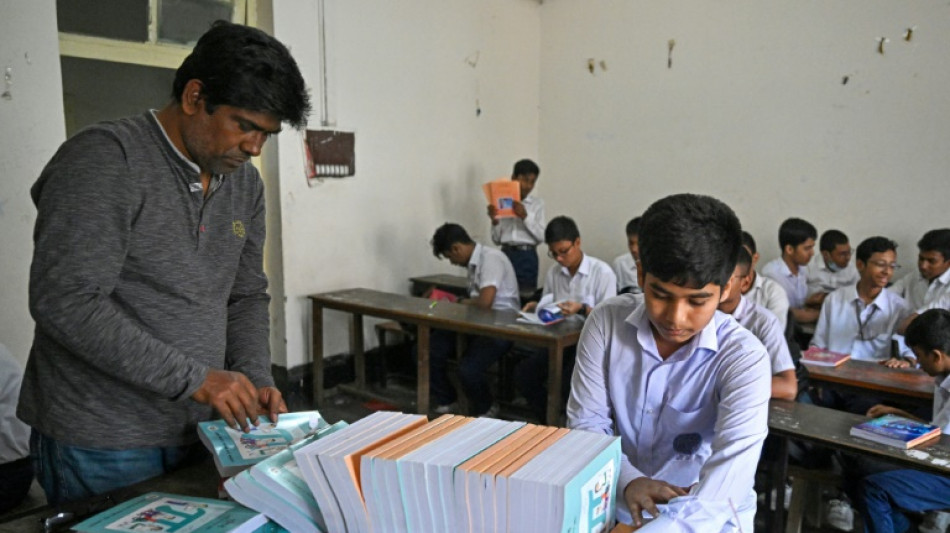
After revolution, Bangladesh textbooks rewrite history / Photo: © AFP

 Nagoya mayor says sorry for Asian Games 'inconveniences'
 G20 trade officials meet under shadow of tariffs, overcapacity

 India's fat dog vote goes viral
 Asian Games crowds in spotlight as 998 see hosts in 50,000 stadium

 The eight stadiums for the 2027 Rugby World Cup

 Thieves swipe drugs under nose of Fiji police, swap with flour
 South Korea demands North apologise for DMZ mine blasts
 In Nepal's flood zone, teachers mourn students who never returned

 US Supreme Court lifts limits on third-country deportations

 Antonelli eager to 're-establish order' as F1 returns to Malaysia

 Paw-fect candidate: Australia finds new koala rescue dog
 One third of world population exposed to harmful air pollution: monitor

 North Korea denies South's claim it was apparently behind DMZ mine blasts

 West Bank's violent settlers part of a new generation fuelled by ideology

 US-led coalition ends mission in Iraq
 Pope-backed White Sox join Braves with MLB playoff wins

 NBA close to picking new $12-13bn Vegas team owners: report
 LA28 Olympics torch relay to visit all 50 states
 Spain brush aside Croatia in Nations League, England down Czechs

 Trump hails 'morally binding' AI self-regulation pledge
 Yamal inspires Spain to Croatia romp on World Cup homecoming

 UN to hold fourth informal poll of secretary-general candidates
 Who are the Emiratis behind crisis-hit Manchester City?

 Singer Angelique Kidjo urges Africans to 'create together'

 Alleged Rihanna mansion shooter mentally fit for trial, says judge
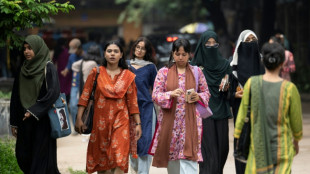
Bangladeshi high schooler Laiba is being educated for the future, but what she learns has been determined by the latest chapter in her country's battle over its past.
Last year, a student-led revolution overthrew the government of iron-fisted premier Sheikh Hasina when public anger over her increasingly autocratic rule boiled over.
Her ouster has prompted Bangladesh to do something that has followed every sudden change in national leadership: rewrite its history books to suit new orthodoxies.
"The tradition of altering history must stop at some point -- the sooner, the better," Laiba's mother Suraiya Akhtar Jahan told AFP.
"Textbooks should not change every time a new government takes office."
Radical changes to the school curriculum are routine in Bangladesh, where febrile political divisions dating back to its ruinous 1971 independence war against Pakistan have persisted.
Until this year, textbooks gave special exaltation to the country's first president Sheikh Mujibur Rahman for spearheading that liberation struggle.
But Mujib, assassinated in 1975 in a military coup, is also Hasina's father, and his daughter's disgrace and exile has dented the late leader's stature.
"The books had turned into one side's political manifesto," AKM Riazul Hassan, head of the national agency tasked with reforming the curriculum, told AFP.
"That does not conform to the purpose of textbooks. We tried to get them back on track."
New history books have expunged dozens of poems, speeches and articles penned by Mujib, alongside images of his daughter.
They instead now valorise the hundreds of people killed in the protests that ultimately toppled Hasina last summer, while bringing back from exile other previously erased heroes of Bangladesh's early history.
Among them is former army chief Ziaur Rahman -- no relation to Mujib -- credited with issuing the first public proclamation of Bangladesh's independence during the 1971 war.
Zia had been left out of the curriculum during Hasina's time because he founded the Bangladesh Nationalist Party (BNP), her chief opposition.
His return to the page augurs the resurgence of the political force he created, which is strongly favoured to win elections expected by next year.
- 'Endless cycle' -
While the overhaul of Bangladesh's official history gives clues as to the country's future direction, critics say the new curriculum has its own litany of omissions.
Of particular contention is one of the country's darkest chapters -- the murderous purge of its intellectual elite in the opening days of the 1971 war.
Bangladesh's main Islamist party Jamaat-e-Islami, which at the time opposed the country's independence, helped orchestrate these killings in concert with Pakistani forces.
Revised textbooks mention that militia groups were responsible for the murders, without mentioning that the militias were run by Jamaat.
The omission is significant because Jamaat -- another party suppressed by Hasina's government -- is likely to be a major force in Bangladesh's next parliament, and has governed in the past in coalition with the BNP.
Dhaka University professor Mujibur Rahman -- no relation to the independence leader -- told AFP that the apparently deliberate attempt to obscure details around the purge raised questions about the reasons behind the changes.
"The real question is whether this interim government wants students to learn the actual history," he added.
Asked about the changes, Hassan said that the textbook commission he helms did not want to trap the nation's youth "in an endless cycle of hatred".
"At some point, we need to start reconciliation," he added. "Should we make our textbooks flooded with hatred? How rational would it be?"
- 'Minimise their anxiety' -
Other signs suggest the new textbooks have conceded several changes to hardline religious sentiment in the Muslim-majority nation.
Hasina's government, for all its other shortcomings on rights issues, was lauded for championing the rights of Bangladesh's transgender community.
The new textbooks excise references to transgender Bangladeshis, a demand long held by Islamist groups.
Hassan acknowledged that the decision had been taken following objections from a Muslim group campaigning against representations of transgender issues in the curriculum.
"We took their concerns into account," he said, "and made adjustments accordingly to minimise their anxiety."
K.Brown--BTB