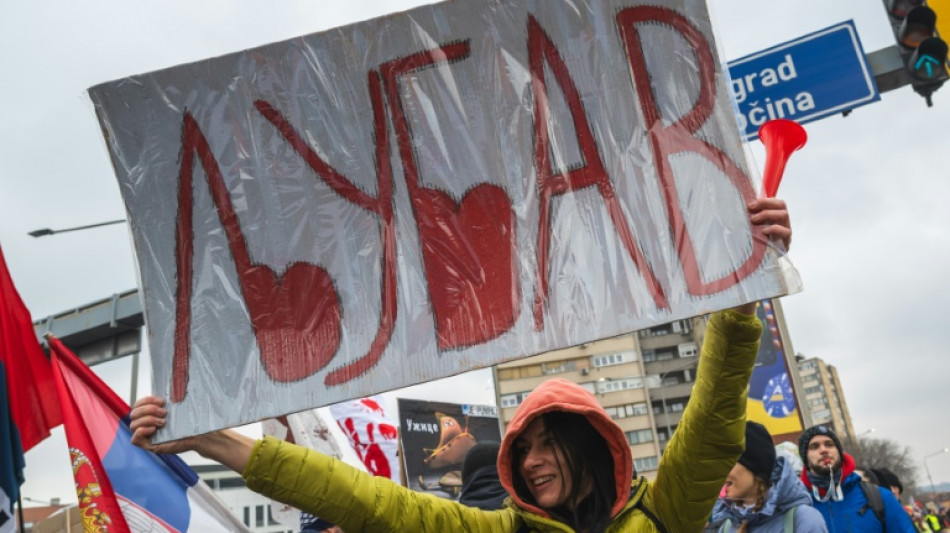
Thousands mark Serbian Statehood Day with anti-corruption protest / Photo: © AFP

 How to Watch the Rugby League World Cup Final on 7plus for Free

 Kayla Harrison Defeats Amanda Nunes via Submission at UFC 334

 GTA 6 Advertising Strategy and Disc Version Controversy

 From First Date to Wedding Day: How a TV Quote Sparked a Lifetime Commitment
 Malta Stuns Sweden with Late Penalty Comeback in Rugby Europe Trophy

 BingX: Major Announcement of Far-Reaching Significance

 Élan Opens as Late-Night Wine Bar in Honolulu

Thousands of Serbians blocked the main boulevard of the central city Kragujevac on Saturday, the latest in a series of student-led protests to rock the Balkan country after the deadly collapse of a train station roof.
Crowds gathered in the city's centre on the start of Serbia's national Statehood holiday calling for greater government accountability and reforms.
Protesters filled the streets well into the afternoon, waving flags marked with bloody handprints -- the protests' logo -- as they organised performances and shouted "pump", indicating that they are not giving up.
The university student-led movement has put increasing pressure on Serbia's government, spurring the resignation of several high-ranking officials, including prime minister Milos Vucevic at the end of January.
The collapse of the station roof in Novi Sad in November last year, which killed 15 people, followed extensive renovations to the building in the northern city and fuelled long-standing anger over corruption and demands for accountability.
The Kragujevac blockade is the third day-long city demonstration, after Belgrade and Novi Sad a few weeks ago.
At 10:52 GMT, the time of the tragedy, protesters observed 15 minutes of silence to honour the victims.
In one part of the boulevard, 15 chairs with the names and year of birth of the victims were placed where citizens laid flowers, while climbers hung a banner on the top of a 15-storey building saying: 15 lives, 15 hours of protest, 15 weeks without accountability.
The blockade is planned to last past midnight, also marking the anniversary of the first Serbian Constitution in 1835, one of the most progressive in Europe at the time, with students calling on institutions to uphold constitutional principles.
- Support from professors -
Belgrade chemistry student Nikola Knezevic, 25, said it was important to hold protests beyond the capital.
"To show not only Belgrade, but all these cities that support our demands, and that we support them. That is the message," Knezevic said.
Dragana Mitic, 55, a professor from the same faculty, hailed the students for "fighting against corruption".
"They have rekindled my hope. We tried 25 years ago, but the system deceived us. Now we hope that won't happen," he told AFP.
To quell the months-long protests, the government has sought to meet several of the students' demands.
President Aleksandar Vucic, at a rally in the northern town of Sremska Mitrovica, told thousands of his supporters the country was being attacked from the outside "helped by many inside who manipulate our children".
He urged the protesters to engage in dialogue and to listen to him.
"Declare victory, you have had all your demands met, return to your benches," he said.
"That would be best you have done for your parents, for your country, but also for yourselves, and for your future families."
They were welcomed with fireworks, whistles and vuvuzelas, and chants of "Bravo" and "Serbia has risen".
"We are sending a message that this is a meeting with the people, with history and with the future that we are now building," Milica Pavlovic, a 20-year-old electrical engineering student told AFP after completing the 130-kilometre route (80-mile) route from Belgrade.
C.Kovalenko--BTB