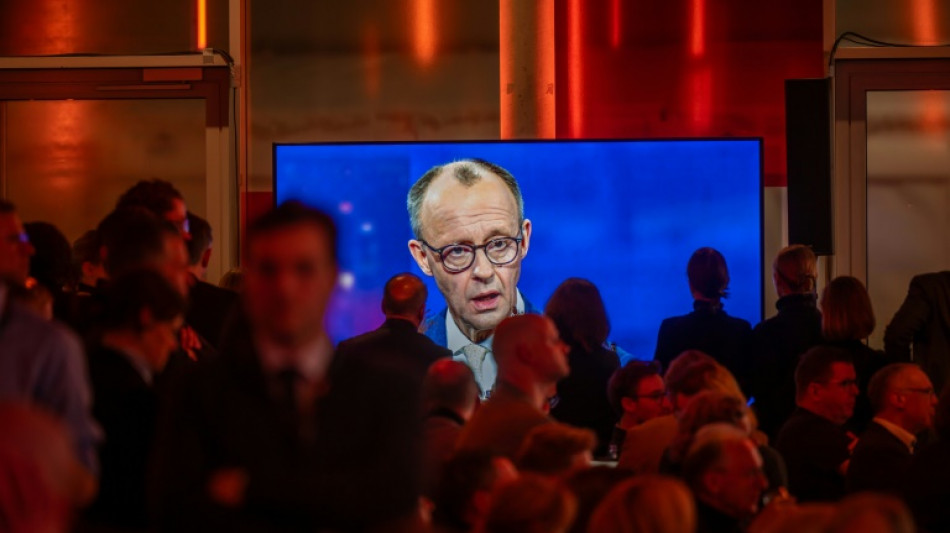
US tensions add fire to final stretch of German election campaign / Photo: © POOL/AFP

 How to Watch the Rugby League World Cup Final on 7plus for Free

 Kayla Harrison Defeats Amanda Nunes via Submission at UFC 334

 GTA 6 Advertising Strategy and Disc Version Controversy

 From First Date to Wedding Day: How a TV Quote Sparked a Lifetime Commitment
 Malta Stuns Sweden with Late Penalty Comeback in Rugby Europe Trophy

 BingX: Major Announcement of Far-Reaching Significance
 Élan Opens as Late-Night Wine Bar in Honolulu

Germany entered the final week of election campaigning Monday, with the debate more heated than ever after the Trump administration weighed in with backing for the anti-immigration far-right AfD party.
US Vice President JD Vance and tech billionaire Elon Musk, a Trump ally, have voiced support for the Alternative for Germany (AfD) party, which is polling at a record 20 percent.
All other parties have vowed a "firewall" on non-cooperation with the AfD, and tens of thousands again protested against the party at the weekend -- but Vance said Friday in a combative speech in Munich that there was "no room for firewalls".
His blistering comments, in which he also accused EU governments of stifling free speech, became a major topic in the latest TV debate between the four top candidates in the February 23 election.
"I will not allow an American vice president to tell me who I can talk to here in Germany," said Friedrich Merz whose conservative CDU/CSU is leading the polls on around 30 percent.
Merz told voters he would "not tolerate such interference" in the polls or in any subsequent coalition negotiations.
Centre-left Chancellor Olaf Scholz also rejected Vance's comments as "unacceptable" and asserted there is "no cooperation with the extreme right".
But the AfD's top candidate Alice Weidel praised Vance for having "spoken out so clearly".
"We must not build firewalls to exclude millions of voters from the outset," she told the TV audience. "We have to talk to each other. He made that clear."
- 'No knock-out blow' -
Merz called the AfD "a radical right-wing party", a view shared by Scholz and Habeck, but Weidel told her political foes that by insulting her "you are insulting millions of voters".
News outlet Der Spiegel said the evening was "a complete success" for Weidel despite her "theatrically cold manner" because her very presence among the top four candidates "gives the impression that the AfD belongs there and is a party like any other".
In Sunday's debate, Merz was declared the winner by 32 percent of respondents in a poll by the RTL broadcaster, and Scholz by 25 percent.
Weidel -- the first AfD politician to feature in such a debate -- found favour with 18 percent of viewers. She tied with Robert Habeck of the Greens.
"None of the candidates landed a knockout blow," the head of polling firm INSA, Herrmann Binkert, told Bild daily.
The debate was unlikely to produce any "big changes", Binkert said, as Merz's polling lead looks set to hold firm.
- Migration, Ukraine -
In the final stretch of the campaign, the candidates are fighting for every last vote, with around 30 percent still undecided according to latest surveys.
The vote is being held six months earlier than planned after Scholz's centre-left coalition collapsed in November in a row over budget questions.
The campaign has been dominated by the dire state of the economy and a bitter debate on migration after a series of attacks blamed on asylum seekers.
Most recently, a two-year-old girl and her mother were killed in a car-ramming attack in Munich last week that left 37 others wounded, blamed on an Afghan suspect.
The campaign's final stage gets underway as Europe confronts a growing rift with Washington over the Ukraine war, now raging for almost three years.
Trump has sidelined European leaders by directly calling his Russian counterpart Vladimir Putin to discuss how to end the conflict, with their top diplomats due to meet in Saudi Arabia.
Like other European leaders, Scholz said in the TV debate that Europe must be involved in any talks "because it cannot be done without us".
He added that "no decisions will be made over its (Kyiv's) head –- we Europeans will not allow that".
Habeck accused the Trump administration of "a frontal attack on the Western community of values".
L.Janezki--BTB