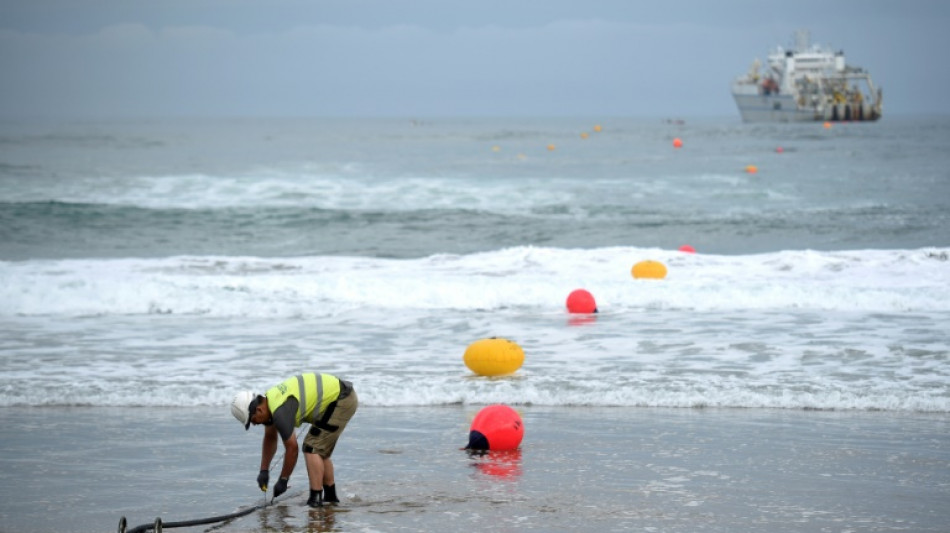
Fishing trawlers, not sabotage, behind most undersea cable damage: UN / Photo: © AFP/File

 South Korea break China hearts to reach Asian Games football final
 Eala storms into Asian Games semi-finals to thrill adoring fans

 Turkey freezes ex-minister's assets as fund crisis grows

 What we know about the North Korean POW dispute
 Most equities rise after oil price plunge, US data in focus
 Polar oceans transformed as warming melts ice habitats: research

 Lost shark becomes viral star in South Korea
 Dangote to launch $16bn refinery in Kenya
 North Korean leader 'extremely obese': Seoul spy agency
 Yankees and pope-backed White Sox start MLB playoffs with wins
 Malaysia's ex-PM Mahathir in hospital for observation
 'No limits': Marathon world record holder Sawe chasing history
 Countdown begins to biggest-ever Rugby World Cup
 Bangladesh women lose ground after quota reform
 Vietnam admits 'differing opinions' on Hanoi development
 Stocks temper gains as oil pares heavy losses, US data in focus
 New Zealand denies breaching climate commitments to EU
 Albert becomes youngest US scorer in 4-2 win over Chile
 Pirate island's plunging population shows Greece's demographic decline
 With elections ahead, Latvia's Russian-speakers reject Moscow's help
 Brazil football clubs face massive sponsorship blow from betting ban
 ChatGPT maker wants to be the App Store for AI as safety concerns grow

 Women fight fires and sexism in Indonesian Borneo

 Forsling's OT blast lifts Florida over Carolina in NHL opener

 Hurricane Polo sweeps over Mexico's Pacific coast, heads inland
Much has been written about suspected sabotage of undersea cables in the Baltic Sea, but the UN says fishing trawlers are causing the most damage by far, rather than spies.
Western officials have accused Russian vessels of sabotaging undersea communications and power cables in several high-profile incidents in the Baltic Sea in recent months.
European leaders and experts suspect acts of "hybrid warfare" against Western countries supporting Ukraine, and are calling for increased maritime security.
"The fact that interest in cable resiliency obviously has increased ... shows the importance of (this) infrastructure that we are so dependent on," Tomas Lamanauskas, the deputy head of the United Nations' International Telecommunications Union (ITU), told AFP in an interview.
The laying and operation of underwater cables was long the preserve of a consortium of large telecoms operators, but the internet giants have largely taken over in recent years, as they strive to keep up with ballooning flows of data.
Today, submarine cables form the backbone of global communications, carrying approximately 99 percent of the world's internet traffic, Lamanauskas said, pointing out that even when traffic goes through satellites, it is bounced to land stations and goes through underwater cables "to reach every corner of the Earth".
About 1.4 million kilometres (nearly 900,000 miles) of fiberoptic cables are laid on the ocean floor, enabling the provision of essential services such as trade, financial transactions, public services, digital health and education around the world.
- Frequent outages -
Damage to submarine cables is not uncommon.
According to the International Cable Protection Committee (ICPC), there are an average of 150 to 200 outages per year worldwide, or around three incidents a week.
But while suspected nefarious activities have been in the headlines, Lamanauskas stressed that fishing and anchoring is responsible for 80 percent of all recorded damage.
There are also natural hazards, ageing, abrasions and equipment failures, he added.
Given the growing importance of such cables, "every incident and every cut of the cable is much more noticeable", Lamanauskas said.
And while the undersea cable network is vast, there are actually only around 500 individual cables in the world, meaning that "even when a few of those are cut or ... damaged, the impact" is huge, Lamanauskas said.
That was certainly the case when three submarine cables carrying about a quarter of all internet traffic between Asia and Europe were cut last year in the Red Sea, or when a huge volcanic eruption severed the cable linking the Tonga archipelago to the rest of the world, he said.
Lamanauskas also highlighted last year's "important cable cut on the West African coast, (which) really impacted quite a bit of economies" in the region.
It was after that incident that Nigerian Communications Minister Bosun Tijani approached the UN's ITU telecoms agency to figure out "what can we do together on that", he said.
- 'Cohabitation rules' -
In a bid to increase cable resilience, the UN is pushing for the international community to increase cooperation in this highly sensitive sector.
The ITU and ICPC have set up a group of specialists tasked with developing solutions, who will meet for the first time from February 26 to 27 in Nigeria.
Lamanauskas said there were clearly a number of solutions for improving cable security and resilience.
There was a need for better protection of the cables, he said, but also for faster repairs of damaged cables.
More cables should also be laid in isolated areas, allowing data to be more easily redirected in the event of a cut.
Lamanauskas also insisted on the need for strict "cohabitation rules", to avoid cable cuts by fishing trawlers or other ships that drop anchors on the seabed.
D.Schneider--BTB