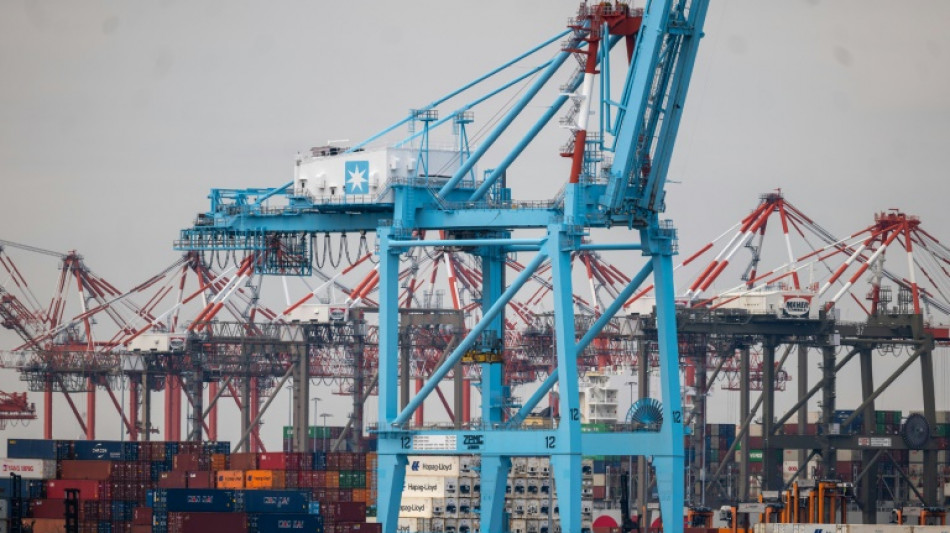
Trump auto tariff threat prompts pushback in Germany / Photo: © GETTY IMAGES NORTH AMERICA/AFP/File

 South Korea break China hearts to reach Asian Games football final
 Eala storms into Asian Games semi-finals to thrill adoring fans

 Turkey freezes ex-minister's assets as fund crisis grows
 What we know about the North Korean POW dispute

 Most equities rise after oil price plunge, US data in focus
 Polar oceans transformed as warming melts ice habitats: research

 Lost shark becomes viral star in South Korea

 Dangote to launch $16bn refinery in Kenya

 North Korean leader 'extremely obese': Seoul spy agency
 Yankees and pope-backed White Sox start MLB playoffs with wins

 Malaysia's ex-PM Mahathir in hospital for observation
 'No limits': Marathon world record holder Sawe chasing history

 Countdown begins to biggest-ever Rugby World Cup
 Bangladesh women lose ground after quota reform
 Vietnam admits 'differing opinions' on Hanoi development

 Stocks temper gains as oil pares heavy losses, US data in focus
 New Zealand denies breaching climate commitments to EU
 Albert becomes youngest US scorer in 4-2 win over Chile
 Pirate island's plunging population shows Greece's demographic decline

 With elections ahead, Latvia's Russian-speakers reject Moscow's help
 Brazil football clubs face massive sponsorship blow from betting ban

 ChatGPT maker wants to be the App Store for AI as safety concerns grow

 Women fight fires and sexism in Indonesian Borneo

 Forsling's OT blast lifts Florida over Carolina in NHL opener

 Hurricane Polo sweeps over Mexico's Pacific coast, heads inland
Germany's car lobby on Wednesday warned that tariffs threatened by US President Donald Trump would raise prices for American drivers after Trump said he might hike taxes on imports of cars, pharmaceuticals and semiconductors.
Speaking at his Mar-a-Lago resort in Florida on Tuesday, Trump told reporters that tariffs on the automobile industry will "be in the neighbourhood of 25 percent", with specifics to come around April 2.
Asked about threatened tariffs on pharmaceuticals and chips, Trump said: "It'll be 25 percent and higher, and it'll go very substantially higher over (the) course of a year."
He added that he wanted to give affected companies time to bring their operations to the United States, saying that he had been contacted by major firms that "want to come back".
The president also said that Washington's trading partners could avoid being taxed by investing in factories in the United States.
"We want to give them time to come in," he said. "When they come into the United States and they have their plant or factory here, there is no tariff. So we want to give them a little bit of a chance."
Trump has announced a broad range of levies on some of his country's biggest trading partners since taking office in January, arguing that they will help tackle unfair practices -- and in some cases using threats to influence policy.
He recently pledged an extra 10 percent duties on all goods coming from China, and 25 percent on steel and aluminium imports.
The German VDA auto lobby on Wednesday described Trump's announcement as a "provocation" and warned that tariffs could rebound on the United States.
"Further tariffs would directly hit the American economy and make products for US consumers more expensive," said VDA chief Hildegard Mueller.
- Asia imports -
Experts have warned that it is often Americans who end up paying the cost of tariffs on imports, rather than foreign exporters.
About 50 percent of the cars sold in the United States are manufactured within the country. Among imports, about half come from Mexico and Canada, with Japan, South Korea and Germany also major suppliers.
Trump's tariff threats were cautiously received in Asia, home to some of the main US suppliers of the potentially affected industries.
Yoshimasa Hayashi, Tokyo's top government spokesman, told reporters: "With regards to automobile tariffs, we have raised the issue with the US government, taking into account the importance of Japan's auto industry."
"Japan will first take appropriate action while carefully examining the specific details of the measures," he added.
Taiwan, a global powerhouse in semiconductor production that Trump has accused of stealing the US chip industry, also remained cautious.
"The scope of products subject to tariffs has not yet been clarified. We will continue to monitor the direction of US policies and assist Taiwan's industries," Taipei's economic ministry said in a statement.
The island's government had previously said it would boost investment in the United States as it sought to head off Trump's duties.
- 'Wrong tool' -
Meanwhile a spokesperson for Malaysia's semiconductor industry, which accounts for around 13 percent of global back-end manufacturing, on Wednesday told AFP that the United States would be "slapping themselves" with the new tariffs.
Malaysia has long been a chip manufacturing hub for many US semiconductor companies.
"If we (Malaysia) ship these products back to the US, it will only increase the cost of components back to the US," Malaysia Semiconductor Industry Association president Datuk Seri Wong Siew Hai said.
Speaking on Tuesday, Trump said he was pleased to see the EU "reduce their tariffs on cars to the level we have".
"The EU had 10 percent tax on cars and now they have a 2.5 percent tax, which is the exact same as us... If everybody would do that, then we'd all be on the same playing field," he said.
"The EU has been very unfair to us. We have a trade deficit of $350 billion, they don't buy our cars, they don't take our farm products, they don't take almost anything... and we'll have to straighten that out," he added.
The VDA said that any differences between specific EU and US tariff rates did not justify Washington hiking tariffs, noting that tariffs on pick-up trucks popular with US consumers were 25 percent.
"Tariffs as a negotiating instrument are the wrong tool. The risk of a global trade war with negative consequences for the world economy is high," Mueller said.
D.Schneider--BTB