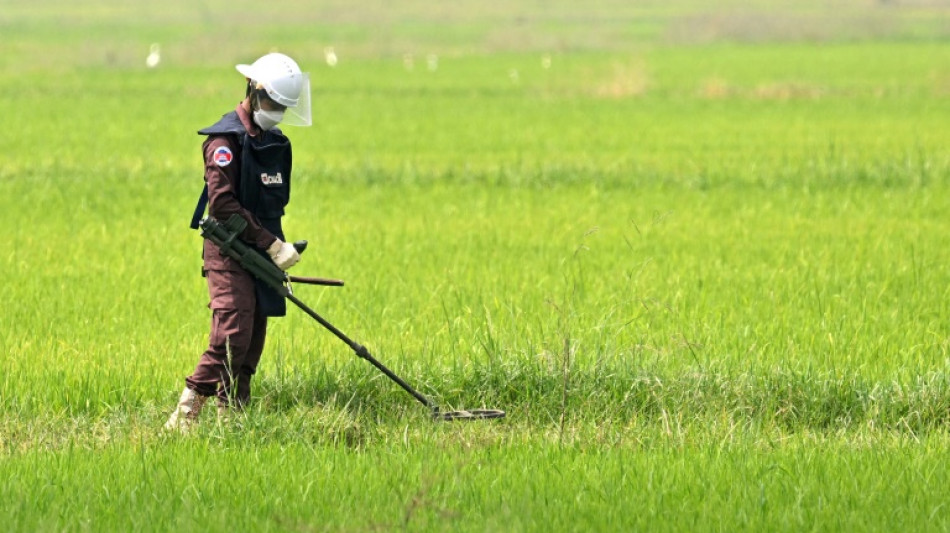
Cambodian farmers risk lives for rice as US freezes demining aid / Photo: © AFP

 In Manchester, people say City scandal is 'shame for football'
 Stocks lacklustre as inflation data weighs on sentiment

 Israel-bound plane rerouted, pilots wounded in reported fight

 Truth commission on Sweden's Sami people seeks redress

 Energy costs spark inflation surges in France, Italy

 South Korea break China hearts to reach Asian Games football final
 Eala storms into Asian Games semi-finals to thrill adoring fans

 Turkey freezes ex-minister's assets as fund crisis grows
 What we know about the North Korean POW dispute

 Most equities rise after oil price plunge, US data in focus

 Polar oceans transformed as warming melts ice habitats: research

 Lost shark becomes viral star in South Korea
 Dangote to launch $16bn refinery in Kenya
 North Korean leader 'extremely obese': Seoul spy agency

 Yankees and pope-backed White Sox start MLB playoffs with wins
 Malaysia's ex-PM Mahathir in hospital for observation

 'No limits': Marathon world record holder Sawe chasing history

 Countdown begins to biggest-ever Rugby World Cup

 Bangladesh women lose ground after quota reform
 Vietnam admits 'differing opinions' on Hanoi development
 Stocks temper gains as oil pares heavy losses, US data in focus
 New Zealand denies breaching climate commitments to EU

 Albert becomes youngest US scorer in 4-2 win over Chile
 Pirate island's plunging population shows Greece's demographic decline
 With elections ahead, Latvia's Russian-speakers reject Moscow's help
Eleven-year-old Yeat Saly lies in a hospital bed, a piece of shrapnel lodged in his forehead -- one of the many injuries inflicted by an old mortar he found near his village in Cambodia.
Parts of the kingdom are still littered with unexploded ordnance from decades of conflict, but US President Donald Trump's decision to freeze virtually all American aid has forced many long-running projects to clear the deadly debris to grind a halt.
Villagers now fear for themselves and their children unless a way is found to keep removing the leftover landmines, mortars and other lethal munitions scattered across the countryside.
Yeat Saly was herding his cows outside his village in Tboung Khmum province on February 5 when he found a metal object by a rubber tree.
"I thought it was just a piece of metal. I threw it, then it exploded into a ball of flame," he told AFP from a hospital bed.
"A piece of shrapnel is still in here," he said, touching his forehead.
He is receiving treatment for injuries to both his legs and body at a hospital in Tboung Khmum.
"I was so frightened, my ears could not hear anything. Blood was spraying from my forehead, and I rode a motorbike (back home) with one hand blocking the blood," he said.
- Deadly US legacy -
Much of Cambodia's unexploded ordnance is a legacy of US operations during the Vietnam War.
Then-president Richard Nixon ordered a clandestine bombing campaign over swathes of Laos and Cambodia, which helped fuel the rise of the Khmer Rouge.
After more than 30 years of civil war ended in 1998, Cambodia was left as one of the most heavily mined countries in the world.
Injuries and deaths from war remnants are still common, with around 65,000 casualties, including 20,000 people killed, since 1979.
The annual additions to that count have fallen dramatically in recent years thanks to clearance programs, but more than 1,600 square kilometres (620 square miles) of contaminated land still need to be demined.
In recognition of American responsibility for causing the problem, Washington has been a key partner in Cambodia's mine clearance, providing around $10 million a year in funding.
But Trump's 90-day freeze on virtually all foreign aid has forced many demining operations in Cambodia to stop, according to officials.
Deminers in eastern Cambodia have suspended work to clear UXOs and cluster bombs, even as requests for removals have grown.
"We have received a pile of requests, and we could not respond to them. We are so upset," Moch Sokheang, who has been a deminer for 16 years.
"We worry that when villagers go into the forests, dig land to grow their crops, they may trigger explosions or children may play with them when they go herding cows," the 36-year-old added.
Cambodian demining authorities say more than 1,000 deminers and experts have been affected by the aid freeze.
Days after Trump's announcement, China -- Cambodia's close ally -- pledged $4.4 million to fund mine clearance activities.
But the Cambodian Mine Action Centre (CMAC) said that aid was "not a substitute" for US funding.
- 'So worried' -
Farmers in eastern Svay Reing province told AFP they must keep working their fields despite the risks.
Mao Saroeun said he was "unhappy" that deminers had been forced to suspend a search in his rice field where many US bombs fell.
"I know (about UXOs) but our livelihood is poor so we keep farming rice in UXO fields," Mao Saroeun said.
Cambodia had aimed to be mine-free by 2025, but the government pushed the deadline back by five years because of funding challenges and new landmine fields found along the Thai border.
The loss of US funding is a further setback.
"The aid freeze will cause more accidents... A lot of UXOs are still littered around," Keo Sarath, manager of the Cambodian Mine Action Centre's demining unit 5 headquarters, told AFP.
In Banteay Kraing village in Svay Rieng province, AFP journalists saw a rusty mortar left between tree trunks with police tape around the site to warn people away.
Villager Som Khatna told AFP that her husband unearthed the bomb last month when he dug a pit to lay the foundation for a house.
"I am so worried that children would come and play with it," said the 59-year-old grandmother.
D.Schneider--BTB