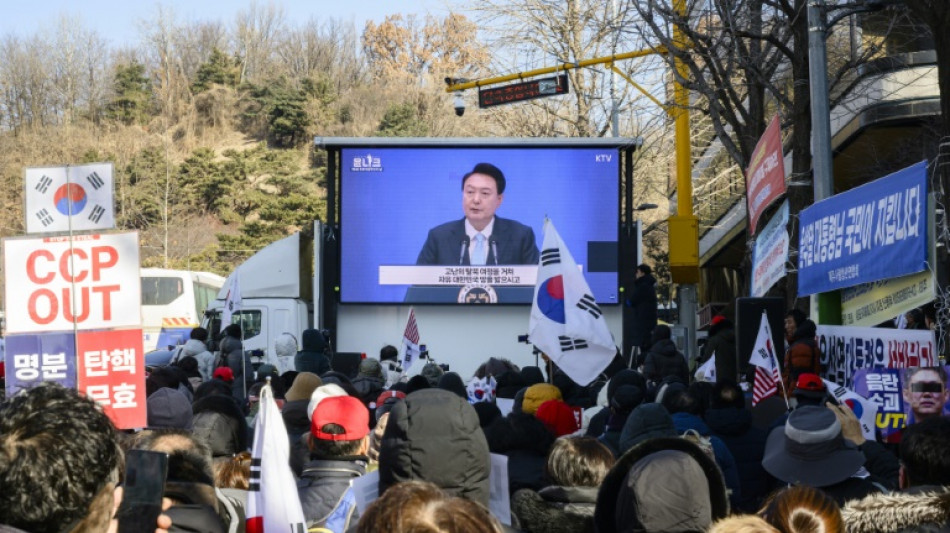
Two trials, one president: South Korea's Yoon in the dock / Photo: © AFP

 In Manchester, people say City scandal is 'shame for football'
 Stocks lacklustre as inflation data weighs on sentiment
 Israel-bound plane rerouted, pilots wounded in reported fight

 Truth commission on Sweden's Sami people seeks redress

 Energy costs spark inflation surges in France, Italy

 South Korea break China hearts to reach Asian Games football final
 Eala storms into Asian Games semi-finals to thrill adoring fans

 Turkey freezes ex-minister's assets as fund crisis grows

 What we know about the North Korean POW dispute
 Most equities rise after oil price plunge, US data in focus
 Polar oceans transformed as warming melts ice habitats: research
 Lost shark becomes viral star in South Korea
 Dangote to launch $16bn refinery in Kenya
 North Korean leader 'extremely obese': Seoul spy agency
 Yankees and pope-backed White Sox start MLB playoffs with wins

 Malaysia's ex-PM Mahathir in hospital for observation
 'No limits': Marathon world record holder Sawe chasing history

 Countdown begins to biggest-ever Rugby World Cup

 Bangladesh women lose ground after quota reform

 Vietnam admits 'differing opinions' on Hanoi development
 Stocks temper gains as oil pares heavy losses, US data in focus
 New Zealand denies breaching climate commitments to EU
 Albert becomes youngest US scorer in 4-2 win over Chile
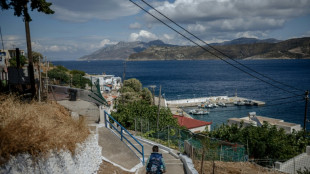 Pirate island's plunging population shows Greece's demographic decline
 With elections ahead, Latvia's Russian-speakers reject Moscow's help

South Korea's ousted President Yoon Suk Yeol on Wednesday became the country's first sitting head of state on trial on criminal charges.
He is also concurrently attending hearings at the country's Constitutional Court, whose judges are to decide in the coming weeks whether to uphold his December impeachment by parliament.
AFP takes a look at how South Korea's justice system is holding Yoon to account for declaring martial law -- and what might happen next.
- How do the two trials differ? -
Yoon was suspended from office by lawmakers in December on allegations of insurrection for imposing martial law.
He was then arrested in January on insurrection charges and has since been held at a detention centre.
Ongoing trials will now determine whether both of those decisions are upheld.
"The Constitutional Court makes the decision to remove President Yoon from office through impeachment proceedings," lawyer Chu Eun-hye told AFP.
"Whether the individual Yoon Suk Yeol is guilty or not is determined in a criminal trial," Chu said.
If the Constitutional Court backs his removal, Yoon will become the second president in South Korean history to be successfully impeached.
"The Constitutional Court's procedure holds Yoon accountable for political responsibility," Yun Bok-nam, president of Lawyers for a Democratic Society and who is not involved in the investigation, told AFP.
"His criminal liability remains separate and that will be dealt with by the criminal prosecution process," said Yun.
In December 2016, then-President Park Geun-hye was impeached by parliament for receiving or requesting tens of millions of dollars from conglomerates, including tech giant Samsung, and blacklisting any prominent figures in the cultural or entertainment industries, as well as officials who opposed her.
She was later sentenced to 20 years in prison and slapped with heavy fines.
- How long will it take? -
The criminal trial process takes longer than an impeachment trial, typically lasting at least six months, said Chu.
Park, for example, was impeached in December 2016 -- but it wasn't until January 2021 that the Supreme Court finalised her sentence.
Thursday's Constitutional Court hearing will be Yoon's last unless either side requests another session and it is accepted, Kim Hyun-jung, a researcher at the Korea University Institute of Law, told AFP.
Experts then predict that the verdict for Yoon's impeachment case will be delivered in March.
"Considering the practice of issuing rulings just over ten days after setting a date, a decision is expected by March 11," Park Kyun-taek, Democratic Party lawmaker told a radio show this week.
"If the judges recognise the urgency of the matter, a ruling as early as March 6 could also be possible," he said.
For late President Roh Moo-hyun, who was reinstated by the Constitutional Court after being impeached by parliament, it took 14 days.
Former President Park, on the other hand, was issued a verdict only 11 days after her final hearing.
- What happens if he is found guilty? -
Legal experts agree it is highly unlikely the Constitutional Court will reinstate Yoon.
"Many legal scholars and experts agree that a unanimous ruling in favour of impeachment would be made by the Constitutional Court judges," said Kim.
"Legally speaking the case is quite clear-cut," Yun argued.
Unlike President Park's case which involved multiple moving parts, for Yoon, the issue is "only about the constitutional violations made as the martial law was declared".
But if Yoon is restored to office, it would "lead to an absurd situation," said Yun.
Legally, Yoon will remain in power -- despite his remaining criminal trials.
"It's a contradiction, really," Yun told AFP.
"If the president is not removed from office, he would continue to face a criminal trial for insurrection while still serving as the sitting president," he explained.
"That in itself would be highly inappropriate."
For charges of insurrection, Yoon could be sentenced to life in prison.
The 64-year-old could also face the maximum penalty: a death sentence.
But is it highly unlikely that sentence would be carried out: South Korea has had an unofficial moratorium on executions since 1997.
B.Shevchenko--BTB