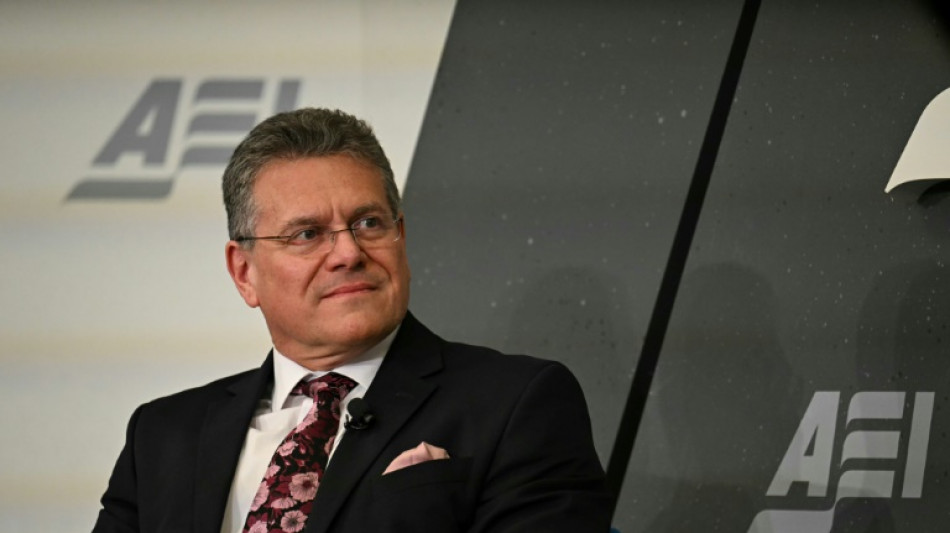
EU trade chief says tariff reciprocity 'must work for both' sides / Photo: © AFP

 Women's Asian Champions Trophy 2026 in Bhopal Revives Hockey Legacy

 California GOP Faces Near-Extinction After 2026 Midterms; Calls for New Vision

 St Francis School Leads €60,000 EU Project to Transform Early Childhood Education

 South Africa's Universal Health Coverage Depends on Tackling Poverty and Inequality

 Rare Siberian Rubythroat Dies in UK Garden After Cat Attack

 Go Kyung-pyo Drunk Driving Incident Prompts Heavy Editing Across Multiple TV Shows

 KFF Health News Reporters Discuss ACA Enrollment Challenges, Rising Costs, and Measles Risks

EU trade chief Maros Sefcovic said Thursday that reciprocity in tariffs should be made to work for both the bloc and Washington, after talks with his counterparts in US President Donald Trump's administration.
While the United States is planning "reciprocal tariffs," the European Union is open to working with Trump officials towards lowering duties for industrial goods and stepping up purchases of US products, Sefcovic told reporters.
"We will be ready to look (at) how we can lower the import duties for all industrial products," he said, a day after meeting Commerce Secretary Howard Lutnick and US Trade Representative nominee Jamieson Greer.
Trump has taken aim at the EU and others over trade, announcing plans for sweeping duties tailored to each US trading partner, and taking into consideration non-tariff factors.
But Sefcovic stressed after his four-hour meeting with trade counterparts that if Washington were seeking reciprocity, "it must work for both" sides.
During Sefcovic's three-day Washington visit, he pushed back against Trump's claim of unfairness in US-EU trade ties.
He said Thursday that one of his requests was to hold off US tariffs -- avoiding tit-for-tat escalation -- as both sides discussed their concerns.
He said his impression was that the United States too would be "ready to consider" a reduction in its tariffs, adding that auto duties were a priority.
Although the EU has higher tariffs for personal vehicles, the United States protects other areas like pick-up trucks, said Sefcovic, who is European Commissioner for Trade and Economic Security.
"While we protect European interests, we seek constructive dialogue to avoid unnecessary pain of measures and countermeasures," he said.
- Balancing trade -
Brussels and Washington understand that they share common challenges such as "global overcapacities driven by non-market practices" -- a concern involving China -- he said.
He said it would be beneficial if the transatlantic partners could tackle global overcapacity together.
He also expressed optimism that the EU could allay US concerns about the trade deficit between both sides.
The EU needs more LNG as it phases out Russian gas, he noted, adding that this is an area of potential collaboration.
While Washington focuses on its goods deficit with the EU, he said this is somewhat offset by American firms' surplus in services.
Balancing both ends, if the EU had to resolve a 50 billion euro trade gap with the United States, he said, "we can really do it, if we put our mind to it," adding that this could be accomplished "relatively quickly."
Sefcovic said Wednesday at the American Enterprise Institute that the EU saw "no justification for sudden, unilateral tariff increases" by the United States.
"If we are hit by unfair import duties, then we will react firmly and proportionately. We'll be prepared for it," he added Thursday.
Besides reciprocal tariffs, Trump has slapped an added tariff on Chinese goods and unveiled sweeping duties on imports of steel and aluminum to take effect in March.
He has also threatened levies affecting specific sectors like imports of automobiles, semiconductors and pharmaceuticals.
W.Lapointe--BTB