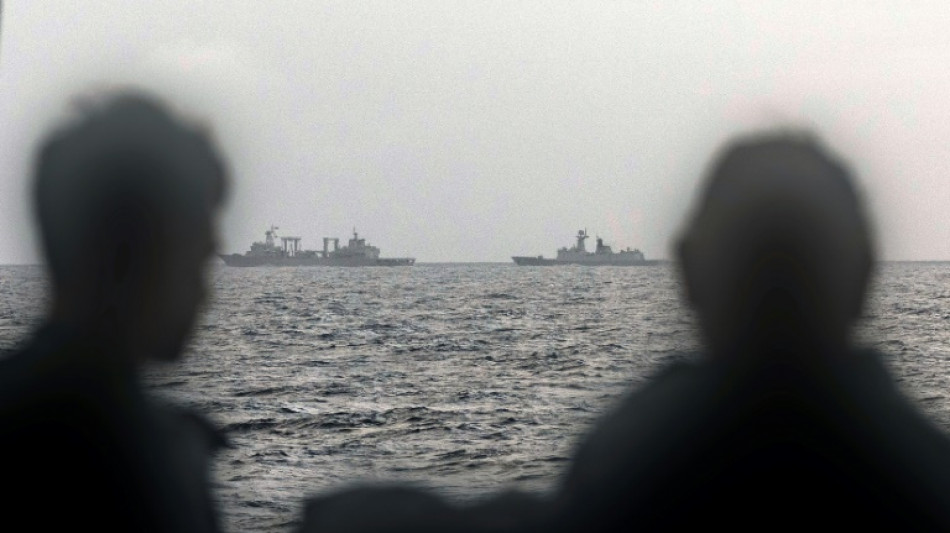
New Zealand says Chinese naval vessel fires live rounds in new drill / Photo: © AUSTRALIAN DEFENCE FORCE/AFP

 Women's Asian Champions Trophy 2026 in Bhopal Revives Hockey Legacy

 California GOP Faces Near-Extinction After 2026 Midterms; Calls for New Vision

 St Francis School Leads €60,000 EU Project to Transform Early Childhood Education

 South Africa's Universal Health Coverage Depends on Tackling Poverty and Inequality

 Rare Siberian Rubythroat Dies in UK Garden After Cat Attack

 Go Kyung-pyo Drunk Driving Incident Prompts Heavy Editing Across Multiple TV Shows

 KFF Health News Reporters Discuss ACA Enrollment Challenges, Rising Costs, and Measles Risks

A Chinese naval cruiser fired live rounds Saturday during a task force drill in the sea between Australia and New Zealand, government officials said, prompting an alert to commercial air traffic.
It was the Chinese warships' second exercise in two days in international waters of the Tasman Sea, held despite Canberra and Wellington raising concerns over a lack of prior notice.
Australia and close ally New Zealand have been monitoring the three Chinese navy vessels -- a frigate, a cruiser and a supply tanker -- since they were spotted off Australia's shores last week.
Personnel on a New Zealand naval frigate "observed live rounds being fired from the Zunyi's main gun, as would be expected during the course of such an exercise", New Zealand Defence Minister Judith Collins' office said in a statement.
The three Chinese ships were in international waters in the Tasman Sea at the time, her office said.
"As happened yesterday, the Chinese Task Group advised via radio channels of its intent to conduct live firing," it said.
"Defence is working with the NZ Civil Aviation Authority to ensure all aircraft are notified. The safety of all people, aircraft and vessels in the area remains our paramount concern."
New Zealand said its concerns over notification times and best practice would be "communicated appropriately".
Australia said Saturday it had not yet received a satisfactory explanation from Beijing for Friday's drill, in which the warships broadcast a "disconcerting" live-fire warning that forced commercial flights to change course.
In Friday's exercise, "no weapon firings were heard or seen" from the Chinese task force despite it temporarily deploying a floating firing target, Canberra said.
- 'Safe, standard and professional' -
Australian Defence Minister Richard Marles said that while China abided by international law, it did not follow best practice of giving 12-24 hours' notice, and Canberra had raised this with Beijing.
Foreign Minister Penny Wong had also discussed it directly with her Chinese counterpart Wang Yi on the sidelines of a G20 meeting in Johannesburg.
Beijing has described Friday's manoeuvres as training exercises that were "safe, standard and professional" and in line with international law, without commenting on whether live ammunition was used.
It was the latest in a string of tense encounters between China and Australia in the increasingly contested airspace and shipping lanes of the Asia-Pacific region.
Last week, Canberra rebuked Beijing for "unsafe" military conduct, accusing a Chinese fighter jet of dropping flares near an Australian air force plane patrolling the South China Sea.
A Chinese fighter jet was accused of intercepting an Australian Seahawk helicopter in international airspace in 2024, dropping flares across its flight path.
In 2023, a Chinese destroyer was accused of bombarding submerged Australian navy divers with sonar pulses in waters off Japan, causing minor injuries.
The Australian government says it respects the right of all states to pass through international waters and airspace.
The United States and its allies including Australia frequently cross through the 180-kilometre (112-mile) Taiwan Strait to reinforce its status as an international waterway, angering China, which claims jurisdiction over the waters.
O.Krause--BTB