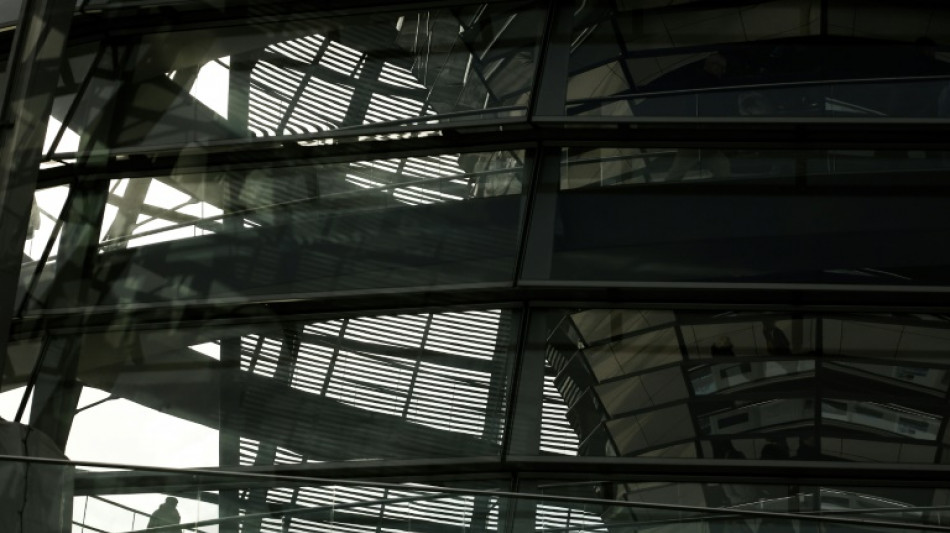
Germany may face long wait for new government after vote / Photo: © AFP/File

 Japan win marathon penalty shootout to set up South Korea gold-medal clash

 Djokovic grinds out opening-round win at China Open

 Northern Ireland police probe blockade of disputed parade
 UK PM Burnham reopens divisive debate on rejoining EU
 Man City future in doubt after guilty verdict
 'Do something,' begs Iranian woman after death sentence over protests
 China extends 52-year unbeaten record as Games organisers say sorry
 In Manchester, people say City scandal is 'shame for football'
 Stocks lacklustre as inflation data weighs on sentiment
 Israel-bound plane rerouted, pilots wounded in reported fight
 Truth commission on Sweden's Sami people seeks redress

 Energy costs spark inflation surges in France, Italy

 South Korea break China hearts to reach Asian Games football final
 Eala storms into Asian Games semi-finals to thrill adoring fans

 Turkey freezes ex-minister's assets as fund crisis grows

 What we know about the North Korean POW dispute
 Most equities rise after oil price plunge, US data in focus
 Polar oceans transformed as warming melts ice habitats: research
 Lost shark becomes viral star in South Korea
 Dangote to launch $16bn refinery in Kenya
 North Korean leader 'extremely obese': Seoul spy agency
 Yankees and pope-backed White Sox start MLB playoffs with wins
 Malaysia's ex-PM Mahathir in hospital for observation
 'No limits': Marathon world record holder Sawe chasing history
 Countdown begins to biggest-ever Rugby World Cup
German voters head to the polls in a winter election on Sunday but may not have a new government for some time.
Arduous coalition negotiations tend to drag on for weeks if not months in Germany, spelling long stretches of political paralysis before a new chancellor takes charge.
The confident poll frontrunner Friedrich Merz has said he's aiming for an Easter deadline -- April 20 -- for a deal and urged potential allies to get ready for speedy talks.
"If we spend weeks, possibly months... then the period in which this country is without a majority capable of governing will be too long for me," Merz said in a recent Politico interview.
In Berlin, a bulging in-tray of challenges awaits whoever is the next leader, from a stagnating economy to the Ukraine war and an increasingly hostile Trump administration.
Current polls give the conservative CDU-CSU alliance of Merz a strong lead over Chancellor Olaf Scholz's Social Democrats (SPD).
But the surveys also suggest that Merz's party, now polling around 30 percent, would need a junior coalition partner to gain a parliamentary majority.
Merz could potentially opt to work with Scholz's centre-left SPD in a so-called "grand coalition" of the two big-tent parties, known as the "GroKo" in German.
Scholz -- whose own motley alliance with the Greens and the liberal Free Democrats (FDP) broke up in November -- would not be expected personally to join such a government.
Alternatively, or additionally, a victorious Merz could invite the Greens into an alliance -- but this has so far been strongly opposed by the CDU's Bavarian sister party the CSU.
- Marathon talks -
Attempting to forge any such pact forces former campaign trail foes to quickly make nice. The parties first engage in exploratory talks before moving on to full coalition negotiations.
Scholz in 2021 needed 10 weeks from polling day to form his government with the Greens and the FDP.
Tired-looking selfies posted by party leaders during the marathon talks attested to the arduous work to forge a coalition of unprecedented complexity.
But the time span was "within the usual range", said Uwe Jun, political science professor at Trier University.
Coalition agreements are highly detailed and have a "contractual character", said Dorothee de Neve, politics professor at Justus Liebig University, but have long been a "feature of German politics".
The longest wait came in 2017, when it took Angela Merkel's conservatives some six months to forge a GroKo with the SPD.
Merkel's initial attempt at a coalition with the Greens and FDP spectacularly failed, prolonging the wait.
- 'Divided society' -
Once staid German politics have been disrupted by the over decade-long rise of the far-right Alternative for Germany (AfD) party, now polling around 20 percent.
Although all other parties have vowed not to govern with the anti-immigration AfD, its popularity has eroded their voter support.
A wild card in the election is whether a number of smaller parties will cross the five-percent threshold to enter parliament or be cast into oblivion.
The FDP and the upstart far-left BSW are fighting for their lives around the five percent death zone, while the other small leftist party Die Linke has polled somewhat higher in recent days.
Jun said that forming another grand coalition would "not be simple", given their "clear differences" especially on social and economic policy.
Nonetheless, the two mainstream parties have ruled together in three of the last five governments -- a trend decried by the AfD, which labels them the establishment or "system parties".
When the ballots are counted, "fragmentation could produce a historically fractured parliament," said Michael Broening of the Friedrich Ebert Foundation.
"Regardless of the parliamentary makeup, social fragmentation is likely to persist," he told AFP.
"This will make coalition-building more challenging -- not only within parliament but also in terms of broader engagement with an increasingly divided society."
C.Kovalenko--BTB