German 'rust belt' town spotlights growing appeal of the far right / Photo: © AFP

 Japan win marathon penalty shootout to set up South Korea gold-medal clash
 Djokovic grinds out opening-round win at China Open

 Northern Ireland police probe blockade of disputed parade
 UK PM Burnham reopens divisive debate on rejoining EU

 Man City future in doubt after guilty verdict
 'Do something,' begs Iranian woman after death sentence over protests
 China extends 52-year unbeaten record as Games organisers say sorry
 In Manchester, people say City scandal is 'shame for football'
 Stocks lacklustre as inflation data weighs on sentiment
 Israel-bound plane rerouted, pilots wounded in reported fight
 Truth commission on Sweden's Sami people seeks redress

 Energy costs spark inflation surges in France, Italy

 South Korea break China hearts to reach Asian Games football final
 Eala storms into Asian Games semi-finals to thrill adoring fans

 Turkey freezes ex-minister's assets as fund crisis grows

 What we know about the North Korean POW dispute

 Most equities rise after oil price plunge, US data in focus
 Polar oceans transformed as warming melts ice habitats: research

 Lost shark becomes viral star in South Korea
 Dangote to launch $16bn refinery in Kenya
 North Korean leader 'extremely obese': Seoul spy agency
 Yankees and pope-backed White Sox start MLB playoffs with wins
 Malaysia's ex-PM Mahathir in hospital for observation
 'No limits': Marathon world record holder Sawe chasing history

 Countdown begins to biggest-ever Rugby World Cup
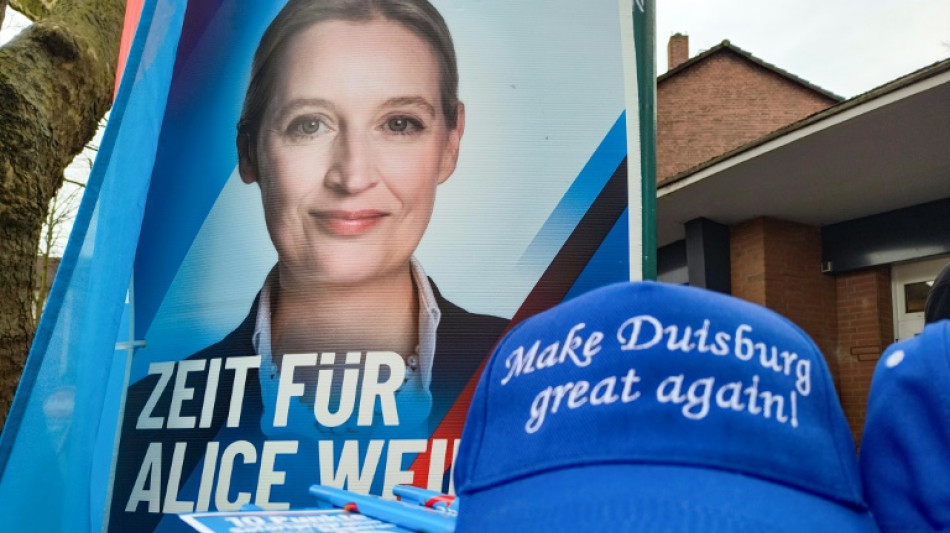
Sporting a cap with the Trump-inspired slogan "Make Duisburg Great Again", AfD candidate Alan Imamura was upbeat as he campaigned for the far-right party in Germany's ailing industrial heartland.
"In the past, lots of people looked at us strangely or even insulted us -- that's hardly been the case this year," said the 51-year-old in the working class district of Duisburg North, as passing cars tooted horns in support.
The city in Germany's western Ruhr region highlights how the far right has made progress beyond its traditional strongholds in Germany's ex-communist east, helping propel the AfD to a record nationwide result in Sunday's elections.
Duisburg is a steel town and traditional symbol of Germany's industrial might, and Duisburg North has long been a stronghold of the Social Democrats (SPD) of Chancellor Olaf Scholz.
But, as the city went into industrial decline, so the political landscape has shifted, with many SPD voters saying they no longer feel represented by the party.
The upheaval was clear as election results rolled in late Sunday.
According to a nearly complete vote count, the AfD more than doubled its share in Duisburg North from the last elections in 2021, hitting over 24 percent, just slightly behind the SPD, which shed around 10 points.
- 'Mood is bad' -
Ludger Schulppen, a former SPD member who switched to backing the AfD, said the city is struggling with a growing number of migrants that it cannot support.
"So many companies are closing, it's just not possible for people to come and just go and work," the 63-year-old told AFP.
He works for steel titan Thyssenkrupp, which last year announced it was cutting 11,000 jobs in the face of rising Asian competition.
"The mood is bad," Schulppen said. "Nobody knows who's affected, which departments are affected, what comes next."
Tax cuts and environmental deregulation backed by the AfD would help his industry, he argued.
Duisburg has a long history of welcoming newcomers, particularly after World War II when workers from Turkey and Italy arrived and helped power the country's "economic miracle".
Nowadays 58.3 percent of school children in Duisburg are migrants or the children of migrants, according to official data.
But, 10 years after Middle Eastern migrants began arriving in large numbers under former chancellor Angela Merkel, attitudes have hardened in the face of high-profile attacks and problems with integration.
"The people who come here are not people who have good jobs in their own countries," said Schulppen.
"They're people who come for the benefits on offer. I have plenty of Turkish colleagues who point out that they got nothing when they came over, they just came and worked."
The AfD's growing appeal highlights how the far-right party is making progress in western Germany.
Its advances were clear at Sunday's elections, with the party roughly doubling its support nationwide to around 20 percent.
They came in second to the centre-right CDU, whose leader Friedrich Merz is set to become the next chancellor -- although he insists he won't involve the far right in coalition talks, despite relying on their support for a parliamentary vote in January.
- 'Can't go on like this' -
Duisburg has seen better days. Just 500,000 people call the city home, down from almost 600,000 in the mid-1970s.
Outside the town centre, abandoned buildings dot the cityscape.
On a housing estate nicknamed the "White Giants" -- which hit the headlines last year after postal firm DHL suspended deliveries there, citing threats to its staff -- cleaner Manuela Spitzwieser said she has shifted to supporting the AfD from the SPD.
The 54-year-old complained some residents "break everything and go on rampages," and throw rubbish from the upper floors of tower blocks, pointing to the rubbish-strewn playground.
Most Germans in her circle were AfD supporters, she said, but insisted it was "not about chucking foreigners out".
"It's about deporting criminals. Deporting illegal migrants. Things can't go on like this."
F.Müller--BTB