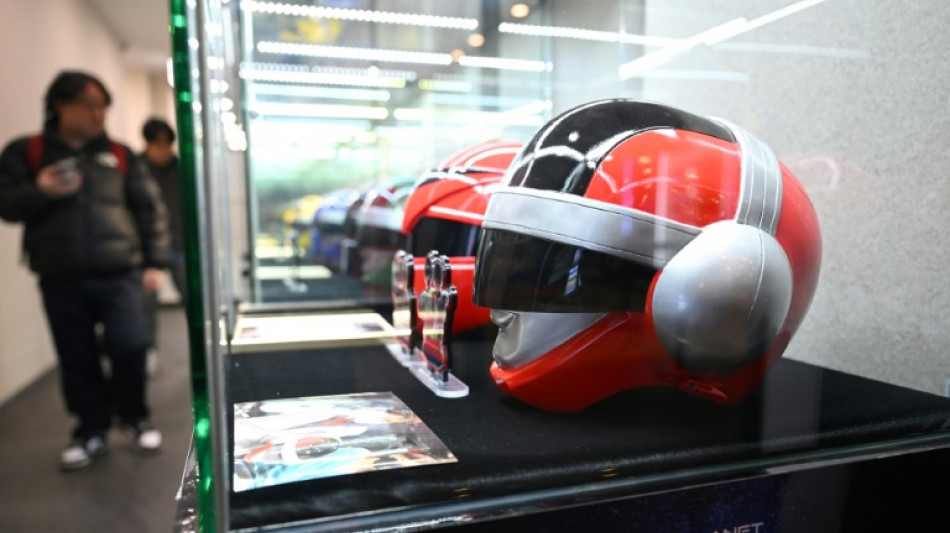
South Korean fans soak up nostalgia with vintage Japanese superheroes / Photo: © AFP

 Japan win marathon penalty shootout to set up South Korea gold-medal clash

 Djokovic grinds out opening-round win at China Open

 Northern Ireland police probe blockade of disputed parade

 UK PM Burnham reopens divisive debate on rejoining EU

 Man City future in doubt after guilty verdict

 'Do something,' begs Iranian woman after death sentence over protests

 China extends 52-year unbeaten record as Games organisers say sorry

 In Manchester, people say City scandal is 'shame for football'
 Stocks lacklustre as inflation data weighs on sentiment

 Israel-bound plane rerouted, pilots wounded in reported fight

 Truth commission on Sweden's Sami people seeks redress

 Energy costs spark inflation surges in France, Italy

 South Korea break China hearts to reach Asian Games football final

 Eala storms into Asian Games semi-finals to thrill adoring fans

 Turkey freezes ex-minister's assets as fund crisis grows

 What we know about the North Korean POW dispute

 Most equities rise after oil price plunge, US data in focus

 Polar oceans transformed as warming melts ice habitats: research

 Lost shark becomes viral star in South Korea

 Dangote to launch $16bn refinery in Kenya

 North Korean leader 'extremely obese': Seoul spy agency

 Yankees and pope-backed White Sox start MLB playoffs with wins

 Malaysia's ex-PM Mahathir in hospital for observation

 'No limits': Marathon world record holder Sawe chasing history

 Countdown begins to biggest-ever Rugby World Cup

Die-hard South Korean fans cheer and clap as their favourite superheroes strike poses in brightly coloured uniforms to the sounds of a soulful Japanese ballad, a nostalgic throwback to the days of VHS.
It has been decades since Japanese superhero series "Choudenshi Bioman" was last on TV, but its epic stories of good versus evil still resonate deeply for these South Korean millennials.
And while their masked heroes are now well into their sixties, a chance to meet them in person at a sold-out concert hall event this month in Seoul was too good to pass up -- even with ticket prices starting at 300,000 won ($210).
"Most of us here are office workers, and though the ticket price wasn't cheap, it wasn't beyond our means as lifelong fans," said Oh Myung-hoon, 39.
"It wasn't a matter of choice for fans like me. It was a must."
Part of the "Super Sentai" series, better known to Western audiences as the inspiration for the "Power Rangers" phenomenon of the 1990s, "Choudenshi Bioman" and its companion shows tell the story of a group of people with special powers fighting supervillains intent on world domination.
The show was broadcast at a time of Japan's transformation into a global cultural powerhouse, its animation and film studios producing content seen the world over.
But many Korean fans of "Choudenshi Bioman" were initially not even aware the show was Japanese.
- Japanese imports banned -
For decades, South Korea imposed sweeping restrictions on Japanese cultural imports due to historical tensions stemming from Tokyo's colonial rule over the peninsula in the early 20th century.
It was not until 1998 -- more than half a century after Korea's independence -- that Seoul began lifting its ban on Japanese media content.
Japanese superhero series -- best known in South Korea through "Bioman" and "Flashman" -- were among the few exceptions to the ban and imported on VHS tapes, making them a rare and cherished phenomenon in the 1980s and 1990s.
Even so, authorities required all Japanese text in the series to be replaced with Korean and the voices dubbed, effectively erasing any trace of their Japanese origins.
This allowed the series to thrive in an era when anti-Japanese sentiment remained strong, media columnist Kim Do-hoon told AFP.
"The media that dominated my youth was all Japanese, like the animation 'Galaxy Express 999', but they had to appear Korean through dubbing," the 49-year-old said.
"The 1970s and 80s were an era of peak anti-Japan sentiment, with the belief that anything related to Japan was bad."
But "thanks to South Korea's strong cultural exports and vibrant economy" times have changed, he added.
Some scenes managed to avoid the censorship and showed Japanese characters in the background -- puzzling young Korean kids.
Cha Jeong-in, a 39-year-old game developer, admits she was confused by the "unrecognisable letters".
"I asked myself 'what is it?'" she told AFP.
"I later learned it was all made in Japan."
- Good triumphs over evil -
For the actors who starred in the hero series, the heartfelt reception in Seoul was both exhilarating and perplexing -- especially in a country where Japanese content was once heavily censored.
"I had never expected something like this to happen 40 years after filming, so I was really surprised," said Kazunori Inaba, who played Red Mask in "Maskman".
The 68-year-old former actor, who now runs a ramen restaurant in Tokyo, said it was "difficult" for him to account for the devoted following his decades-old fantasy drama still enjoys in South Korea.
"If this work that we did can be a good bridge between Japan and Korea, then we have done a really good job," he told AFP.
"I think heroes are really important, especially when you're a child. As you grow up, you forget about them," he said.
"But rewatching them can help bring back the memories."
Game developer Cha said she spent $1,500 to come to Seoul from the Philippines, where she now lives.
"I thought that if I missed this chance, I'd never be able to see them face to face in my lifetime because of their advanced age," she told AFP.
"They all taught me that good always triumphs over evil and that I must not choose the path of wrongdoing," Cha said.
"They instilled those values in me."
N.Fournier--BTB