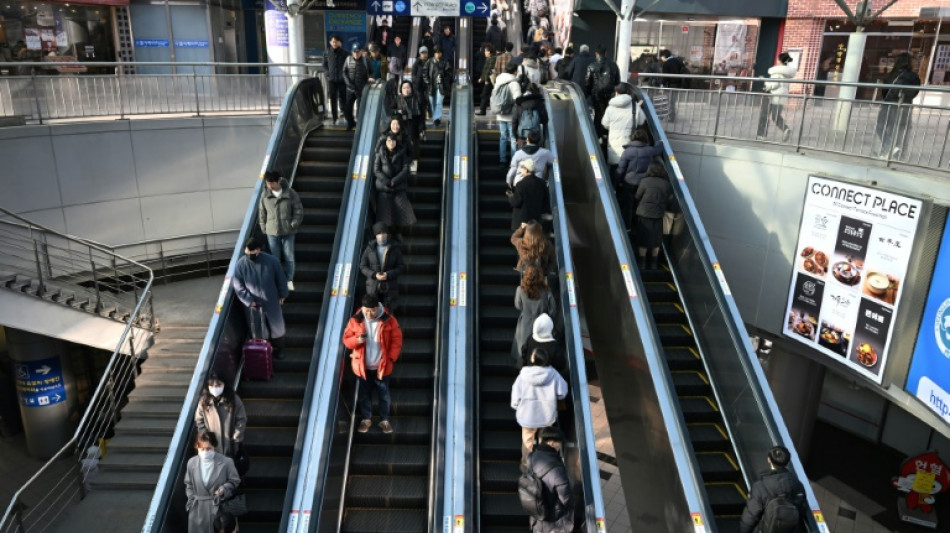
South Korea births rose last year on surge in marriage / Photo: © AFP

 Oil companies close in on Venezuela despite hurdles

 Turkey freezes ex-minister's assets as fund scandal grows

 Guardiola backs Man City after bombshell guilty verdicts
 G20 trade ministers open talks under strain of Trump tariffs

 France in talks with UK to end 2025 migrant accord: ministry

 Europe's surging inflation spreads gloom in stock markets

 Truth commission demands compensation for Sweden's Sami people

 Japan win marathon penalty shootout to set up South Korea gold-medal clash

 Djokovic grinds out opening-round win at China Open

 Northern Ireland police probe blockade of disputed parade

 UK PM Burnham reopens divisive debate on rejoining EU

 Man City future in doubt after guilty verdict

 'Do something,' begs Iranian woman after death sentence over protests

 China extends 52-year unbeaten record as Games organisers say sorry
 In Manchester, people say City scandal is 'shame for football'
 Stocks lacklustre as inflation data weighs on sentiment

 Israel-bound plane rerouted, pilots wounded in reported fight

 Truth commission on Sweden's Sami people seeks redress

 Energy costs spark inflation surges in France, Italy

 South Korea break China hearts to reach Asian Games football final

 Eala storms into Asian Games semi-finals to thrill adoring fans

 Turkey freezes ex-minister's assets as fund crisis grows

 What we know about the North Korean POW dispute

 Most equities rise after oil price plunge, US data in focus

 Polar oceans transformed as warming melts ice habitats: research

The number of births in South Korea rose last year for the first time in more than a decade on the back of a rise in marriages, officials said on Wednesday, bucking a trend for a country battling a demographic crisis.
South Korea has one of the world's longest life expectancies and lowest birth rates -- a combination that presents a looming demographic challenge.
Seoul has poured billions of dollars into efforts to encourage women to have more children and maintain population stability.
The crude birth rate -- the number of babies born per 1,000 people -- was 4.7, interrupting a continuous downward trend since 2014, according to preliminary data from Statistics Korea.
And the fertility rate, or the average number of babies a woman is expected to have in her lifetime, was 0.75, "up 0.03 from 0.72 in 2023", it said.
"The number of births in 2024 was 238,300, an increase of 8,300 (3.6 percent) from the previous year," the report added.
Park Hyun-jeong, an official from Statistics Korea, attributed the rise to an increase in marriages as well as shifting demographics.
"The population has seen a significant increase in the number of people in their early 30s," she told a press conference.
"This has had a major impact," Park explained.
"Additionally, many marriages that were delayed due to Covid-19 have now taken place, and this upward trend continues."
Park said the number of marriages last year had been the most since 1996 -- "the highest on record".
The average maternal age at childbirth in 2024 was 33.7 years, Seoul said, one of the highest in the world.
But the fertility rate remains far below the 2.1 children needed to maintain South Korea's population of 51 million.
At current rates, the population will nearly halve to 26.8 million by 2100, according to the Institute for Health Metrics and Evaluation at the University of Washington in Seattle.
- Continued decline -
Experts say there are multiple reasons for the low birth rate, from high child-rearing costs and property prices to a notoriously competitive society that makes well-paid jobs difficult to secure.
The double burden for working mothers of managing the brunt of household chores and childcare while also maintaining their careers is another key factor, they say.
The South Korean government offers cash subsidies, babysitting services and support for infertility treatment.
But the number of births has until now continued to decline.
Neighbouring Japan is grappling with the same issue -- it has the world's second-oldest population after Monaco and the country's relatively strict immigration rules mean it faces growing labour shortages.
D.Schneider--BTB