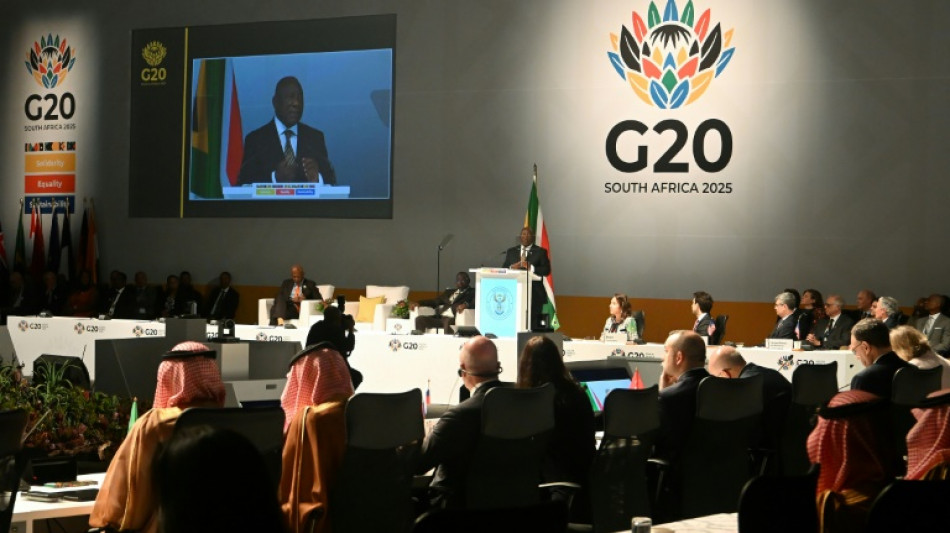
Erosion of multilateralism threatens global stability: S.Africa leader / Photo: © AFP

 Oil companies close in on Venezuela despite hurdles
 Turkey freezes ex-minister's assets as fund scandal grows

 Guardiola backs Man City after bombshell guilty verdicts
 G20 trade ministers open talks under strain of Trump tariffs
 France in talks with UK to end 2025 migrant accord: ministry

 Europe's surging inflation spreads gloom in stock markets

 Truth commission demands compensation for Sweden's Sami people
 Japan win marathon penalty shootout to set up South Korea gold-medal clash
 Djokovic grinds out opening-round win at China Open
 Northern Ireland police probe blockade of disputed parade
 UK PM Burnham reopens divisive debate on rejoining EU
 Man City future in doubt after guilty verdict
 'Do something,' begs Iranian woman after death sentence over protests

 China extends 52-year unbeaten record as Games organisers say sorry
 In Manchester, people say City scandal is 'shame for football'
 Stocks lacklustre as inflation data weighs on sentiment
 Israel-bound plane rerouted, pilots wounded in reported fight
 Truth commission on Sweden's Sami people seeks redress

 Energy costs spark inflation surges in France, Italy

 South Korea break China hearts to reach Asian Games football final
 Eala storms into Asian Games semi-finals to thrill adoring fans

 Turkey freezes ex-minister's assets as fund crisis grows
 What we know about the North Korean POW dispute
 Most equities rise after oil price plunge, US data in focus
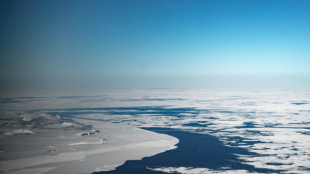 Polar oceans transformed as warming melts ice habitats: research
The erosion of multilateralism threatens global growth and stability, President Cyril Ramaphosa warned Wednesday at a G20 finance meeting in South Africa marked by the absence of the US Treasury secretary.
Two days of talks by finance ministers and central bank governors from the world's leading economies opened a week after a meeting of G20 foreign ministers was snubbed by US Secretary of State Marco Rubio, who complained of its "anti-Americanism".
"The erosion of multilateralism presents a threat to global growth and stability," Ramaphosa said in his opening address.
"At this time of heightened geopolitical contestation, a rules-based order is particularly important as a mechanism for managing disputes and resolving conflict," he said.
The G20, a grouping of 19 countries as well as the European Union and the African Union, is divided on key issues from Russia's war in Ukraine to climate change, with world leaders scrambling to respond to drastic policy shifts from Washington since the return of US President Donald Trump.
"Multilateral cooperation is our only hope of overcoming unprecedented challenges, including slow and uneven growth, rising debt burdens, persistent poverty and inequality, and the existential threat of climate change," Ramaphosa said.
South Africa this year holds the rotating G20 presidency and has chosen the theme "Solidarity, Equality, Sustainability".
US Treasury Secretary Scott Bessent said on February 20 that he would not attend the Cape Town meeting because he was too busy.
Just days before, Rubio had accused the G20 hosts of an "anti-American" agenda. It followed criticism from President Donald Trump about land reforms in South Africa aimed at redressing inequalities perpetrated during the apartheid era.
"South Africa is doing very bad things. Expropriating private property. Using G20 to promote 'solidarity, equality, and sustainability,'" Rubio wrote on social media.
The Group of 20 brings together the world's largest economies, which together represent around 85 percent of global GDP, to discuss international economic and financial stability.
- 'Dangerous world' -
The Cape Town meeting was attended by finance ministers from Britain, Switzerland and France as well as deputy ministers and other senior central bank and finance officials.
Britain's Finance Minister Rachel Reeves would stress at the talks that bolstering defence spending was necessary for economic growth, the UK Treasury said in a statement.
"It's clear we are facing a more dangerous world," Reeves was quoted as saying. "National security will always be the first responsibility of this government and is the bedrock economic growth."
British Prime Minister Keir Starmer pledged Tuesday to boost defence spending to 2.5 percent of the economy by 2027, as uncertainty reigns over Trump's commitment to European security while he pursues talks with Russia over its war in Ukraine.
Ramaphosa said South Africa's priorities for its year at the helm of the G20 included strengthening the resilience of poorer countries to cope with natural disasters.
"The increasing rate of climate-induced natural disasters is disproportionately affecting countries that can least afford the costs of recovery and rebuilding," he said, calling for "innovative financing and insurance mechanisms" to boost funding for disaster prevention and reconstruction.
Another priority is to help developing economies cope with debt repayments, he said.
"In recent years, low- and middle-income countries have seen their levels of sovereign debt and the cost of servicing that debt rise substantially," he said.
"Debt service costs are increasingly crowding out spending on education, healthcare and other social services, as well as infrastructure needed for economic development."
The UN Development Programme said in a statement ahead of the meeting that ballooning debt service payments in the poorest countries had reached alarming levels and called for "bold, immediate" action to overhaul the borrowing system.
Interest payments exceed 10 percent of government revenue in 56 developing countries, nearly double the number from a decade ago, it said.
G.Schulte--BTB