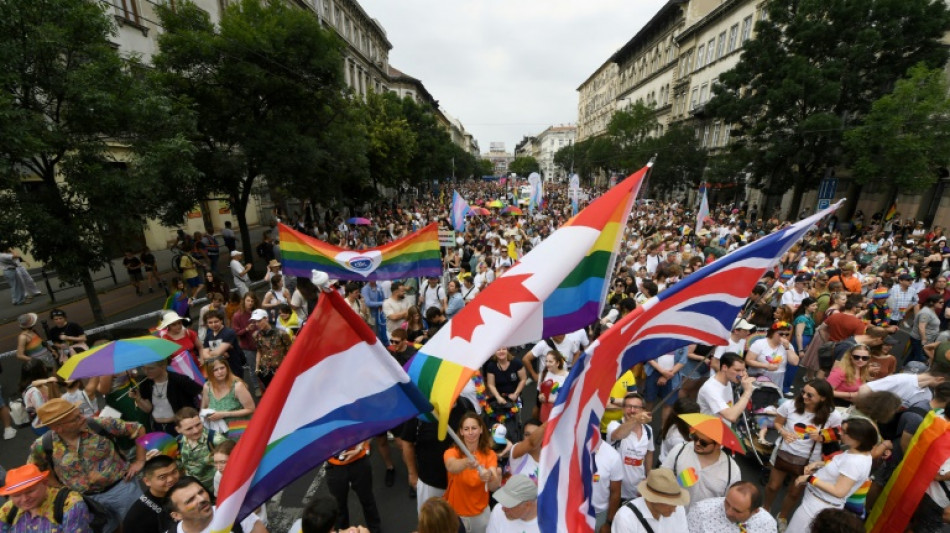
Hungary will no longer 'tolerate' public Pride march / Photo: © AFP

 Kayla Harrison Defeats Amanda Nunes via Submission at UFC 334

 GTA 6 Advertising Strategy and Disc Version Controversy

 From First Date to Wedding Day: How a TV Quote Sparked a Lifetime Commitment

 Malta Stuns Sweden with Late Penalty Comeback in Rugby Europe Trophy

 BingX: Major Announcement of Far-Reaching Significance

 Élan Opens as Late-Night Wine Bar in Honolulu

 Shiv Sena (UBT) Criticizes NCP Merger Talks as 'Ridiculous Laughing Stock'
Hungary's government has proposed legal changes to stop the annual Pride march from taking place in the "same public form" as previously, a top official said Thursday.
The government had never supported the parade, Prime Minister Viktor Orban's chief of staff, Gergely Gulyas told journalists.
But "the room for manoeuvre was not wide enough" for a ban, until US President Donald Trump's return to the White House.
"We believe that Pride marching through downtown, now that the US ambassador can no longer lead it, should not be tolerated by the country," he added.
The former US ambassador to Hungary David Pressman, a constant critic of the Orban government, regularly joined the Pride march along with other foreign diplomats.
Pressman stepped down from his post last month before the Trump administration took office.
On Saturday, Orban hinted at banning the event in his annual state of the nation address.
Referring to that speech, Gulyas told journalists: "It follows directly from this that there will be no Pride in the future in the public form in which we have come to know Pride in recent decades."
The government would file a constitutional amendment prioritising the need for child protection, and on that basis the current format of the Pride march could be banned, he added.
- Anti-LGBTQ measures -
Hungary has restricted LGBTQ rights in recent years to "protect children", but the parade has still drawn thousands of people.
Pride organisers say they are still preparing the 30th Budapest Pride for June 28.
In a statement Saturday, they condemned the politicisation of the question at a time when people were struggling with basic problems such as the cost of living.
"The government's task should not be to further restrict the basic freedoms of the Hungarian people, but to find real solutions" the statement added.
Since 2019, Hungary's constitution has stated that marriage is only possible between a man and a woman, and that the mother is a woman and the father is a man.
Laws have effectively banned same-sex couples from adopting children and prevented transgender people from changing their name or gender in official documents.
In 2021, a law that banned the "promotion and display" of homosexuality to minors sparked fury among critics who said it conflated being gay with paedophilia.
The legislation, which drew criticism from the European Union, led to books with LGBTQ themes being covered up and bookshops fined.
K.Thomson--BTB