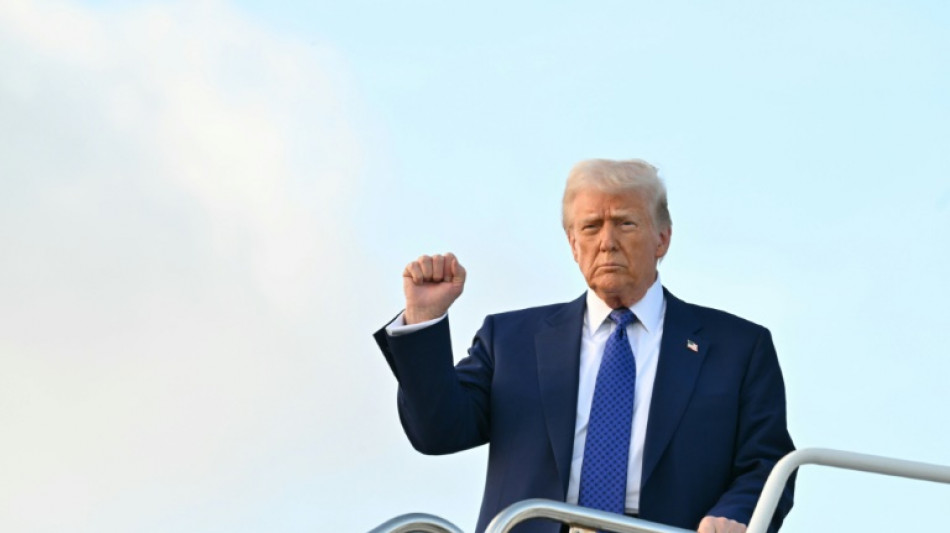
Constitutional crisis looms as Trump admin flirts with defying the courts / Photo: © AFP

 GTA 6 Advertising Strategy and Disc Version Controversy

 From First Date to Wedding Day: How a TV Quote Sparked a Lifetime Commitment
 Malta Stuns Sweden with Late Penalty Comeback in Rugby Europe Trophy

 BingX: Major Announcement of Far-Reaching Significance

 Élan Opens as Late-Night Wine Bar in Honolulu

 Shiv Sena (UBT) Criticizes NCP Merger Talks as 'Ridiculous Laughing Stock'

 Dell Announces AI-Integrated PC Lineup for 2026 with Wi-Fi 7 Support
US president Andrew Jackson famously reacted to an unfavorable ruling by the Supreme Court chief justice with the defiant rejoinder: "John Marshall has made his decision, now let him enforce it."
Nearly 200 years later, the United States teeters on the brink of a constitutional crisis as the administration of President Donald Trump -- faced with a series of court setbacks to his aggressive right-wing agenda -- flirts with open defiance of the judiciary.
Trump has said he will abide by court rulings and appeal those he disagrees with, but he also recently posted on Truth Social a quote attributed to Napoleon Bonaparte: "He who saves his Country does not violate any Law."
Vice President JD Vance and designated cost-cutter Elon Musk, on the other hand, seem to be inviting a clash between the executive and the judiciary.
"If a judge tried to tell a general how to conduct a military operation, that would be illegal," Vance posted on X this month.
Same thing if a judge tries to command the attorney general, he said, adding: "Judges aren't allowed to control the executive's legitimate power."
Musk has called for the impeachment of judges he accuses of blocking his sweeping cuts to the federal workforce and government programs.
"If ANY judge ANYWHERE can block EVERY Presidential order EVERYWHERE, we do NOT have democracy, we have TYRANNY of the JUDICIARY," the billionaire said in a post on X.
White House Press Secretary Karoline Leavitt has also weighed in.
"The real constitutional crisis is taking place within our judicial branch," Leavitt said, accusing judges in "liberal districts" of "abusing their power to unilaterally block President Trump's basic executive authority."
Leavitt's comments are in line with a conservative legal doctrine known as the "unitary executive theory" under which the president holds the sole authority over the executive branch.
The theory could meet its ultimate test in the Supreme Court, where conservatives hold a 6-3 majority.
- 'Power grab' -
Senator Dick Durbin, the top Democrat on the Senate Judiciary Committee, accused Trump and Musk of "pursuing a power grab that -- if left unchecked -- will leave the federal courts impotent and Congress a museum piece."
Carl Tobias, a law professor at the University of Richmond, said a constitutional crisis occurs when one of the three co-equal branches of government -- the legislature, the executive and the judiciary -- attempts to exercise the power of another branch.
The United States has faced constitutional crises before, most notably when southern states seceded from the Union, precipitating the 1861-65 Civil War.
Another was when Jackson, America's seventh president, defied the Supreme Court order to stop the military from removing members of the Cherokee Nation from their land in Georgia.
Steven Schwinn, a law professor at the University of Illinois Chicago, said there is no universally accepted definition of a constitutional crisis.
"Some think we're already in one," Schwinn said. "Others say it's if and when the president openly defies the Supreme Court.
"I think we're fast approaching a crisis with the administration seemingly openly defying court orders to re-start USAID funding," he said.
- 'Dangerous suggestions' -
Supreme Court Chief Justice John Roberts warned of the danger of ignoring court rulings in a year-end letter in December that may prove to be even more prescient than he intended at the time.
"Elected officials from across the political spectrum have raised the specter of open disregard for federal court rulings," Roberts wrote. "These dangerous suggestions, however sporadic, must be soundly rejected."
The conservative chief justice noted that every administration suffers court defeats -- sometimes in cases with major ramifications for executive or legislative power.
"Nevertheless, for the past several decades, the decisions of the courts, popular or not, have been followed," he said.
What happens next is anybody's guess.
The courts do have some tools at their disposal if their orders are being defied, Tobias said, including civil and criminal contempt, possible fines and threats of imprisonment.
At the end of the day, however, "the courts rely on the good-faith compliance of other constitutional actors with the rule of law," Schwinn said.
"If there's no such good-faith compliance, there's little the courts can do."
J.Horn--BTB