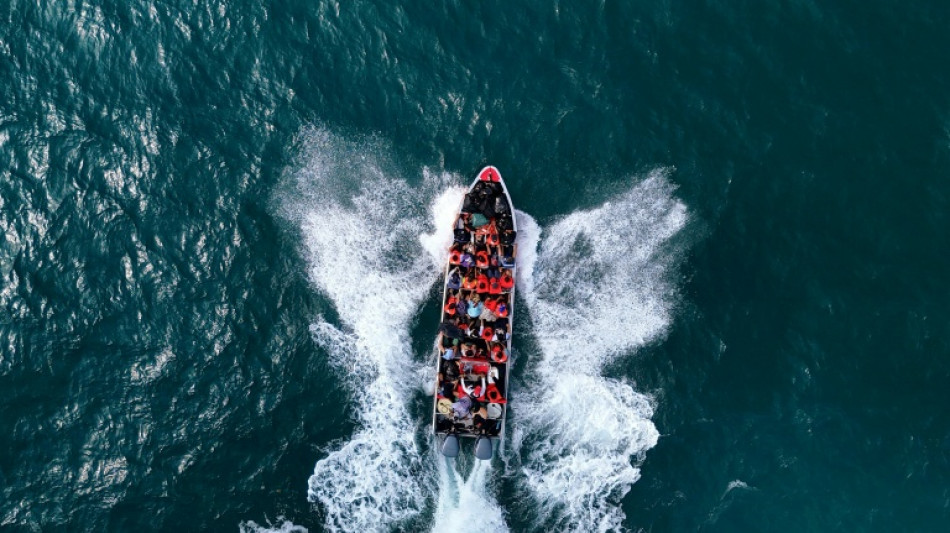
Trump crackdown leaves Panama facing chaotic reverse migration wave / Photo: © AFP

 GTA 6 Advertising Strategy and Disc Version Controversy

 From First Date to Wedding Day: How a TV Quote Sparked a Lifetime Commitment

 Malta Stuns Sweden with Late Penalty Comeback in Rugby Europe Trophy

 BingX: Major Announcement of Far-Reaching Significance

 Élan Opens as Late-Night Wine Bar in Honolulu

 Shiv Sena (UBT) Criticizes NCP Merger Talks as 'Ridiculous Laughing Stock'

 Dell Announces AI-Integrated PC Lineup for 2026 with Wi-Fi 7 Support
Boatloads of migrants have returned to South America this week from a new departure point in Panama -- part of an increasing and chaotic reverse migratory flow triggered by US President Donald Trump's hardline policies.
In total, around 2,200 migrants have entered Panama from the north in recent weeks, according to the government, having abandoned their hopes of a new life in the United States.
More than 200 migrants left on Thursday by boat from Panama's Caribbean port of Miramar, which has emerged as a new gateway on the sea route from Central to South America.
The journey south was as hard as traveling north, said Francisco, a 31-year-old Venezuelan who did not want to give his full name because of worries about his safety.
"They extort and rob us. Leaving Mexico to come down here was the same story as leaving Venezuela," he told AFP.
Days earlier, hundreds of others -- many of them from crisis-hit Venezuela -- left from the island of Carti off Panama's Caribbean coast for a roughly 12 hour journey to Colombia.
But after a shipwreck that claimed the life of an eight-year-old Venezuelan girl, overwhelmed authorities in that Indigenous autonomous region asked the government and international organizations for helping managing the flow.
- Avoiding dangers of jungle -
Panama's President Jose Raul Mulino told a news conference on Thursday that the number of migrants returning from the north "is on the rise."
He said his country was committed to collaborating with its partners, especially neighboring Costa Rica, to manage to flow while respecting migrants' rights.
Panama is making "concrete efforts" to arrange for the government in Bogota to allow Venezuelan migrants to reach the Colombian border city of Cucuta, from where they could enter their country, Mulino said.
In the absence of humanitarian flights promised weeks ago, migrants arrive from a migrant center in Costa Rica by bus to board boats.
The sea route enables them to avoid migration controls and the arduous return trek by foot through the Darien jungle between Central and South America, where dangers lurk including fast-flowing rivers, wild animals and criminal gangs.
More than 300,000 migrants, mostly Venezuelans, crossed the Darien jungle in 2024.
So far this year, 2,633 have arrived from the south to north -- 96 percent less than in the same period in 2024, according to Panamanian government figures.
Those heading home are full of disappointment.
Some waited months in vain for a chance to seek asylum, before Trump canceled their appointments and vowed mass deportations.
"I had hoped to give my daughters a better life, but it wasn't possible," Darwin Gonzalez, a 46-year-old Venezuelan, said at the Miramar dock.
Several migrants said that they had to pay hundreds of dollars for transportation on the way back. The boat to the Colombian border alone costs about $250.
"We've spent about $2,000 or so to return, saving money by eating just one meal a day," said Venezuelan Milagros Rubio, 44, who is traveling with three relatives.
D.Schneider--BTB