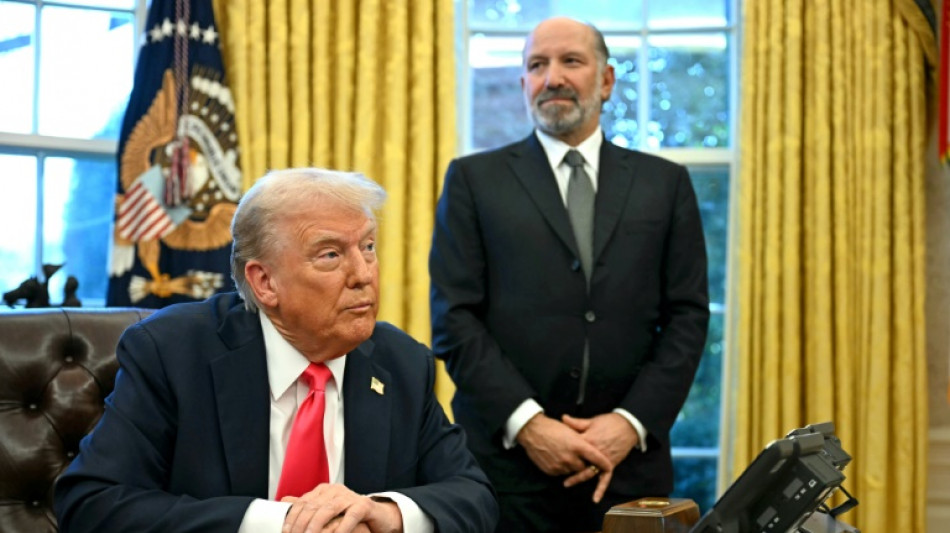
Trump says no room for Canada and Mexico to avert tariffs, hikes China levy / Photo: © AFP/File

 GTA 6 Advertising Strategy and Disc Version Controversy

 From First Date to Wedding Day: How a TV Quote Sparked a Lifetime Commitment

 Malta Stuns Sweden with Late Penalty Comeback in Rugby Europe Trophy

 BingX: Major Announcement of Far-Reaching Significance

 Élan Opens as Late-Night Wine Bar in Honolulu

 Shiv Sena (UBT) Criticizes NCP Merger Talks as 'Ridiculous Laughing Stock'

 Dell Announces AI-Integrated PC Lineup for 2026 with Wi-Fi 7 Support
US President Donald Trump shut down hopes Monday of an eleventh hour deal with Canada and Mexico to avert sweeping tariffs, while signing an order to hike duties on China.
Trump had unveiled -- and then paused -- blanket tariffs on imports from major trading partners Canada and Mexico in February, accusing them of failing to stop illegal immigration and drug trafficking.
The halt is due to expire Tuesday, and US stock markets tumbled after Trump told reporters Monday there was "no room left" for both countries to avoid fresh levies.
The White House also said Trump had inked an order to increase a previously imposed 10 percent tariff on China to 20 percent.
But sweeping levies, particularly on Canada and Mexico, are set to snarl supply chains for key sectors like automobiles and construction materials, risking a hike in consumer prices.
This could complicate Trump's efforts to fulfill his campaign promises of lowering costs for households.
On Monday, Trump told reporters that tariffs of up to 25 percent on Canada and Mexico were "all set."
"What they'll have to do is build their car plants, frankly, and other things in the United States, in which case they have no tariffs," he added.
In Ottawa, Canadian foreign minister Melanie Joly said Trump's looming tariffs represent an "existential threat" to the country, with thousands of jobs at stake.
She added that if Trump went ahead, "we are ready with counter tariffs."
Beyond this week's looming deadline, Trump said on social media that Monday that tariffs on agricultural imports would come on April 2.
A White House official told AFP that this came under Trump's existing plans for reciprocal tariffs tailored to each trading partner.
"There's no doubt that the administration is trying to solve the long-standing fentanyl and immigration challenges, and these tariffs have given the administration leverage," said Ryan Majerus, a former US trade official.
Washington is also trying to rebalance trade ties, he told AFP.
But using emergency economic powers to impose tariffs on Canada, Mexico and China is novel.
"It remains to be seen how this will all play out in potential lawsuits," warned Majerus, a partner at law firm King & Spalding.
- Cost concerns -
Robert Dietz, chief economist at the National Association of Home Builders, told AFP the group expects that "we could see a combined duty tariff rate of above 50 percent on Canadian lumber."
Trump's tariffs on Canada are expected to pile on to other potential levies on lumber.
"Softwood lumber futures prices have gone up eight percent in the last few weeks," he added.
While the United States also plans to expand forestry, Dietz said, prices will likely rise in the short-run.
Anecdotally, some builders expect they could face higher costs of $7,500 to $10,000 per newly-built single family home, he said.
- 'New headwind' -
JPMorgan analysts warned Friday that Tuesday's tariffs would "create a significant new headwind to economic activity" and boost consumer costs.
Mexico's President Claudia Sheinbaum said Monday that her country has contingency plans, whatever the decision Trump takes.
While Washington has targeted China over chemicals for the fentanyl drug, many of these components have legitimate medical uses, too -- making prosecution tricky.
Canadian Prime Minister Justin Trudeau has said that less than one percent of the fentanyl and undocumented migrants that enter the United States come through the Canadian border.
But he added Sunday that Canada would "have a strong, unequivocal and proportional response" if levies took effect.
Trudeau's government has taken a series of steps to address Trump's concerns including a Can$1.3-billion ($901-million) plan to enhance border security.
It has also named a fentanyl czar to coordinate efforts against the drug.
Meanwhile, Mexico last week extradited some of its most notorious imprisoned drug lords to the United States in a bid to avert the sweeping duties.
They included a cartel kingpin wanted for decades over the murder of a US undercover agent.
H.Seidel--BTB