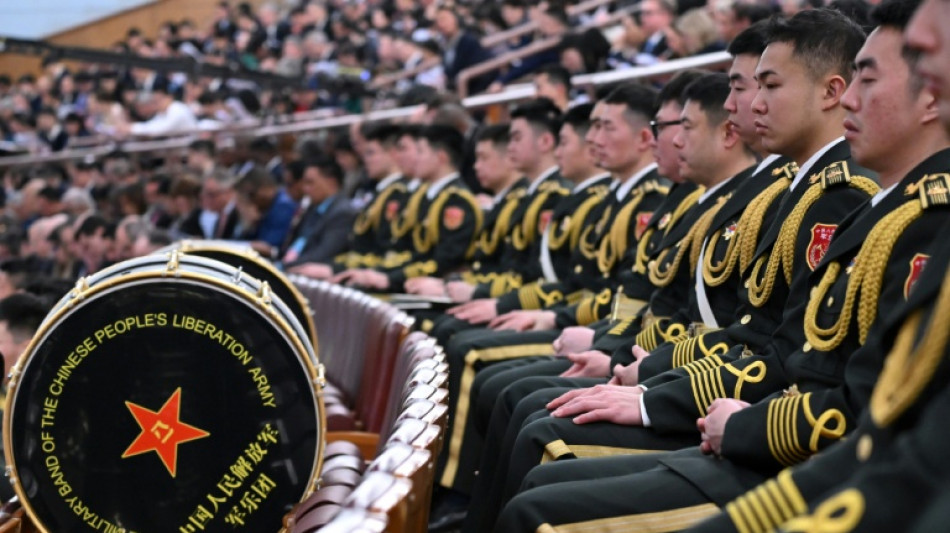
China says to hike defence spending by 7.2% this year / Photo: © AFP

 St Francis School Leads €60,000 EU Project to Transform Early Childhood Education

 South Africa's Universal Health Coverage Depends on Tackling Poverty and Inequality

 Rare Siberian Rubythroat Dies in UK Garden After Cat Attack

 Go Kyung-pyo Drunk Driving Incident Prompts Heavy Editing Across Multiple TV Shows

 KFF Health News Reporters Discuss ACA Enrollment Challenges, Rising Costs, and Measles Risks

 Alberta Unveils New High School Graduation Requirements to Increase Student Choice

China's defence spending will rise by 7.2 percent in 2025, the same as last year, Beijing said on Wednesday, as its armed forces undergo rapid modernisation and eye deepening strategic competition with the United States.
The country's expenditure on its armed forces has been on the rise for decades, broadly in line with economic growth.
China has the world's second-largest military budget, but lags well behind the United States, its primary strategic rival.
Despite this, the People's Liberation Army (PLA) surpasses the US military by number of personnel.
Beijing's 1.78-trillion-yuan ($245.7-billion) defence budget for this year is still less than a third of Washington's.
China's military spending last year made up 1.6 percent of its GDP, far less than the United States or Russia, according to the Stockholm International Peace Research Institute.
But its defence expansion is viewed with suspicion by Washington, as well as other powers in the region including Japan, with which Beijing has a territorial dispute over islands in the East China Sea.
China has also increasingly flexed its muscles in the South China Sea, which it claims almost entirely despite an international arbitration ruling that declared its stance baseless.
Beijing's spending boost is also a cause for concern for self-ruled Taiwan, which Beijing says is part of its territory to be claimed by force if necessary.
- 'Growing uncertainties' -
The budget hike comes as thousands of delegates congregate in Beijing for the opening session of the National People's Congress, the second of China's "Two Sessions" meetings this week.
Speaking at that session, Premier Li Qiang vowed that China would "resolutely oppose separatist activities aimed at Taiwan independence and external interference, so as to promote the peaceful development of cross-Strait relations".
China describes its military stance as "defensive" and aimed at preserving its sovereignty.
But its sweeping territorial claims over areas controlled by other governments have raised fears of a regional clash.
Chin-Hao Huang, Associate Professor at the National University of Singapore, told AFP the hike took place in the context of "growing uncertainties in China's external environment and domestic security priorities".
"The defence budget increase reflects the need to maintain and upgrade the PLA's military capabilities to keep pace and be ready for all contingencies," he said.
The announcement also comes as Europeans are considering significantly increasing their military budgets in the face of American disengagement from their region.
"As the geopolitical tension between China and the US increases, China cannot slow down its military expenditures," said Niklas Swanstrom, director of the Sweden-based Institute for Security and Development Policy.
S.Keller--BTB