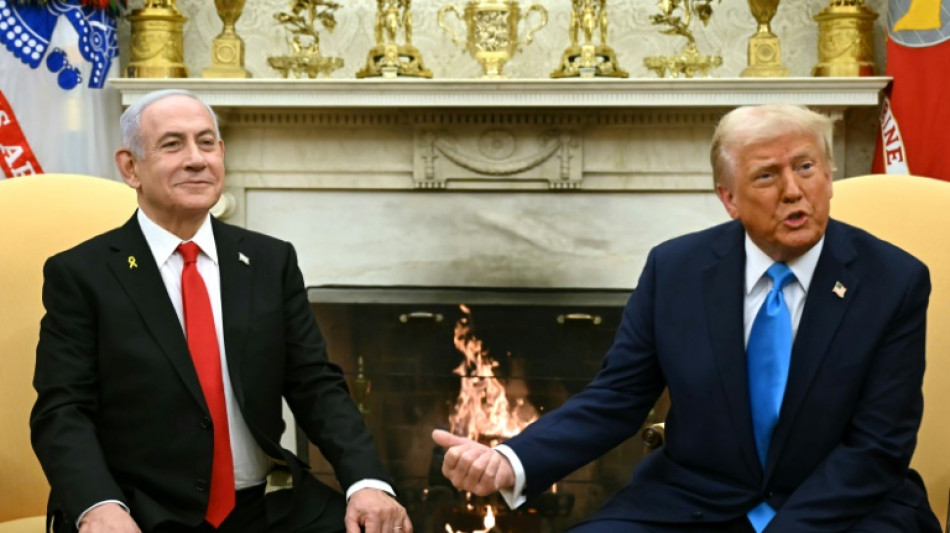
US-Hamas talks complicate Gaza truce efforts: analysts / Photo: © AFP/File

 St Francis School Leads €60,000 EU Project to Transform Early Childhood Education

 South Africa's Universal Health Coverage Depends on Tackling Poverty and Inequality

 Rare Siberian Rubythroat Dies in UK Garden After Cat Attack

 Go Kyung-pyo Drunk Driving Incident Prompts Heavy Editing Across Multiple TV Shows

 KFF Health News Reporters Discuss ACA Enrollment Challenges, Rising Costs, and Measles Risks

 Alberta Unveils New High School Graduation Requirements to Increase Student Choice

Unprecedented direct talks between the US and Hamas are a sign of dysfunction in fraught negotiations to prolong a truce in Gaza, analysts said Thursday.
Washington revealed it held talks with Hamas, which it designates as a "terrorist" organisation, amid a standoff between Israel and the Palestinian militant group over how to proceed with the ceasefire, whose first phase expired last weekend.
The direct contact is "a sign of a breakdown in mediation for a wider ceasefire", geopolitics expert Neil Quilliam said, calling the move "symptomatic" of United States President Donald Trump's "impatience with complex and timely negotiations".
Israel "must be concerned that his maverick approach to policy could undermine their immediate interests", Quilliam added.
"After all, the US president has already thrown a number of key allies under the bus," said Quilliam, associate fellow at the Chatham House think-tank's Middle East and North Africa Programme.
James Dorsey, another Middle East specialist, said the direct talks would give Hamas "a sense of having been legitimised strongly".
The Israelis are in turn "obviously worried" by the outreach, said Dorsey.
- 'Little confidence' -
"This complicates even more the ceasefire negotiations because Hamas is going to be stiffened in its insistence that the ceasefire agreement be adhered to, rather than an Israeli timetable," Dorsey added.
The first, six-week phase of the Gaza truce, when Israeli hostages were exchanged for Palestinian prisoners held in Israeli jails, ended at the weekend.
Hamas has insisted on a transition to the second phase of the agreement, which should lead to a lasting ceasefire, while Israel moved away from terms of the January deal, calling for extending the first phase until mid-April.
Israel said it had been consulted by the United States and "expressed its opinion". US hostage envoy Adam Boehler's talks with Hamas took place in Doha in recent weeks.
The talks were first revealed by US media outlet Axios, which said Boehler and Hamas discussed US hostages held in Gaza as well as a longer-term truce.
The decision to meet Hamas "clearly shows that the US have very little confidence in Israel and Israeli negotiators... to do what is necessary to get the hostages back," said Andreas Krieg, a Middle East security specialist.
The King's College London academic said Israeli Prime Minister Benjamin Netanyahu had "for the last 12, 13 months if not longer... tried to undermine mediation processes to get the hostages back".
"And I think the US has now understood that," he added.
- 'Separate avenue' -
Krieg said it could be useful for Qatari mediators, who brokered the ceasefire alongside the US and Egypt, "to allow a sort of a separate avenue of negotiations happening where there isn't a party like the Netanyahu government that constantly disrupts, subverts and undermines".
Quilliam said that while Qatar and Egypt "might appear sidelined right now... the US, Israel and Hamas will continue to need them as current US and Israeli efforts will lead to more conflict and the two Arab states are the only interlocutors that step in and play a constructive role".
Hours after Trump's administration revealed the Hamas talks, the president warned Gaza's population that "you are DEAD" if the hostages are not released.
"He may have issued this social media posting simply, to some degree, to try and disillusion Hamas, dampen their expectations and calm Israeli fears," Dorsey said.
"He's not declaring a policy. He's leaving everybody guessing," said Dorsey, an honorary fellow at the National University of Singapore's Middle East Institute.
Krieg said the "ultimatum that Trump put on the table is part of that entire context of mediation where he's using coercion, extremely transactionally, with a lot of pressure on Hamas".
But he added: "I think Trump wants to deflect from that revelation that they are directly talking to Hamas by him now saying, 'I'm strong, I'm going to get the hostages back... this is a way for me to justify why we're directly talking to Hamas.'"
B.Shevchenko--BTB