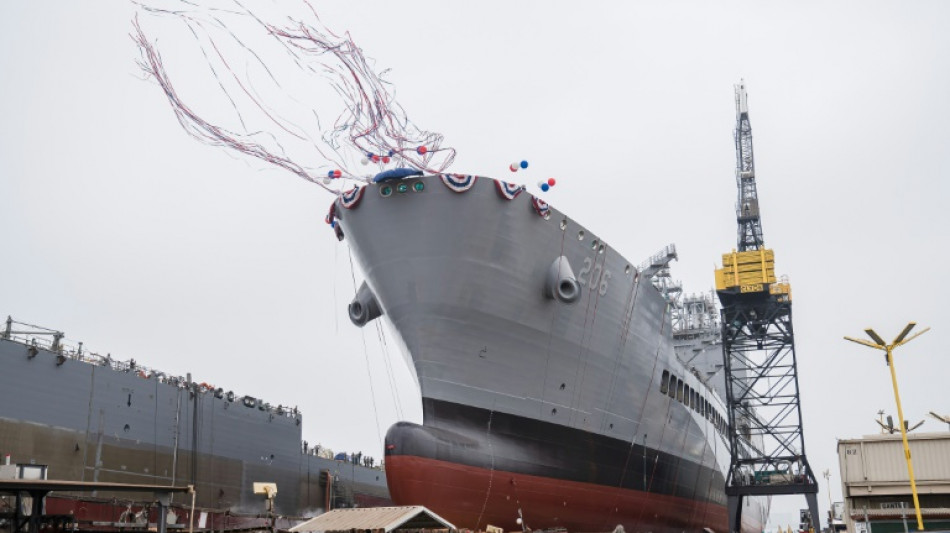
US shipbuilders, a shadow of what they were, welcome Trump's support / Photo: © AFP/File

 California roller coaster shut after brain damage claims

 Panama ministers push for reopening of huge open-pit copper mine

 Bohm's blast keeps Phillies alive in MLB playoffs

 US judge accepts Paramount's Warner Bros. buyout settlement

 Global stocks mixed as markets weigh higher oil prices, bond yields

 Marsh hails improvements after Australia win final one-day international

 Hegseth says US cut number of generals, admirals by 20%

 Kanye West's Russian concerts have been cancelled, organisers say

 First Hollywood, now Fat Bear Week: nepobaby wins Alaska contest

 Barcelona lay down marker in Women's Champions League, Arsenal slip up

 US pushes against overproduction with eye on China at G20 meeting

 Swiss FA withdraws support for FIFA chief Infantino

 Man City's meteoric rise clouded by financial scandal

 Polish activists open first abortion pill locker in Warsaw

 NHL Avalanche ink Bednar to four-year coaching deal

 Polish activists opens first abortion pill locker in Warsaw

 Turkey says news site closed for 'LGBTQ propaganda'

 Oil companies close in on Venezuela despite hurdles

 Turkey freezes ex-minister's assets as fund scandal grows

 Guardiola backs Man City after bombshell guilty verdicts

 G20 trade ministers open talks under strain of Trump tariffs

 France in talks with UK to end 2025 migrant accord: ministry

 Europe's surging inflation spreads gloom in stock markets

 Truth commission demands compensation for Sweden's Sami people

 Japan win marathon penalty shootout to set up South Korea gold-medal clash

Shipbuilding has been in steady decline in the US since the end of the Cold War but some in the industry now hope for a revival of the sector, as was promised last week by President Donald Trump.
The United States was once a world leader in both commercial and naval construction, but has fallen far behind its main rival China.
Trump has now promised to reverse this, declaring in an address to Congress on Tuesday that he would "resurrect" the sector and create an Office of Shipbuilding in the White House.
"We used to make so many ships," Trump said, promising tax breaks. "We're going to make them very fast, very soon."
American shipbuilders say they are ready to seize the moment, but experts warn that even a concerted effort to respond to China's overwhelming dominance of the sector will take years -- and cost many billions of dollars.
"This is a historic moment," said Matt Paxton, president of the Shipbuilders Council of America (SCA), which represents more than 150 US shipbuilding companies.
The US Navy, when asked for comment, referred AFP to the White House.
"We are waiting to learn more," Cynthia Cook, who heads the defense-industrial group at the Center for Strategic and International Studies (CSIS), told AFP. "It is clear that shipbuilding is an industrial weakness of the United States."
But, she added: "You cannot immediately get more ships by throwing money at the problem."
US ship production is down 85 percent from the 1950s, and the number of naval shipyards capable of building the largest vessels has fallen by 80 percent, according to the McKinsey consultancy.
- 'Not what it was' -
In the 1970s, five percent of commercial ships built in the world (in gross tonnage) came from American shipyards.
That share has since plunged to a scant one percent, a drop in the water compared to China (50 percent), South Korea (26 percent) or Japan (14 percent).
"We need some solutions to our shipbuilding gaps," said the CSIS's Cook, while noting that Seoul and Tokyo, at least, are US allies.
"I absolutely admit that US shipyard capacity is not what it once was," Paxton said last month before a congressional committee.
"Our market has changed dramatically since World War II, when shifting administrative priorities, from Republican and Democratic administrations, curbed programs to support our industry," he said.
The US naval fleet has shrunk from 471 vessels after the Cold War in 1992 to 295 today, Paxton said.
According to the Congressional Budget Office (CBO), the US Navy's current plan to build a fleet of 390 vessels by 2054 -- with the purchase of 364 new vessels because of the decommissioning of older models -- would cost an average $40 billion a year.
Paxton said the Trump administration needs a comprehensive strategy for the industry -- including ways to reduce administrative and regulatory obstacles -- if it is to achieve its shipbuilding goals.
Republican Senator Roger Wicker painted a dire picture during a confirmation hearing last month for businessman John Phelan as navy secretary.
"Just about every major US shipbuilding program is behind schedule, over budget or irreparably off track," said Wicker, who chairs the Armed Services Committee.
- Worker shortage -
Shipbuilders say their work is regularly complicated by last-minute changes requested by the navy, which cause delays and budget overages.
Another problem is a severe worker shortage.
The Covid-19 pandemic prompted a wave of early retirements and career-switching, while slowing training. And amid historically low US unemployment, industry wages have had trouble competing.
Still, naval shipbuilding contributes, directly or indirectly, more than $40 billion to the country's GDP.
The industry continues to build "lots of ships," mainly for the domestic market, said Paxton, while adding that Trump probably wants a much larger US share of the global market.
US shipyards not only produce and maintain ships for governmental bodies -- from the US Navy to agencies like the National Oceanic and Atmospheric Administration (NOAA) -- they also produce and maintain the roughly 40,000 commercial vessels.
But competition is fierce, with the industry in many countries -- notably China -- enjoying extensive subsidies and tax breaks, sources say.
A spokesman for Huntington Ingalls Industries said HII, one of the largest US shipbuilders, was "grateful" for Trump's comments and was working with the government to help "meet a generational increase in demand."
F.Pavlenko--BTB